| Walking Across the Years: Landscape, Geography, Culture, History |
Places |
| Andrew Green “Voices on the Path” , Gwasg Carreg Gwalch , January 9, 2025 |
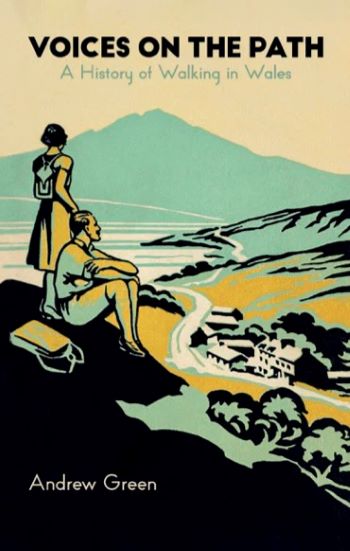 Andrew Green, former winner of the Wales Book of the Year award, is author of the Gwallter website. Accounts of walks across Wales are frequent. “Voices on the Path” is its complement, a book of a replete 352 pages. It has 51 illustrations and is produced on paper of quality. It is a lucid, far-reaching study of an important part of the collective experience of Wales. The subtitle is “A History of Walking in Wales.” If the world speeds up, and much human busy-ness with it, the act of walking remains much as it has been. The impetus is various: necessity, pleasure, enlightenment, curiosity. Kierkegaard said he walked himself every day into a state of well-being. “I have walked myself into my best thoughts.” The daily walk of Kant was so regular that fellow residents of Königsberg could set their timepieces by him. Andrew Green's book on walking is not alone. Rebecca Solnit, the foremost essayist of America, has written her tribute to the walk. Franz Hessel's “Walking in Berlin” from 1929 was re-issued in 2018. Frédéric Gros “Marcher, une Philosophie” was a bestseller in France and is now translated as “A Philosophy of Walking.” Gros does a deep scan across the European tradition. In similar fashion Green conducts his deep search into the subject in Wales. The timespan of those who have walked the landscapes of Wales reaches back through millennia. A peaty surface at Borth, uncovered by new currents, reveals beneath the sand the footprints of adults and a four year old from the stone age. In the time of Christendom, in 1195, some monks stole their abbot's horses. He had refused to allow them to drink beer. They were ordered to walk to Clairvaux in France to receive their punishment. A doughty drover stands in statue form in Llandovery. Their way of life, the great treks across the Cambrian heights to the markets of England, is described evocatively. The drovers performed a cultural service also in what they brought back. They were not just bringers of news, such as the Battle of Waterloo, but were carriers of pamphlets and books. The mileages that these walkers trod were impressive. In four years Edward Llwyd, or Lhuyd, covered over 3000 miles. He found the very rare Snowdon lily high up on the slopes of Yr Wyddfa. In Pembrokeshire, in 1698, he records that he was viewed with suspicion. He might be in the employ of the government seeking new taxes or, still worse, be a spy for the Jacobite cause. The walking of Wales reached a literary crescendo in the age of the Romantics. Thomas de Quincey declared he could never be in good health unless he walked between eight and fifteen miles a day. Coleridge's companion, Joseph Hucks, was discomforted on a beach near Abergele. The bathers he saw were naked. On arrival at Harlech there was no-one -one to admit them to the castle so they scaled the walls. In a Bala tavern Coleridge caused outrage with expression of his republican tendencies. Not everywhere impressed. Hucks called Tregaron “a miserable hole”. In Wrexham on a Saturday night George Borrow was advised that “you will perhaps meet drunken colliers who may knock you down.” In later eras territory takes on a political significance. Thomas Williams made a powerful speech in Swansea on 9th July 1874. Working people needed, and deserved, parks and open spaces for rest and recreation. On 27th May 1926 a group of two thousand women gathered in Pen Y Groes in Gwynedd. Their banners read “Hedd nid Cledd.” By the 31st they had walked to Chester, 150 miles, and held fifteen rallies en route. The Wales Coast Path is described in full from genesis to making to retrospective. It earns, in Green's eye, a high significance. “It has arguably done more to bring Wales together as a geographical entity than...road and rail...Beyond its physical reality the Path has grown in stature as a powerful symbol of an old Wales renewed.” Different walkers take to the land with different intents. O M Edwards walks to the grave of Ann Griffiths with the rapture of a pilgrim. Judith Brominicks and Tom Bullough, author of the award-winning “Sarn Helen”, see the degradation of nature. They come under a new designation of “eco-pedestrians.” Jim Perrin records the slow dying of the historic rivers. In 2014 Ursula Martin set to walk 3700 miles over 17 months. Her daily budget was £5, her motive a physical and meditative grappling with illness, mortality and inner meaning. The Coast Path and Offa's Dyke Path alone have 900 stiles. Hannah Engelkamp walked with a companion, Chico. Chico, bravely, was a donkey. And walking inspires forms of expression. Visual artists like Robert Newell and Valerie Coffin Price walk in deep preparation for their art-making. In 1949 Walter Wilkinson walked with a wooden barrow that carried his puppet theatre. In 2012 Delyth Jenkins walked the Pembrokeshire Coast Path with a harp on her back. In 2017 Horatio Clare initiated his sound-walks for radio. They are made of himself, his walking legs across the land, and a microphone. “Voices from the Path” is made with a scholarly discipline. Twenty pages of detailed notes open a portal to a rich range of sources. An index of nineteen pages completes a book that blends erudition and scale with a relish for what has been a most simple source of satisfaction and pleasure throughout the ages. * * * * Place, and writing about place, have been important in the making of the cultural image of Wales. They have complemented the narrative that has taken primary place, that of Labour Wales. A third narrative has been promulgated vigorously by public authorities in the last half-decade. A guide to the sequence “Places” can be seen in the first link below. The history in “Voices on the Path” is complemented by David Lloyd Owen 17th January 2018. The Wales Coast Path appears 30th May 2012. Coleridge in Wales features 1st July 2016. Jim Perrin is an important walker, three of whose books appear below. “Travels with the Flea” (2003) explores much novel territory of inland Wales. |
Reviewed by: Adam Somerset |
This review has been read 545 times There are 41 other reviews of productions with this title in our database:
|
