| Writer Takes On the Ethics of Art, Artists & Artistic Appreciation |
On Criticism & Critics |
| Claire Dederer “Monsters. What Do We Do With Great Art By Bad People?" , Sceptre Books , June 5, 2025 |
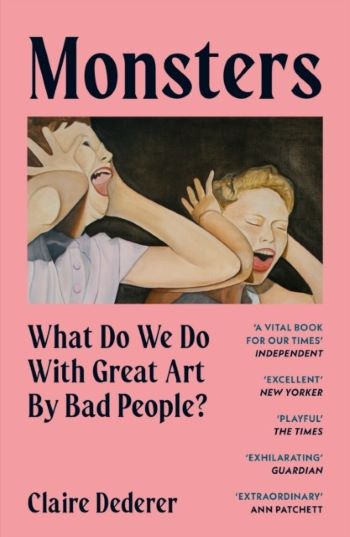 Jonathan Edwards served as the Member of Parliament for Carmarthen East and Dinefwr from 2010 until 2024. I saw him there in debate from the vantage point of the Visitors' Gallery. The subject under debate was British foreign policy toward Saudi Arabia. His contribution was sincere, testament to a lifetime of personal conviction, and eloquent. In private life he was subject to a police caution in 2020 in a case that was widely reported and caused his suspension by his party. His subsequent memoir dealt with candour with the event. The Crown Prosecution Service decided on no further action, a decision reached on two grounds. An experienced political figure, he continues to write about politics and the book “Into the Abyss” was due to be discussed at the Llandeilo Literary Festival in April. The event, a conversation with Alun Wyn Bevan, was sold out to an audience of 60. An email to the ticket-holders intervened. “The trustees of Llandeilo Lit Fest”, it read, “have decided that the scheduled event with Jonathan Edwards will no longer go ahead at this year’s festival*.” That the book be discussed in a public place of gathering was, they contended, cause for harm. This is not an uncommon occurrence. Trustees of literary festivals are largely volunteers confronted with thickets of codes and legislation of variation and difficulty. But it a character of our particular age. The shift to digital commentary has had two effects. The Fundamental Attribution Error, long attested in social psychology, dominates. The algorithmic sub-structure stresses vengeance over love. This has made for a thorny and hazardous field in which few writers step. Claire Dederer has boldly entered with a book that, unsurprisingly, has invited wide attention. The prose is colloquial and the style effervescent. The argument follows several tracks. Claire Dederer was born in 1967 and her first work was as a film critic. From the relative isolation of a Seattle home connections with art beyond the art were slight. There was a thrill to be had in acquiring posters of films of George Cukor, Sam Peckinpah, David Lynch. Connection with the makers did not extend far. The welter of information, and publicity, of the cyber-time has changed this. Art and persona have fused. “Now it seems impossible”, she writes, “to shake work loose from biography. We swim in biography; we are sick with biography.” Connection with art swells to a new point. “When what you like becomes important, becomes defining, becomes an obsession, then an artist's biography has even more power than before. You have not just admired, not just consumed the art, you've become it.” From this she moves to the concept of the parasocial relationship. This is the development of an illusionary sense of intimacy with those who are unknown. “You know this artist personally, as a friend, and, what's more, they possess the same knowledge of you. You are immersed in their biography and by some strange irrational emotional logic you believe that they too are immersed in your biography... this false-yet-extremely-real-feeling connection.” This is extended to a broad cultural critique: “Because we are atomised individuals with no collective power, we are left with a grandiose yet ultimately meaningless sense of the importance of our purchases, our gestures, our decisions...we keep looking to consumption as the site of our ethical choices, but the answer doesn't lie there.” “In late-stage capitalism this individual choice becomes irreparably soldered to consumer choice. What you consume is what you are. You are, after all, your fandom”. “Monsters” turns to a central entanglement. That is the reduction of past time to a display of moral realisation, or more commonly its opposite. “One of the great problems”, she says, “faced by audiences is named the Past. The Past is a vast terrible place where they didn't know any better. Where monsters were accepted.” Although not in the book pyrrhonism is a wiser guide to times before. David Olusoga has written in this vein.** But pyrrhonism goes against a core element of progressivism. “Liberalism”, writes Dederer, “has as one of its central tenets a teleology of goodness, a rising towards justice. We have an idea that we're getting better. This idea separates us from history. History is over there, or behind us, or beneath us. We are in a special position:its apex. From this apex, we know best.” The larger part of “Monsters” deals with testing the linkage of artistry with private goodness. Many artists of greatness demonstrate no such connection. John Banville says he has not been much of a parent. “We are ruthless. We're not nice people. We might be interesting, we might be diverting...but mostly [living with us is] just slog.” Claire Dederer ends with contemplations of love's true character. “When I was young I believed in the perfectibility of humans. I believed that the people I loved should be perfect and I should be perfect too. That's not quite how love works...There is no democracy in any love relation: only mercy.” “That is: Love is not reliant on judgement, but on a decision to set judgement aside.” And lastly Sir Nicholas Hytner is director of a play of the year. “Giant” is manifestly about an artist who is not a source of goodness. The Sunday Times of 27th April cited Hytner: “Looking for moral purity in art is legitimate. Looking for moral purity in artists is a fool's errand.” "Monsters" is an esential book for our days. * * * * Notes *The email to those attending the literary event: “As a festival, we are committed to providing a safe, inclusive, and welcoming space for all participants and attendees. “The event was originally programmed as a discussion of a political memoir. However, upon further review, we believe that the nature and content of the recently published book are not aligned with the values and principles of our festival. Our primary concern is to ensure that our festival remains a space where all individuals feel respected and safe. We have determined that the potential for harm and distress to some individuals mentioned in the book is too significant to overlook.” “We remain dedicated to curating a festival that upholds the values of inclusivity, safety, and literary celebration for everyone involved. We thank our community and partners for their understanding and continued support.” From the book’s publisher: “There is nothing in the book that is illegal and it is very unfortunate that a literature festival should cancel an event where a book was due to be discussed.” For more information see: https://nation.cymru/news/row-as-literature-festival-cancels-ex-mps-book-event/ ** David Olusoga: “I think the job of historians is to try to stand there at this dangerous arsenal of ideas and to make it more difficult to raid that arsenal to use it for their political projects. It is to complicate the picture; it is to show that these simple assertions are much more nuanced; it is to muddy the waters and to try to de-weaponise the past.” |
Reviewed by: Adam Somerset |
This review has been read 465 times There are 40 other reviews of productions with this title in our database:
|
