| amateur theatre | reviews list | |
| Aberystwyth Theatre at its Prime | |
Moll Flanders, The Musical |
[print] |
The Wardens |
|
Aberystwyth Arts Centre |
|
May 27, 2010 |
|
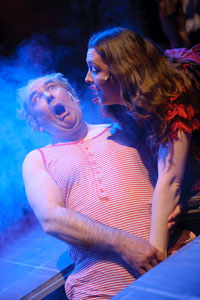 Aberystwyth has had an exhilarating eighteenth century triple dose this Spring. No sooner had the lights dimmed on Louche Theatre’s roisterous, Hogarthian “Tom Jones” than Mappa Mundi visited with their luscious “Dangerous Liaisons”. To complete the troika director Richard Cheshire has reprised the musical version of Daniel Defoe’s 1722 novel “Moll Flanders” whose premiere in America he directed.
 The contrast between the three is fascinating. Whereas Henry Fielding’s hero Tom escapes the noose to regain his true love, the protagonist in the French play is a self-destroyer of love. Moll Flanders too escapes the hangman, due to the intercession of Joe Begley’s highwayman-turned-fake priest Jemmy. She discovers, after husbands too many to count, that sex after fifty can also be friendship. The plot opens and closes in Newgate prison. A noose hangs high over the stage, a reminder of a harsh world whose justice is short and sharp. “The world is so wicked” says the young Moll “But, God, make me good”. Despite her early good fortune in a socially advantaged marriage she soon learns “If I cannot be good/ I’ll be what I must.” The show dates from 1993. In an age where songs in musicals do not go beyond dum-de, dum-de couplets Paul Leigh’s lyrics are a sunburst of near Cole Porter-esque ingenuity. He uses triple, even quadruple rhymes. “Prize” gets to rhyme with “thighs” but then he adds on “size.” Voices rhyme in counterpoint. “Less gut” commands Theresa Jones’ materfamilias as she presides over her family’s group portrait. “Mouth shut” ripostes the painter. Paul Leigh uses some conventional rhymes but they earn their place alongside pieces of scintillating wordplay. “Inspect ‘em” rhymes with “rectum”, “clandestine” with “rest in.” Among the ailments to be treated in Bath “ague/ shall plague you.” Claire Luckham is an experienced dramatist and her book sculpts the one hundred and thirty-nine thousand word novel into a proper theatrical sequence. It is necessarily episodic and picaresque, shifting from country to town, England to Virginia, London to Liverpool. The book, always servant to the music, swims in innuendo. A couple of jaunty sailors arrive back on terra firma and sing of their enforced self-pleasuring while at sea. Moll’s numerous adventures invariably lead to amorous coupling, during which the character rarely takes breath to stop singing. Julie McNicholls is a regular on the Aber stage but her Moll is revelatory. Right from the opening the rest of the cast are in grey and white while she is clothed in red. The lyrics later draw attention to her plunging décolleté but she retains a buoyant sense of virtue even at her lowest fortunes. It is not just the absolutely right, unsinkable cheer of the character but her lovely light soprano does justice to every syllable of the lyrics. The ensemble singing of the eighteen-strong cast is word-perfect clear. Even in this choral work Rachel Crane’s voice sounds out over the group. Among the acting Ryan Woodruff’s Cyril, Moll’s first seducer, gives his left eyebrow an upward tweak of knowingness to the audience. Tom Fotheringham’s Robert, Moll’s first husband of a long line, has a dim defective “r” which gives his pronunciation of a word like “gibberish” a fine aristocratic asininity. Ioan Guile’s limp invalid at the Spa in Bath is restored to full lecherous life, courtesy of a piece of deft handwork on the part of Moll. George Stiles score lacks the one anthemic tune pitched to be the hit single. What it does have is a melodic flow, almost Mozartian in its profusion, moulded around the lyrics. If towards the end he falls back on borrowing “Greensleeves” that melody only shows that the rest of the score is not bad at all. The tilted stage has no set. The cast are all visible off-stage. Props, even one as bulky and complex as a double bed, appear without effort. The direction is marked out by a steady wit. Three London low-lifers suddenly pop up through trapdoors. A bumpy coach to Liverpool with eleven swaying passengers is created with a few trunks and cases. Musical director Peter Golding’s orchestration draws heavily on a sprightly harpsichord. It is beautifully lit by Iestyn Griffiths. Aberystwyth has a theatre culture that is probably unique. The blending of talents that came together for “Moll Flanders” shows it at its peak. ....................................................... Moll Flanders, The Musical - Director Richard Cheshire, Musical director Peter Golding’ |
|
| Adam Somerset | |
| This review has been read 2658 times |
|
Privacy Policy | Contact Us | ©2006 keith morris / red snapperr web deisgns / keith@artx.co.uk