| amateur theatre | reviews list | |
| A rare piece of artistry | |
Compleat Female Stage Beauty |
[print] |
Theatre Film and Television Studies, Aberystwyth University |
|
Castle Theatre, Aberystwyth |
|
November 9, 2007 |
|
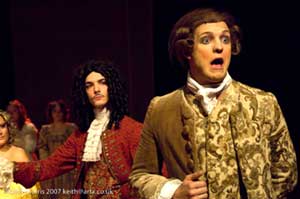 As Britain emerged from the privations of Cromwell’s Puritan Protectorate, a new lustre was added to life by the hedonism and love of good life embraced by particularly the moneyed and titled of the new, restored Kingdom. Theatre flourished under Charles II, but the fate of those highly-trained men who played the parts of women in the age before women could appear onstage hung in the balance. One of these was the celebrated actor Edward Kynaston and, in 1999, American author Jeffrey Hatcher retold his story, as recorded by Samuel Pepys, in his play ‘Compleat Female Stage Beauty’. This tale was Richard Cheshire’s choice for his departmental production this year, and it was a rare piece of artistry.
Fiona Russell’s set was a work of gorgeous simplicity. A red-washed floor, a gauze at the rear (for projection, backlighting of figures behind it or being raised and lowered to reveal a small playing platform behind) and some very simple pieces of furniture which came and went – a table, a chair, a throne, a bed, a bench, created an atmosphere that beautifully supplemented and complemented the action without trying to make its voice heard. This was well complemented by David Haylock’s perfectly nuanced lighting and the costumes, under Susan Griffiths’ supervision, which ranged from the most extravagant and luscious of Restoration wear to the rags of urchins and everything in between. Sound was mainly live, with the apparent exception of original music cues by Robert J. Southworth, which added a timeless gloss to the aural landscape. The performances were mesmerising, and it is one of those occasions where, despite the size of cast, to overlook certain performers would be to do a disservice to the show. Stephanie Jepson and Kate Christmas cut hilarious figures as the faux-coquettes Lady Meresvale and Miss Frayne, imbuing their roles with sparkle and bawdy finesse. Dominic Ward, in a number of roles including that of the King’s First Minister Hyde, also shone, though in perhaps the most subtle way out of the whole company, which is not to be read as a denigration of a very assured contribution. Robert J. Southworth played Villiars - Duke of Buckingham and sometime lover of Kynaston as a deliciously loathsome tomcat of a man – felinely graceful of movement but with a mixture of lust and loathing in his haughty sneer. Thomas Betterton, the great actor-manager, was played with a delicate blend of emotions by Aidan Crowe, who mastered the complex and difficult journey of a man of depth, but who remains largely unknown by the audience. The diarist Pepys was played with ebullience and élan by Benjamin Way, clear of communication, steadfast of purpose and noble of brow throughout. King Charles II was fabulously well portrayed by Fabio Valenti in a display of hauteur absolutely right for the role, while his mistress Nell Gwynn was given a bawdily brash rendering by a consistently watchable Lauren Ricketts that stayed just the right side of coy when necessary, and just the wrong side of proper when similarly called for. Alex Wadham gave an hysterically funny and sinister performance as Sir Charles Sedley, the fop who plays his part in Kynaston’s downfall, and whose lisping manner and outrageous appearance made him part clown, part devil. His protégée, Margaret Hughes, the first actress, was played very satisfyingly by Delyth Owen. Initial concerns about a very forced courtliness to her speech were swiftly allayed by the growing obviousness of its being a trait painted on by her character, and the nuances of her performance were expertly handled. Catherine Yearly gave the most delectably underplayed, but deeply, deeply moving performance in the role of the seamstress Maria, whose relationship with Kynaston is complex, but whose demeanour is often quiet, always powerful. But the show was Kynaston’s. Sam Richardson, playing the part of the most beautiful woman in the house, guided us with clear voice and sensitive hand along the path of a journey like no other. The delicate tones and shades of colour that make up his character were handled with due care, and more than due care, and the highs and lows of this remarkable man’s career were presented with integrity, dignity and true artistry, in a performance that, with so many others, will live long in the memory. I will not give too much away, but the second half of the show, showing the strictures placed on Kynaston’s very existence following the introduction of women to the stage is by turns moving to the point of crushing and very affirmative of the necessity of human flaws. The script is not easy to handle, but the company did so, with the fathomless sensitivity required to make this show exquisite. I do worry when I have nothing critical to say about a show, but, apart from disliking the writing in the epilogue (which, damn it all, the cast still managed to pull off well), I truly have not a bad word to say. Richard Cheshire, his assistants – Lauren Caddick, Lucy Topham and the multi-tasking Rob Farrington - and their team have pulled off another coup, and I salute them for it. The run is sold out, but, while keeping in mind the explicit content and unsuitability for children, if you have to queue and plead for returns or cancellation openings, do, for truly not to see it is not to feel the power of a truly great story, supremely well told. Whether male or female or that soft and liminal space in between, this production simply is Complete Stage Beauty. |
|
| Paddy Cooper | |
| This review has been read 145 times |
|
Privacy Policy | Contact Us | ©2006 keith morris / red snapperr web deisgns / keith@artx.co.uk