
|
GWENT THEATRE Presents ‘DR. KORCZAK’S EXAMPLE’ by David Greig |
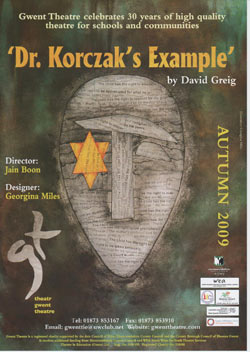 Its subject is the Polish Jew, Janusz Korczak, whose vision in which children structure their own world and become experts in their own matters, sowed the seeds for the UN Convention on the Rights of the Child. The time is early August 1942 and the Jewish community is confined to the ghetto. Within the orphanage that Korczak runs he establishes his own form of Utopia, a self-governing republic in which the children set up their own court, council and newspaper. Greig’s play similarly enables young people to acknowledge and judge their peers. It suggests that children are capable of dealing with difficult themes if treated with dignity, autonomy and respect.
Korczak’s legacy remains enshrined in international law as a basis for the UN Convention on the Rights of the Child, whose stipulations include the right to play, the right to an education and the right to protest. He did not specify the right to challenging, inventive and intelligent theatre, but we trust our production of Greig’s play will provide them with that. Touring to Secondary schools from September 15th – November 6th 2009. Public performances can be seen at: Llanover Hall Arts Centre, Cardiff – October 9th 2009 – 7.30pm The Melville Theatre, Abergavenny – October 16th 2009 - 7.30pm Gwent Theatre is part of a unique Wales-wide network of eight professional Theatre in Education Companies funded by the Arts Council of Wales and individual local authorities to meet the criteria of artistic excellence. For further information telephone: 01873 853167 Email: gwenttie@uwclub.net Website:www.gwenttheatre.com |
| Gwent Theatre web site: www.gwenttheatre.com |
| e-mail: gwenttie@uwclub.net |
Saturday, October 3, 2009 |
Older news
stories have been carefully archived.
2006 | 2005 | 2004 | 2003 | 2002 | 2001 | 2000 | 1999