
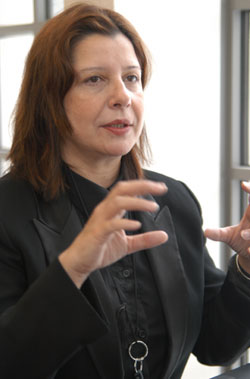
 Firenza Guidi sits among the students in the Butler University Starbucks, a surrealist’s dream come true. Dressed in a black tailcoat, hair framing her smiling face, Guidi looks like a magician Salvador Dali might have imagined. Guidi is at Butler for seven weeks, the time it will take her to direct an adaptation of George Bernard Shaw’s classic play, Saint Joan.
Firenza Guidi, artistic director of European Live Arts Network (ELAN), is at Butler for seven weeks, the time it will take her to direct an adaptation of George Bernard Shaw’s classic play, ‘Saint Joan.’ Born in Milan, Italy, and based in Wales, UK, Guidi is the artistic director of European Live Arts Network (ELAN), an experimental theater company dedicated to creating site-specific projects. This is her second time in Indianapolis. In May 2002 she and her company produced a performance piece in the Catacombs beneath the City Market downtown called Endangered Species, Endangered Land, based on Georg Buchner’s Woyzeck. Guidi uses words like “investigation,” “exploration” and “journey” to describe her approach to theater. In the case of Saint Joan, she has taken Shaw’s play apart and reassembled it, incorporating additional characters and an ensemble approach that will place a cast of 19 on stage for the duration of the performance. She enthusiastically calls Shaw’s work “a great reservoir, a battleground … it’s a huge machine and I find myself at the center of Shaw and the text, the aesthetics of theater, performance training — culture.” Saint Joan is actually part of an international season Guidi is working on entitled The Machine — when is a man/woman free? It will constitute the U.S. portion of a series of performances that will also take place in Iceland, Denmark and Italy. “It is my life-long project to focus on women, history and memory,” she has written. “I want to produce artifacts that constantly challenge definitions of femininity, or what we believe a woman to be.” Guidi challenges conventional notions of theater as a text-based, or literary, artform. In her work, language is not the basis for the theatrical experience, so much as a source of creative tension. “You’ve got to exist before you open your mouth,” she says. “What you utter is a result and it’s not your reason for existing.” Guidi sees language as overlaying theatrical experience with a rational construct which, she says, she has “a feverish desire to enter and make it shake.” Ecstasy Guidi was smitten by performance as a child, when, at 6, she performed in a version of The Taming of the Shrew, “running after Petruchio with a rubber hammer.” When she was 17, she spent a year studying theater in Italy, an experience she found disappointing. “I knew what I didn’t want,” she recalls. “What they wanted was a talking head. I was declaiming; maybe that started the feud with language that I had to resolve in the coming years.” Ultimately, Guidi found an artistic home in Great Britain. She received her Ph.D. from Queen’s University in Belfast. In 1989, she founded ELAN with her partner, David Murray. Shaw’s Saint Joan was first performed in New York in 1923. Shaw portrayed Joan as an early nationalist and prototypical Protestant thinker who put her conscience before the judgement of the church. Guidi points out that Joan is a historically resonant figure, appropriated by different groups at different times. She has been an icon of the French revolution and of feminists. She remains a militant female heroine. “She was a soldier in a world where that was unheard of.” As Shaw points out in his script, Joan was seemingly in love with both religion and war. In the play, according to Guidi, “She is in a state of ecstasy most of the time.” Finding ways to credibly express a state of ecstasy in performance may be the central challenge of this production. Joan, Guidi observes, was a visionary. But the audience can’t see her vision — that must be manifest through the bodies of the actors. Guidi, who has previously directed Shaw’s play Candida, began her preparation for this work by thinking that she might have to start by getting rid of Shaw’s anachronistic language, burdened as it is with exposition and, at times, turgid dialogue. But the more she worked on it, the more she found that “Shaw wins.” Indeed, Guidi reached an unexpected conclusion about Shaw’s Victorian language: “It’s so obsolete, it’s avant-garde!” The sensual pleasure of the words themselves won her over, as did the challenge of working within the construct of Shaw’s belief that words could create a naturalistic bridge to truth. “Unless we re-enter naturalism and exorcise its language,” Guidi says, “we will never get rid of it.” No apologies Guidi’s approach can seem radical to many of her students, whose experience of theater is limited to storytelling naturalism — plots, in other words, with a beginning, middle, end and a message. Sometimes Guidi is bombarded by questions about what her work “means.” This can be a bone of contention. “The visual arts got there 90 years ago but we are still apologizing,” she says. “What does a Picasso painting mean? I don’t want to apologize anymore.” Guidi, who came of age in the wake of the revolutionary period of the 1960s and early ’70s, notes that aesthetics appear to be subject to generational shifts. “Not only in America, but in Britain, in Italy, in Denmark, the generation of 20-year-olds are like my parents 30 years ago. I find I have to convince many young people about the value of not knowing, of allowing failure, of allowing a process to develop, of entering an investigation with questions but no answers. I find that what I did once with my parents, I am doing now with 20-year-olds.” But whatever a person’s age, Guidi has an abiding faith in theater’s power to transform lives. “Performance leaves a legacy,” she asserts. “The best theater is one where you leave the building with questions. The end of the performance is the beginning of your own investigation.” Guidi says she had the chance to speak with two local theater artists, Dante Ventresca and Rebecca Hutton, who attended ELAN’s performance as part of Butler’s International Theatre Project in the Catacombs two years ago. She was deeply affected by the immediacy of their recollections of what happened that day, of how the images they encountered during the performance stayed with them. “One thing I always wish for my audience is to come out alive,” she smiles. “I mean that feeling, ‘Oh, God, I am alive!’ That’s what theater needs to do.” |
| NUVO.NET web site: www.nuvo.net/archive/2004/02/11/coming_out_alive.html |
| David Hoppe e-mail: |
Thursday, February 12, 2004 |
Older news
stories have been carefully archived.
2006 | 2005 | 2004 | 2003 | 2002 | 2001 | 2000 | 1999