| When You Experience Poetry, Music, Dance You Are Biologically Changed” |
Art & the Senses: Body &Mind |
| Susan Magsamen & Ivy Ross- Your Brain on Art: How the Arts Transform Us , Canongate Books , April 7, 1991 |
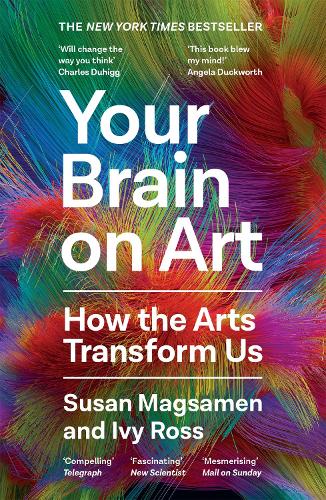 Over the course of “Your Brain on Art” the two authors meet many people. Poets, actors, novelists do not feature. Music is the most common art-form researched by the neuro-aestheticians.
 The writers meet Brandon Staglin. He was diagnosed with schizophrenia and pursued the guitar as part of the coping process. He went on to form a charity devoted to the purpose of understanding music and mental life. We learn of children who construct kaleidoscopes or build butterfly boxes. Saliency, attention, humour and play are the key features. Taking part in drama helps with perspective-taking and empathy-building which are vital to executive function. The experiments are also in Ellen Winner, below 4th May 2026. . Daisy Fancourt and team published a study in “Lancet Psychiatry” in 2021. The study identified and mapped more than 600 mechanisms on the arts as a leisure activity working on health. “People have often viewed the field of arts and health as needing to operate like the field of pharmacology. For example, a drug has an active ingredient with maybe one or two biological mechanisms of action and these have predictable outcomes. Whereas, our clear point in this paper is that in complexity science, you recognise that there are hundreds of ingredients, hundreds of mechanisms. They all work bidirectionally, not just unidirectionally...We've been applying an overly simplistic biomedical lens on something that needs to be seen with a complexity science lens.” Another 2021 study in “Frontiers in Psychology” showed that dance alleviated chronic pain. In 2020 a report by the National Endowment for the Arts analysed more than 116 studies on music and pain reduction in opioid-use disorders. Daisy Fancourt is co-director with Jill Sonke of the EpiArts Lab at the University of Florida Center for Arts in Medicine. Sonke herself was a previous principal dancer and soloist. The researchers at University College London conduct epidemiological analyses of large cohorts to understand the health effects of artistic participation. Jill Sonke: “When people are having self-transcendent moments through the arts, they're expanding their conceptual boundaries and seeing the world differently. They're seeing themselves differently. Those moments are particularly memorable. We remember our aesthetic experiences, they stand out, and they have lingering effects in our senses and they help with our self-efficacy.” Dr Assal Habibi from the Brain and Creativity Institute at the University of Southern California studied the brains of young musicians. He monitored changes in twenty children who were learning to read music and play instruments from the age of six. They experienced a greater engagement of the brain involved in executive function and decision-making. The conclusion was that “music training accelerates brain maturity in areas of the brain responsible for sound processing, language development, speech perception, and reading skills.” “Playing music not only stimulates multiple regions of the brain- motor, auditory, visual- it strengthens the neural connections between them, and enhances memory, spatial reasoning, and literary skills in the process.” The National Endowment for the Arts in 2015 found that children aged 0-8, who were engaged in the arts, were better able to collaborate with peers and communicate with parents and teachers. The trifecta of cognitive processing are attention, learning, memory. “You can't learn if you don't pay attention and you can't remember if you don't learn.” The arts are being used in at least six ways to heal the body: as preventative medicine, as symptom relief, as a treatment or intervention for illness, developmental issues and accidents, as psychological support, as a tool for living with chronic issues, and at the end of life to provide solace and meaning “Healthcare professionals are treating and reducing symptoms in everything from obesity and heart disease to inflammation and arthritis by including the arts.” Again irksomely the references are unavailable. A 2017 study from the Max Planck Institute for Human Development used infrared spectroscopy to collect neurobiological data on people sitting or walking in a forest. Importantly the subject had to pay attention to what was around them. Endorphins flowed, blood flow increased, heart rate calmed. All supported clearer thinking. When MRI scanners are applied to the reading of poetry sub-cortical areas of the brain lit up. The right side of the brain stimulates parts that are associated with meaning-making and the interpretation of reality. “Poetry, at a cognitive level, can help us make sense of our world and consider our place in it.” When it comes to an estimation of life and value Aristotle is always the starting-point, his discussion of eudaimonia. In the present day Tyler VanderWeele, head of Harvard's Human Flourishing Programme, rests his measurements on five metrics: happiness and life satisfaction, mental and physical health, meaning and purpose, character and virtue and closd social relationships. The core of the book is “When you experience virtual reality, read poetry or fiction, see a film or listen to a piece of music, or move your body to dance, to name a few of the many arts, you are biologically changed.” The virtual reality reference is no doubt due to Ivy Ross' career with a technology titan. The aesthetic triad comprises individual physiology, cognition, and meaning-making. But meaning is always socially formed. An experience in a world that is not our material world is all too frequently socially diminished. The attractions of a novelty-enriched filled environment are seductive but are also insufficient. The result is our era, one of never such loneliness. The deficiencies of mediated sensory experience, visual and auditory via artificial means, are described below 23 March 2021. |
Reviewed by: Adam Somerset |
This review has been read 26 times |
