| Which human emotion does your story lead with? |
TheatreWriter Book |
| Jemma Kennedy- The Playwright's Journey , Nick Hern Books , January 6, 1991 |
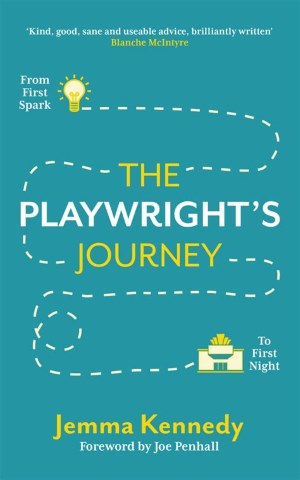 The cover to Jemma Kennedy's book shows a dotted line from a lightbulb to a theatre with the words “From First Spark” to “To First Night.”
 Blanche McIntyre is cited to the effect “Kind, good, sane and usable advice, brilliantly written.” These are good and wisely chosen words. Joe Penhall provides the briefest of forewords. “This is a very, very smart book which left me nodding in sage agreement with every chapter.” He says that he avoids books that advise how to write. But “Jemma Kennedy is that rare exception, a writer with the gift of laying bare the most convoluted ideas with exquisite lucidity, wit and empathy.” It is “a substantial and rare aesthetic achievement which every aspiring playwright, producer and director should read and respect.” It is a likeable book too, to be read alongside Stephen Jeffries, David Edgar and Steve Gooch below. Craft is achieved by immersion. It does not come via short-cuts. So she writes on page 2 that “I learnt to write, as most of us do, by trial and error. Watching plays. Reading plays. Studying their structure. Discussing productions with friends and colleagues. And slowly, tentatively, starting to write myself. It was hard.” Immersion is broad. “I have sat in the theatre of Dionysus at the foot of the Acropolis in Athens where Aeschylus, Sophocles and euripides debuted their plays.” The book flows with fine sense. Page 4 is about “time to feel your way through the writing process, as well as applying craft to those base materials. Then you can find and harness the patterns, rhythms and devices of theatrical narrative- and of language- in order to tell your story. “ There are those who do not relish theatre enough. On the first chapter “I read lots of new plays that should probably be novels, and some that should be poems, and even more that are really television shows. And most of them share a key characteristic, which is a distinct lack of theatricality.” And throughout are exercises and questions. “What are the colours, smells or tastes of your play?” “Describe your play as if it were a building, what is the architecture like? Baroque, Rococo, Gothic, Modernist. Is it dark or light, big or small?” “Which human emotion does your story lead with?” Chapter 2 is called “Getting Started: the Statue in the Stone.” She makes the analogy with Michelangelo. “The sculpture is already complete within the marble block before I start my work. It is already there, I just have to chisel away the superfluous material.” So, she says, “In my experience, most playwrights usually start in an enthused but creative muddle, and must painstakingly chip away at their block...line by line.” “Human imagination feeds on detail.” Pinter is cited from a speech at the National Student Drama Festival in 1962. “The context has always been for me concrete and particular, and the characters also. I have never started a play from any kind of abstract idea or theory.” The instrumentalisation of theatre, away from drama, is common.“By and large, audiences don't want to be force-fed the writer's value system masquerading as drama.” Anthony Neilson: “It is not that a play cannot be quasi-educational, or even overtly political- just that debate should organically arise out of narrative.” Included in the exercises are “try articulating the core meaning of your play into a sentence or paragraph and then write a list of visual metaphors that might carry that meaning.” In a chapter headed “Emotional Logic: The What of Plot and Why of Story” she quotes Lisa Cron as to what makes a story “about how what happens affects someone in pursuit of a deceptively difficult goal and then how that person, the protagonist, changes internally as a result, how their world view changes.” Dialogue, setting versus world, symbolism; the book tumbles with good sense and precise examples. The harvest feast in “the Ferryman” is chosen along with an apposite line from Jez Butterworth. “It's about an entrance and an exit...theatre is based entirely on entances and exits, like our lives.” Florian Zeller, Anthony Neilson, Bruce Norris, Caryl Churchill provide more examples. And the exercise. “Think about how much exposition and backstory is contained in these settings. What do they tell us...what meaning do they carry?” Part Two is about the play going out into the world, meeting designers, actors, directors. Blanche McIntyre: When writers ask me what my “vision” for the play is, I say “to do the play as written.” In other words, how can I dramaatise the intrinsic qualities of the playscript?” And then the critics. In the tumble of the modern-day blogs and blurts there is time to acknowledge those who matter and why they matter. As for essence Jemma Kennedy ends her introduction with: “In the darkened Lafayette Theatre- I watched the narrow, horizontal ribbon of light that connects the stage curtain to the floor of the stage, and which also separates them. That narrow ribbon of light then contains a mystery. That mystery may contain the future- you are, yourself, suspended, as mortal as that ribbon. No-one can possibly know what is about to happen: it is happening, each time, for the first time, for the only time...everyone seemed to be waiting, as I was waiting. The curtain rose.” The play was “Macbeth.” The year was 1936. Orson Welles directed. James Badwin was there, aged thirteen. |
Reviewed by: Adam Somerset |
This review has been read 73 times |
