| A Look-back and Guide |
VisualArts |
| Painting, Sculpture, Photography, Architecture , Landscape, Books and Media of Wales , November 30, 1991 |
 1 December 2023 “The Art of Music” by Peter Lord
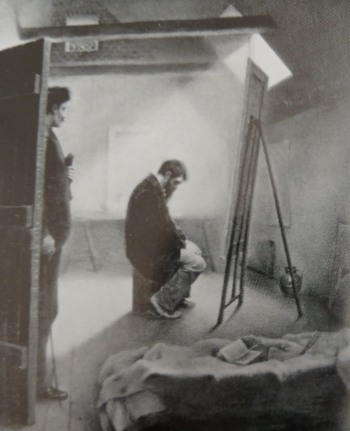
 “The Art of Music is a dense text, filled with painstakingly collected evidence: on harpists, song publishers, eisteddfod-goers and gentry enthusiasts, lyricists and composers, postcard artists and popular printmakers, most of them known now only to specialists. As such it is an exercise in recovery of cultural memory. “The place of Peter Lord at the heart of Wales' cultural self-understanding goes back a quarter century. For this book two questing spirits join in an exploration of synergistic scholarship. Rhian Davies, a graduate of Aberystwyth, Oxford and Bangor Universities, is best known publicly for her programming of the Gregynog music festivals. Her career in music research, publication and documentary has been extensive. Covid-19 robbed the authors of visits to concert hall or gallery. This book was made over the months of lockdown.” * * * * 14 December 2020 “Looking Out” by Peter Lord “Peter Lord, a practising artist before pre-eminent art historian, learned early on that public art was a combustible area. He was winner of a public commission. A part of it comprised a mosaic which entailed his working on hands and knees. For a while a citizen of Whitland would stand near to the artist's hands and offer his daily suggestion of “why don't you f*** off where you came from?” “With “Looking Out”, a collection of six weighty essays, Peter Lord continues the thesis that has been his historiographical achievement. Wales has a visual tradition. Lord has his long-standing opponents, curators, critics and cultural appointees who have combined in the past to declare that Wales is a land of voice and word. In Lord's perspective culture, the story that a national community shapes to tell itself, is lacking. * * * * 11 March 2020 Ben Dearnley, Sebastian Boyesen, Samantha Wynne-Rhydderch: public art on the Ceredigion coast “Sculpture does not even have to be at a physical border to cause trouble. Peter Lord as an artist was as well qualified as any to execute a commission in the 1980s in Whitland. As he describes it in in his autobiography, the project Cofeb Hywel Da aroused the ire of the Labour Party. The artist set to his work and a resident would stop each day with “why don’t you f*** off back where you came from?” Croeso yma.” * * * * 18 April 2019: Jonah Jones Centenary at Oriel Plas Glyn y Weddw “The centenary of Jonah Jones, born 17th February 1919, has been marked with an exhibition at Oriel Plas Glyn y Weddw. He was subject of a characteristically elegant obituary by Meic Stephens for the Independent on 2nd December 2004. Stephens encapsulated the life’s work in his opening sentence. “Jonah Jones was a sculptor who, despite a lack of formal training, won a reputation as a master-craftsman in stone and, in particular, as an artist devoted to the word in all its visual forms, from calligraphy to the inscriptions on gravestones.” * * * * 24 July 2017: Monumental Public Sculpture at Flint “Uniquely in the four nations of the United Kingdom the arts in Wales are stalked by the tourist interest. The guardians of culture lean its way despite the fact that the aims of art and tourism are at odds. There is plenty of good small-scale public art. I stop sometime to see Llywelyn at Llandovery, St Crannog on the Ceredigion cliffs or O.M. Edwards in Llanuwchllyn. But larger-scale public art has a background in Wales. Last year Machynlleth’s MOMA staged a debate over tourist slogans being dropped in National Park locations under the purported guise of art. Meredydd Barker wrote a play a few years back called Two Princes that revolved around a work of a public sculpture in a fictional town in Pembrokeshire. Peter Lord relates in his scintillating memoir Relationship with Pictures the grief that ensued over a public commission in Whitland.” * * * * 18 December 2016: Art at Machynlleth and Oriel Plas Glyn-y-Weddw “John Cyrlas Williams' output was as prodigious as it was compressed. One hundred and fifty pictures survive from a career that had ceased by age thirty. The title for this rich selection was appropriately “A Brief Flowering.” Highlights included “the Studio” “the Life Studio, Newlyn” and “Lynne, the Artist's Sister, at “Sandringham”, Porthcawl”. * * * * 12 September 2016: Jeremy Moore Nature Photography “A similarly pale and evanescent colouring was created by Moore for a triple picture of swans, that featured in a summer exhibition, Bird/ Land, at Aberystwyth Arts Centre. The format was unusual, thirty-eight sets of three photographs measuring twelve inches by just three inches in height. The lighting effects – tokens of extraordinary care and much patience – defy reproduction. If these images required direct apprehension Moore has left a selection of his work in another book. Pembrokeshire Journeys and Stories, also from Gomer, dates from 2011. It is slender at one hundred and fifty pages. The images are augmented by text by Trevor Fishlock. It is the best book there is on Pembrokeshire.” * * * * 17 August 2016 “A Companion Guide to the National Museum of Wales” “The one hundred and fifty mini-essays roam across history and aesthetics, biography and art history, quotation and matters of technique, ownership and commercial passage. Oliver Fairclough opens with six pages on the stages of formation of the institution itself. In 1882 William Menelaus, manager of the Dowlais iron and steel works, is donor of thirty-eight paintings. James Pyke Thompson, a director of the milling firm Spillers, is creator of Turner House in Penarth and owner of extensive watercolours, oils and ceramics. Chemist Robert Drane is instrumental in building the collection of ceramics, including the porcelains from Swansea and Nantgarw.” * * * * 14 April 2016: Clive Hicks-Jenkins at Symposium on Landscape and Memory , Museum of Modern Art Machynlleth “I am a narrative painter” he says “Discovering the things I love and to share them. That’s what painting is about.” * * * * 11 March 2016 “The Tradition” by Peter Lord “Yet tradition, in Lord's telling, is a story that culture devises to relate to itself. Hence the paradox of a movable history that shifts as the zeitgeist amends it. The notion that Wales was unable to sustain an ecology of painters and patrons is “a historical nonsense.” A tradition becomes itself in the telling.” * * * * 03 August 2015 Trevor Fishlock “A Gift of Sunlight” “The Gwendoline and Margaret Davies Charity has produced in “A Gift of Sunlight”- handsomely produced by Gomer- a book to tell the story of the unique bequest that is the foundation stone of the national collection. The charity’s chosen author Trevor Fishlock does justice to his mix of turbulent history and boldness of aesthetic judgement- driven by a belief in the ennobling quality of beauty- of great wealth joined to modesty of living and personal humility. "That blue of the dress, comments Fishlock in his attention to the fine grain of the detail of history, owed much to the astonishing leaps in the chemistry of the time. Fishlock tells of the eighteen-year old prodigy William Perkin in his reeking workshop in London’s East End. His experiments with coal were intended to find artificial quinine to combat the malaria that was endemic all over the Empire. Instead he discovered a brilliant dye that did not fade, the source of his subsequent vast fortune.” * * * * 18 April 2015 David Fraser Jenkins “William Wilkins” “Wilkins’ infinitely painstaking methodology is a challenge to the camera. The gradual application of the paint, tiny stroke upon tiny stroke, is the opposite to what the camera sensor, however sophisticated, seeks. It searches for a certainty of line for its focus, precisely the element that Wilkins’ method dissolves. It is reassuring that Graffeg’s fine and deep images are simulacra rather than replications. The work itself remains triumphantly a Ding an Sich.” * * * * 17 September 2014 Glyn Rhys “A Celtic Canvas” “Glyn Rhys’ book on Carey Morris is a slim book of great elegance. Y Lolfa is its own printer and binder and has done its subject proud. Morris' work is all privately held with the exception of one portrait in Carmarthenshire's County Museum and four in the National Library. For the landscapes and less formal portraiture the reader is dependent on the quality of Y Lolfa's reproduction. The book has a format of eight by six inches with many pictures represented full-page. Those like “Daf'ir Felin as a Fisherman” and “Ann” are beautifully rendered with great subtlety of hue in the colouring.” * * * * 28 August 2014 Falcon Hildred exhibition at Newport Art Gallery “Falcon Hildred has been resident in Gwynedd since his purchase of Melin Pant-yr-Ynn in Bethania in 1969. He warmed at once to the landscape around Blaenau Ffestiniog with its twenty quarries, its abandoned tramway tracks, its tips and terraces. Most importantly it had ‘no fat ring of mediocrity around it’. The restoration of the mill, still smelling strongly of rust, was done on a negligible income, a tribute to craft where not an item of plastic intrudes. Pete Telfer’s film depicts the artist as lucid, expository and unshowy. ‘I didn’t want to do work that only brought in money,’ he says; ‘My drawings have a job to do.’ Falcon Hildred is a unique artist and Peter Wakelin’s book does full and rightful honour. The late recognition is a natural extension to the Royal Commission’s curatorial role. With support from the Lottery, it acquired in 2011 over six hundred of Hildred’s drawings in joint ownership with the Ironbridge Gorge Museum Trust.” * * * * 15 July 2014 Ivor Roberts-Jones sculpture Jonathan Black & Sarah Ayres “Abstraction and Reality” is a title that might mislead. This study of the work and life of sculptor Ivor Roberts-Jones is light on speculation, abstraction or curatorial pirouetting. A fine tribute to Wales' foremost maker of public art in the twentieth century it comprises four essays by Jonathan Black and one by Sarah Ayres. "Photographs for comparison feature works by Rodin, Gustav Vigeland, Walter Gropius, Elisabeth Frink and Charles Sargeant Jagger. The frequent documentary photographs include a full-page illustration of four Prime Ministers assembled in the Commons before a sculpture of one of their predecessors.” * * * * 25 May 2014 John Uzzell Edwards & Charlie Uzzell Edwards at Tenby Gallery John Uzzell Edwards died on March 5th. As a result Tenby’s planned exhibition, featuring father and son artists on opposite walls, was amended. The re-selection of fifteen pictures became broader, drawing from work across several decades, albeit all representing the human form. The result in Tenby’s Face to Face exhibition is not just a worthy valediction but a visually bracing tribute to art, and ideas of art, across the generations.” * * * * 22 May 2014 Francesca Woodman photography at Bodelwyddan Castle “Two facts predominate about Francesca Woodman. She died in 1981 at the age of twenty-two and she left behind a body of work of ten thousand photographs. The tour that comes to Bodelwyddan, courtesy of the Art Fund and Arts Council of England, comprises eighteen that make for an absorbing exhibition of unique character.” * * * * 14 April 2014 Ivor Roberts-Jones exhibition at National Museum “The exhibition at the National Museum is the polar opposite of this public monument-making. A single first floor room houses twenty-six works, mainly busts. The height of the displays moves between eye level and chest-height. It makes for a particularly intimate, close-up relationship with Roberts-Jones’ subjects. The closeness is reminiscent of Dannie Abse when he stood beside a Dylan Thomas head for a television documentary. He saw an ‘astonishingly wild and haunted Dylan head staring into space, his tie awry, a cigarette drooping between his lips. The dead’ said Abse ‘can sometimes come alive for a moment.’ * * * * 14 October 2013 Kyffin in Venice “The occasion for ‘Kyffin in Venice’ was a television documentary, acclaimed at the time and now archived inaccessibly. The book comprises twenty-two photographs, twenty-one paintings and a dozen drawings. The text, a transcribed conversation with David Meredith, spans biography, motivation and method, artists and art history.” * * * * 4 July 2013 “Relationships with Pictures” by Peter Lord ‘We grow up in belief and we grow old in belief.’ Peter Lord opens his subtly titled autobiography with these words. ‘Somewhere, in the middle’ he continues ‘sometimes, facts press upon us. But, in the end, only belief is real.’ Lord’s book is all at once memoir, artistic exploration, the evolution of a unique and crucial critical intelligence for Wales, and the forming of a life’s mission. * * * * 25 May 2013 Gideon Koppel filming Borth ‘What can the camera do that the eye can’t do on its own?’ The question is barked out to Gideon Koppel at the end of his introduction to the opening of his film installation Borth. His forty-minute talk, in Aberystwyth’s sleek Arts Centre cinema, has recounted the technical challenge behind his creation of a single travelling shot of the houses that back onto Borth’s beach. Koppel has glided with ease past references to Beckett, Deleuze and Heidegger, and his questioner is easily answered. ‘The camera creates a frame,’ he says, ‘and it lingers where the eye moves on.’ * * * * 18 April 2013 "Bathing Beauties" Imagined Beach Huts at festival of architecture “Alan Hewson’s decision to create and mount a Festival of Architecture has two lines of reasoning behind it. Firstly, after the critical and popular success of the Eye, the Festival of Photography in 2012, architecture is a natural extension to the artistic range celebrated at the Arts Centre under his leadership. Secondly, the Arts Centre is itself a piece of noteworthy architecture that befits its status as cultural centre for West Wales and beyond. Like Theatr Clwyd Cymru the original Theatr Y Werin was given a hilltop site. Both projects were instances of partnership whereby a local civic institution, County Council or University, took on a role of service and property maintenance, as host for the national arts strategy of Wales.” * * * * 11 October 2012 Portraits of Olympians. Lorraine Bewsey “Painting the Flame” “The term “photographic” might be applied but her work is a world away from that of a Richard Estes. The luminosity of colour evokes better the craft of the generation of Byam Shaw, himself encouraged as a fifteen year old by Millais. Tanni Grey-Thompson wears a necklace of several different jewels. An opal is possessed of a Holbein-like lustre and depth. “Lorraine Bewsey states her intention: “I want my portraits not only to draw out the essential character of my subjects, but to be appreciated for the quality of line and tone…to feel that the skill of an individual artist in drawing and painting is important.” * * * * 29 September 2012 David Hurn at the Eye International Photography Festival “David Alston from the Arts Council of Wales has opened the festival with a reminder that photography is document. That word, he says, has its roots in the Latin for ‘teach’. Hurn’s selection of pictures covers the span of fact and imagination. After a heart-achingly romantic 1915 Kertesz he shows a puzzle picture. A line of men may be participants in a peculiar religious rite. Look closer and some small rubber suckers reveal they are doing no more than nudging a plate glass window into place. He shows a Duane Michals sequence of a surreal and witty circularity. Richard Avedon sends a brave model to pose in a convex curve between two elephants.” * * * * 30 October 2011 “Clive Hicks-Jenkins. Critical Essays” Edited by Peter Wakelin “Andrew Green's essay opens with Tretower. It is the crucial symbol of the hiatus in the life “Tretower was where I landed when I threw myself from the parapets of a previous life.” All the first endeavours of art are a working through an artist’s admirations. In a painting of the vegetable garden at Tretower Andrew Green sees that “the mood is contemplative, the colours pastoral, and the style familiar from a line of British painters of the twentieth century.” In the width of the composition Green remembers an echo from Ivon Hitchens. On the opposite page a drawing depicts, in charcoal and contė, black sheep in a night quarry setting. The ghost of John Piper may be present but so too the moon might be that of Samuel Palmer. What is revealing is how quickly Hicks-Jenkins becomes his own distinctive artistic self. * * * * 30 August 2010: Biblical Art in Wales” edited Martin O’Kane & John Morgan-Guy . “The geography of Wales itself has a biblical stamp. Nebo on the Lampeter to Llanrhystud road is one of several and it is the same with Bethesda and Bethel. There is a Caesarea and a Golan close to Porthmadog. Much of the art in the book comes from distinguished names. Jonah Jones adopted Catholicism as inspiration for his life work. Ceridwen Lloyd-Morgan alights on Clive Hicks-Jenkins’ Annunciation of 2004 and Claudia Williams’ Madonna and Child of 1983 as examples of artists choosing biblical narrative for subject matter. John Selway in his fourteen Stations of the Cross in Abertillery has, she says, politics rather than faith for its motivation” |
Reviewed by: Adam Somerset |
This review has been read 217 times |
