| “Big Theatre, Where it Matters" |
At Company of Sirens |
| Water Wars , Aberystwyth Arts Centre , March 13, 2025 |
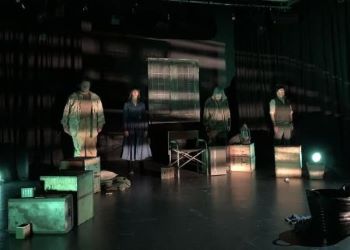 There is an eloquence in every audience. A collective gulp is palpable at the final dimming of the lights on Ian Rowlands' ninety minutes of incendiary action.
 Conflict, passion, both private and political, and pain have been to the fore. That communal gulp from the audience precedes applause of enthusiasm for Arwel Gruffydd, Jâms Thomas, Siwan Morris and Luke Molloy. The last image from Company of Sirens' tour to all points in Wales has been of sexual assault that is mirror, in the play's perspective, as an allegory of national fate. “Water Wars” is big theatre, not as expressed in size of cast or scale or resource, but big where it matters. It wants to be about something that matters. Touring theatre has thinned since the pandemic. The two tours of early 2025 are a study in contrast. Theatr Cymru dug deep, to acclaim, into layers of private experience with “Byth Bythoedd Amen.” “Water Wars” is an expressionist blast of public themes that does not always make for easy watching. A historian of Wales once at the Hay Festival deplored the using of history as a communal comfort blanket. So too, in a culture that is richly varied, a strand of theatre that whips away the comfort blanket is a sign of good health. “Water Wars” has been a good time in gestation. That a credit is given to John E McGrath is an indicator of just how long. A commission originally from National Theatre of Wales it extends beyond status of national theatre- a vexed subject in Wales- to nationalist theatre. The playwright's voice is present. Ernest Renan is cited. “The Senedd still hasn't created a sense of unity” declaims a rebel in arms. It is some years since a play by Ian Rowlands was to be seen on a stage in Wales. “Blink” toured in 2008. “The Sin Eaters” won a nomination for “Best Regional [sic] Play” in 1991. “New South Wales” was reviewed on this site in November 1999. The dominant sequences in “Water Wars” are parallel interrogations, uncomfortable and led by a chilling Arwel Gruffydd, with an emphasis on genital mutilation. The background is sketched with economy. The years are 2048 and 2049. The Thames barrier has been breached. The centre of English authority is moving to Manchester. Eco-force warriors of Wales are set to staunch the flow of water west to east. The assault on eight pipelines is stymied by betrayal. Meanwhile in the south the Senedd has been captured by force. The scenario has a draw-back, not that of a dystopian future but the limitations placed upon the characters. They are made to be vectors of energy. Allegiance to political grouping eclipses nuance and social grounding. In an art of human fissure the drama is lessened. Ian Rowlands is to the well-made play what De Kooning is to the golden section in the visual arts. The aesthetics of an artist usually remain constant. “Water Wars” is best understood from an interview in March 1999. “I wrote plays”, said Rowlands to Hazel Walford Davies, “that were concerned with discussing issues rather than presenting characters. in my plays I dealt with debate rather than emotions and characters. I don't write for characters but for ideas”. “Some writers script for characters and they let their actors grow into that character and influence the text. For me, as a writer of ideas, that is not an option...I'm certainly far more interested in aspects of a debate rather than in naturalistic characters.” This contests the core aesthetics of theatre and also the nature of human cognition. But the sentiments are very much of their day. At an extreme- but not in “Water Wars”, it leads to “The audience are bombarded by these images and they can't make head or tail or sense of what they've seen and what they've heard.” A culture in good health is an ecology. In the world outside herbivores co-exist with carnivores. Company of Sirens has pursued a particular, and admirable, course in Cardiff's performance record. Year on year they have brought to public view the carnivores of theatres, the fauves who test the boundaries of convention and politeness. As a cluster of dramatists they may not be charmers or chummy. But they are bonded in a purpose; that live art counts for something. It really is there to crack the frozen sea within. “Water Wars” fits the company's tradition of honour. Credits for the production: director Chris Durnall, set designer Jo Hughes and Lydia Durnall, lighting designer Ceri James, sound designer John Meirion Rea, stage manager Tyla Thomas, producer Alison Gerrish. “Water Wars” opened at the Atrium in Cardiff. After Aberystwyth it played at Yr Egin in Carmarthen. The tour continues to Neuadd Dwyfor, Pwllheli 11th and 12th March, Pontio, Bangor: 13th March, Theatr Brycheiniog, 17th March, Ffwrnes, 20th March, Glowyr in Ammanford 21st March, the Torch 25th and 26th March, the Welfare in Ystradgynlais 27th March and Theatr Soar 29th March. A guide to productions by Company of Sirens can be read in the first link below. |
Reviewed by: Adam Somerset |
This review has been read 1595 times There are 35 other reviews of productions with this title in our database:
|
