| Heritage Theatre |
I Am Lloyd George |
| Mewn Cymeriad , Aberystwyth Arts Centre , May 8, 2025 |
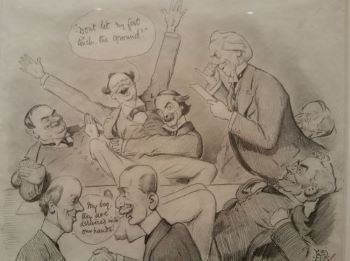 A decade back the Hay Literary Festival had a greater awareness than now that it takes place in Wales. Historians would gather in groups for several years and discuss, usually before packed houses, interesting things from history.
 The theme one year was “Heroes and Villains from Welsh History.” Wales, it was said, had a difficulty with its heroes. History, and its historiography, was lopsided. So too this engaging hour of solo-performance theatre is lopsided. Kenneth O Morgan, Lord Morgan, knows more than any other person about this era of history. He was on a Hay panel; Guto Harri, John Kampfner and Ffion Hague were his companions. “Their knowledge of Lloyd George” ran the report for Wales Arts Review, “individually and together, is formidable. They know his every movement, political and romantic, in that summer of one hundred years ago and are equals in platform confidence. Letters from Lloyd George from July 1914 are read out in which the mood is ever hopeful.” Lloyd George was sixteen years in the Cabinet as a member or its leader. “Laid the foundation for the welfare state, won the war, oversaw the vote for women”, concluded Lord Morgan. “That's not bad.” Adam Johannes published an article on Lloyd George on 11th November 2024.* It had taken some work as it ran to 3000 words. “Lloyd George”, began the article, “a name heralded in history books as the architect of reforms—the old-age pension, unemployment and health insurance. To many, these changes are his legacy, a portrait of a man who sought to ease the hardships of the working class..” It then moved to a lot of history. “As Prime Minister, Lloyd George expanded the British Empire to its greatest ever extent, covering almost one-quarter of the surface of the world and subjugating almost one-fifth of the people of the world.” Not so. With the partition of Ireland Lloyd George oversaw the beginning of imperial shrinkage. This silly history declared that Lloyd George,“he and his ilk”, engineered the First World War for private advantage. He was responsible for shia-sunni rivalry. The Civil War in Ireland is glossed over. Lloyd George is author of the “Empire’s dying sneer, a guarantee that Northern Ireland would remain a ghetto of Britain’s making, simmering with resentment and injustice.” By definition a territory comprising two communities at odds cannot be a ghetto. “Let Lloyd George be remembered as he deserves” ran the conclusion. “A man who fought not for humanity, but for Empire, for greed, for blood and glory...Lloyd George – we name you not as a hero, not as a liberator, but as a criminal of the highest order. And we, those who know and love justice, will make sure your name is never spoken in reverence again.” As to detailing the nature of his criminality this kind of writing is not troubled with such small detail. There is nothing wrong with critique of those who have gone before. It had an exemplar a century ago in Lytton Strachey. But Strachey toppled his Victorian monuments with nuance and literary finesse. This kind of common contemporary writing is its opposite, over-heated, blurry, declamatory. It has a purpose. The person whose fingers are on the keyboard is of a superior moral grading than the man of public life of the past. By extension those in the present day who seek some value in Lloyd George are also of a lower moral standing. So to theatre. In 2011 D J Britton dramatised Lloyd George in “The Wizard, the Goat and the Man Who Won the War”. It was well received. It was performed in Asia. A historian of Lloyd George was there to see it in Aberystwyth. “First-rate”, his verdict, “I couldn't fault it.” It had a powerful metaphor. Britton set his premier on the beach at Antibes. An imagined stone provides a metaphor for political power. Power is just the skimming of a pebble across the water’s surface. It is less strength than skill that keeps it skimming, but sink it will, and sooner than later. And now Lloyd George on stage again fourteen years later. Mewn Cymeriad's production had small publicity. It played twenty venues. “Which version of Lloyd George will you choose to remember?” ran the advertising and referred to “one of the most controversial Welsh speaking Welshmen in our history.” Not really, “I am Lloyd George” is a likeable enough hour. The design is satisfying. The rapport between Llion Williams and his Aberystwyth audience is palpably strong. But at the end, as at every end, the question asks itself. “What was that about?” It is certainly not about politics. Indeed the script mentions not a single politician. No Asquith, Balfour, Bonar Law, Campbell-Bannerman, McKenna, McDonald, Smith, Wheatley. Not a soul. The years of radical ascent are not there. The anti-war firebrand does not feature. It goes straight to “When I became Chancellor.” Elegiac memories of the Dwyfor feature. Margaret Lloyd-George is hailed. But as theatre it is without interest in the thrill of politics. The People's Budget- see illustration- is one of the seismic moments in parliamentary history. It could be said that this review is about a play that was not the one on offer. This is true. But if a titan of politics is going to be dramatised, and indeed marketed, to an audience then that audience is going to go in expectation of politics. This mercurial political persona was summed up by Hudson Kearley MP, a Parliamentary Secretary at the Board of Trade, as “an extraordinarily quick and subtle understanding of human nature combined with unbounded courage.” And Roy Hattersley summed up the paradox of “his ruthless ambition, his supreme self-confidence and his crass insensitivity.” There is the material for drama. Back at the earlier play the review “D J Britton’s script does what theatre can do and journalism cannot. That is to depict complexity and paradox. “They must expect complexity.” And underneath is the stuff that fuels theatre, the line that connects Oedipus to Coriolanus to John Proctor. “The greatest men have the greatest weaknesses”. *Lloyd George at: https://nation.cymru/opinion/lloyd-george-was-a-man-of-empire-and-that-empire-was-brutal/ |
Reviewed by: Adam Somerset |
This review has been read 459 times |
