At Earthfall |
| Theatre Association Chorea and Earthfall , Chapter Arts Centre Cardiff , September 20, 2005 |
 This review first appeared in Planet Magazine and is reproduced with their permission...
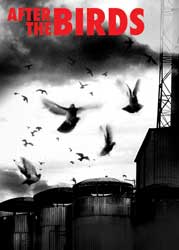
AFTER THE BIRDS was shown at Chapter Arts Centre between the 7th and 10th September 2005. [After the Birds, a fusion of elements from Aristophanes’ comedy, The Birds, is the story of a group of rebels who attempt to create a new, pure, uncorrupted society halfway between humans and the gods. In this vision of a comedic non-conformist utopia in a politically unified but still divided Europe, the departure from one jaded and corrupt society leads to the formation of a new but equally jaded and corrupt society inevitably involved in imposing heavy limitations and conditions. This pioneering theatre performance work combines urban choreography, Greek song, and a uniquely physical choir, with contemporary live music and film, colliding to create a truly must-see spectacle. If you’re familiar with Earthfall’s work, you’ll know that they are always capable of surprising you, and as with all Earthfall shows, this is certainly no ordinary performance… Theatre Association Chorea brings together some of the founding members and most prominent practitioners of the seminal company Gardzienice with young and emergent artists} When the Twittering Had to Stop It’s easy to jump to conclusions about a performance before you’ve even sat down — or perched at least — on a makeshift bench, feet digging into your back because someone else got to the chairs first. After The Birds, a collaboration between the Polish company Theatre Association Chorea and Wales’s own dance company Earthfall, sounds fairly dour in the flyer: “A collision between ancient Greek choral song... and urban choreography... a radical fusion of elements adapted from Aristophanes’ comedy The Birds, transcribed into Polish.” Not, apparently, a recipe for a light-hearted evening, so it’s surprising when this collaboration manages to be both thrilling and warm. The original comedy told the story of a group of people setting up a new regime after the collapse of the old one, and making the same pig’s ear of it. Not an easy tale to interpret through movement and foreign song, but success lies in the obvious professionalism of the piece, the well-structured performance and, above all, the keen eye the directors train on their audience. Given the subject matter of the piece, what could have been serious is leavened by touches of humour. From the start there is broad comedy to put us in a receptive mood — three “stooges” mug around in overcoats and Biggles’-style flying caps, resembling not-very-bright monkeys. Their tomfoolery with a ladder is burlesque, Charlie Chaplin-style. Later, there’s the bittersweet dance of two over-the-hill lovers, who throw themselves around like drunken oldies at the end of a high school reunion, rocking and jiving to their own desperate rhythm. The chorus is a triumph of pared down thinking; with the simplest movements it manages to transform the theatre space from something static to something constantly evolving, throwing out new images for the audience to interpret as individuals break away from the group to do their thing. It begins as a cluster of twittering, aimless people, (the “birds”, presumably), gradually gaining coherence throughout the performance. It is at once funny — inventing the choral sneeze where one person says “aaa...” and the rest go “...choo!” — and, as it starts to march relentlessly around the theatre, sinister. Watching even a small group of people move in synchronisation is somehow stirring, and in this case it has deeper echoes as the chorus arranges itself into formations reminiscent of 1920s Communist worker posters, where comrades march in a triangle of human force. When a madman breaks away to rave at the audience, words tumbling forth against the single voice of the chorus, he is pinned to a wall with the force of the group, then literally trampled underfoot. The group of twitterers who started the performance no longer exist; they’ve transformed themselves into a well-oiled band of soldiers, moving with military precision and martial arts-style kicks and thrusts. Another trick of the production is to involve the audience without resorting to audience participation. Unlike traditional dance performances where the audience is remote, watching the brilliance of the dancer, here we are as much directed as the players themselves. You could complain about the lack of chairs and make-shift benches, but this arrangement allows people to sit around the space instead of above and apart from it. Different levels of the space are used, with dancers perched on a tiny balcony, sometimes echoing the movements on the floor, sometimes singing, sometimes holding improbable poses for improbable amounts of time, although my guest, who was trying to sketch them, found that every time they struck a pose they slid out of it almost immediately. Canny lighting (a man creeping after individual dancers with a strip light) not only picks out different parts of the theatre space to focus on, but lights up the audience so that viewers on the opposite side can watch them, too. A bare stage becomes full of possibility; we are never allowed to grow weary of the same spot. If visually the audience is well-fed (that three-minute attention span is rarely stretched), then aurally we are pretty much drowned. Live voices vibrate with a volume that recorded music never achieves; here they also have that curious flatness of eastern folk songs. The chorus is almost constantly in voice, a wall of melancholy that weighs heavily on the performance. When individual voices are allowed to stand out, they are all the more poignant against the almost religious intonation of the chorus. Given that it’s all in Polish and there can’t be too many in the audience who understand it, the singing becomes a kind of movement in itself, as physically stirring as any of the dancing. It’s a question whether, when the performance is presented in Poland, the songs will be translated into Welsh so that the audience over there gets the same experience. Whatever the confusion, After The Birds is undeniably enjoyable, polished and fast moving, which I wasn’t expecting. In other ways it was exactly what I did expect — parts had the kind of seemingly random movement you associate with contemporary dance; an earnest emotion that is often just that bit over the top. At one point, a cockerel-haired young man starts break dancing, a refreshing change after all that Polish/Greek choral music, and the whole audience perks up. He’s soon run out of town. Shame, really, as he was truly contemporary. You can’t get a more of-the-moment, or indeed more of a commercial force than hip hop, but popular culture never really gets a look in with serious performance. One thing was truly radical though — the main musician, hidden up in the rafters with his sound deck, suddenly burst forth with the ear-splitting wail of goat skin bagpipes, complete with a goat’s skull and horns at the top. Now that I wasn’t expecting. |
Reviewed by: Alex Carolan |
This review has been read 2059 times There are 14 other reviews of productions with this title in our database:
|
