| Lend a Hand and Dig the Land |
At Louche Theatre |
| Louche Theatre- Lilies on the Land , Morlan Centre Aberystwyth , April 22, 2013 |
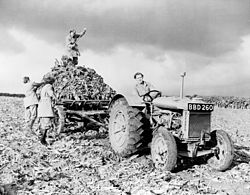 It is an irony of the Second World War that the National Service Act (number two) of December 1941, which extended conscription to women, had no equivalent in Germany. In the war’s last years, scarce transport resource in Germany was deployed in keeping the Reich’s women folk supplied with domestic servants. The Women’s Land Army, although founded in 1915, entered popular memory and culture in its second period of Britain’s total mobilisation of labour.
 Land Girls feature in a forgettable 90’s film but also in two memorable classics of British cinema. Sheila Sim’s Alison is the romantic lead in Powell and Pressburger’s 1944 “Canterbury Tale”. Cavalcanti in “Went the Day Well” of 1942 has an opening scene in which Land Girls Ivy and Peggy are delivering the milk in post-card-pretty Bramley End. It is not a rural view that is represented by the Lion’s part in their adaptation for stage of verbatim accounts from wartime veterans. Emma Sims’ Margie is despatched to a muck-strewn farm near Darlington, presided over by farmers-from-hell Mr and Mrs Bainbridge. Paul Ingrams' reaction to wife Heather Giles on his new, young wartime help is “She’d make a good ornament for t’mantlepiece.” Vera (Sian Taylor) has aspirations to gentility but is attracted by the look of the Land Girl outfit. She too finds that farming is a relentless grind. The remains of the kale, those parts uneaten by the pigs, have to pulled out of their state of trampled slurry. Nettles, rats and ringworm abound. In farming’s largely pre-automated age the task of clearing a field is done with a hand sickle. It takes a lonely girl three weeks to accomplish. A recent book has dealt with the small and privileged minority who escaped privation and rationing in London’s grand hotels. But, for most, the war was the great leveller. Denise Williams’ Poppy arrives with two ringlets arranged in her carefully coiffeured hair to make the appalled discovery that piped water and sanitation are not universally available in Britain’s homes. Tiffany Evans’ Peggy is a little better adapted, having helped with the hop-picking from age three. Even so, she makes as big a bodge as can be of driving her tractor. The war period is now subject to harsher revisionist treatment by historians like William Hitchcock and Max Hastings. Structurally, “Lilies on the Land” divides in two. The earlier part captures the material privation, lunch of margarine sandwiches and beetroot slices, the horrors of dried egg and black bread. “You never wasted string” declare the four leads in unison. It is the never-forgotten attitude of the rationing generation, who regarded an item thrown away as not just wasteful but immoral. Small pleasures are to be had alongside the aching backs and long hours. Poppy uses the excuse of an ailing relative to escape on a two-day rail journey to attend a Ball. When the troops from America arrive, their camps are emporia of luxury with real butter and oranges. V-E Day is a celebration of jubilation without parallel. Beside the small joys “Lilies on the Land” has its elements of sombreness. A friend, an inexpert driver, is killed in a rail accident. A lone aircraft in the sky turns its machine guns on the civilian workers who flee for their lives. Women remain silent in the face of their hosts’ sexual predation. Nearby RAF pilots provide a glamorous date or two, but then fly one mission too many and are gone. The cutting-out of the V1 missile’s engine is followed by the terrible silent seconds of its descent. The play originally had a cast of just four. Director Harry Durnall wisely expands his cast for the small parts, adding much visual texture. John Edwards presents a new arrival with the worst bicycle ever for her onward journey. Millie Jackdaw plays one of the millions of haughty administrators who came to be loathed. The sound design takes in speeches by Winston Churchill and William Joyce. Caroline Clark is the ever inventive wardrobe mistress. Nest Howells, Hazel Fairplay and Sue Harris perform music of the time. The production hits a lyrical high at a cold Christmas, where Italian tenors are joined by German prisoners singing “Stille Nacht.” “Lilies on the Land” is popular theatre in its best sense. It touches on a time and an experience that is now inexorably passing from memory into history. It has played in big theatres and small halls up and down England. That Louche Theatre has brought it to Wales, and West Wales in particular, is appropriate. One Land Girl came from Cardiff to drive tractors, was romanced by one of my neighbours and stayed for life. Of the Italians, captured in large numbers in the Tunisia and Libya campaigns, many were housed in Wales. Real prisoners at Llanon built the protective sea wall. Further south an Italian artist left behind the remarkable frescos of the Henllys chapel. “Lilies on the Land” continues to Machynlleth’s Tabernacl and Barmouth’s Dragon Theatre in May. |
Reviewed by: Adam Somerset |
This review has been read 2671 times There are 25 other reviews of productions with this title in our database:
|
