| What Made This Year Special |
My Year of Theatre |
| Performance After Fifteen Months' Absence , Wales & England , January 13, 2022 |
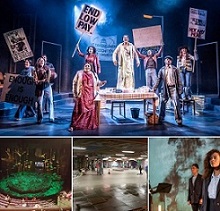 Janice Turner is a columnist whose normal field is incisive defence of women's issues. For the weekend of 21st August 2021 she altered tack with a piece headed “A Heaving Crowd Makes Us Feel More Alive”.
 "There's nothing like the joy of a shared experience", she wrote. She had been among those at a big opening night. "At the end...the whole audience stood as one and I felt we were applauding not just these newly-minted stars but ourselves...we are back. The wisdom- or the madness- of the crowd." She caught the flavour of the season right. My own experience recorded: "These sure are different days- an Artistic Director steps out on stage- Aberystwyth last night- to thank us for being there. It is a mutual feeling, appreciation for MID WALES OPERA braving it all and getting out on tour- a spaced audience of around a hundred, cheering on the singers, who were radiating joy to be back doing what they do. "Surprises are good- the automated booking software seated me in Row F, which sounded mid-auditorium- surprise then to find with an extended stage F1 was front row, right there next to the musicians, the sound close, real and physical. I was so close as to chat to the musicians before the performance started." * * * * On 7th December RUFUS NORRIS took the long walk to the edge of the Olivier stage. "When someone dressed like me appears you know it's not good", he said. One of the leads for "Hex" was in self-isolation. The understudy had stepped up for a preview and she too was also now in isolation. Another company member was taking the part with no preparation. He departed to cheers. The stand-in did it brilliantly. When it was time for applause hers had that extra ring to it. An audience knows what it is getting. Performance had that consistent emotional quality in 2021; I was at twenty-one in all. The Scots group BLAZIN FIDDLES came to Aberystwyth on the seventh leg of a ten-performance tour. They knew exactly how many days had passed between performances, in excess of five hundred. The emotional connection between musicians and audience was palpable. "Thank you for your smiling eyes" said Bruce McGregor to his packed masked audience. * * * * This period will be studied for years to come. The coverage to date has hardly addressed the core; we are public beings, the intimacies of home life being necessary but not sufficient. New words emerged for the winter lockdown, the third in Wales. Monday became "noneday", Thursday "blursday". There were no nights out anywhere. I reckoned myself fortunate to have benefit of a weekly task. This site gave temporal structure and psychological purpose. Thousands who were laid off succumbed to anomie. Lachlan Goudie (the Times 7th November 2020) was characteristic: "All I could feel was demotivated and lacking in purpose and depressed." Each Thursday I managed a seven to nine-paragraph. Without performance they mixed radio reviewing, commentary and retrospection. The most-read piece was sub-titled "DIVERSITY, INTENT, FUTURE at Return of Theatre of Wales" (Theatre in Wales: Comment March 2nd.) Its subject was the "New Directions’ initiative at the SHERMAN. JOE MURPHY is cited: "Change the author and the stories change. Change the stories and everything else changes." * * * * "LOOKING AT THE GAP. Diversity in Theatre of Wales" (Theatre in Wales Comment April 16) covered a reading of OTHNEIL SMITH “Giant Steps”, tellingly in Mold rather than in the city where he lived. The article reprised types of diversity in theatre- "a large topic and not an easy one"- and Cardiff being behind. Looking back to Mustafa Matura, Hanif Khureishi, Kwame Kwei-Karmah, Anchuli Felicia King, Angela Gordon, Gurpreet Kaur Bhatti, Tanika Gupta, Rachel De-La-Haye, Tamasha Theatre the article doubted whether theatre in Cardiff will ever broaden out to see an auditorium filled with the women and men of Butetown. It does not look probable. * * * * The NATONAL THEATRE OF SCOTLAND broke its long Covid-19 absence with "Lament for Sheku Bayoh", an acclaimed dramatisation of the death of a young man in custody. The Kiln in Kilburn put on stage a group of women Asian expellees from Uganda striking for better work conditions. Suhayla El-Bushra’s "Waking/Walking" was one of a trio of plays called "NW Trilogy". Moira Buffini's "Dance Floor" was about the Irish experience in "County Kilburn." The most affecting was simple. In ROY WILLIAMS’ "Life of Riley" a teenager confronts a father who abandoned the household. Riley. the father, is neither a good nor a bad person. It has a universal theme, the claims of art over domestic responsibility. Instead he has played with Bob Marley and Toots and the Maytals. The emotions are deep. A kind of reconciliation is reached with parent and child singing "Young, Gifted and Black" together. spirit, giving us a melting-pot Brent with emotional depth beneath the humour. Arifa Akbar got it right for the Guardian: "Williams’ heart-wringing "Life of Riley" is the strongest story of the night. Harmony Rose Bremner and Chris Tummings' exchanges are hard and unyielding – she refuses to forgive, he to feel guilty – until a flaring connection through music. Bremner and Tummings sing as sensationally as they act, and the writing captures the philosophical tension between family responsibilities and personal freedom with nuance. Both father and daughter stories are brought out with delicacy, and with no final judgment of either." * * * * Theatre in Wales: Comment 23rd March was titled "DIGITAL THEATRE & THE SENSORY DEFICIT" and that of 7th April “Theatre is Carnal, Corporeal”. It posited that arts policy-makers are bereft of knowledge of physiology, biology, cognitive psychology. Lacking the diversity of make-up that matters they are unaware of the research on t-cell and cytokine response to live performance. "Theatre from “Theasthai” means to behold and the root “thea” means variously a view or a seeing or a seat itself. Conceptually “Eisteddfod” is similar, its root “sedd”, a seat...Its first condition is that it be a place in the company of others. If it is an act of separation, done within a private home, whatever it is it has ceased to be theatre.” Jonathan Yeo (Times 7th November 2020) on the difference: "I missed out on the senses of connection, and the body language, and what you get with binocular vision as opposed to the camera lens: a stronger sense of proportion, the 3D shape of someone's face and movements, the more complex way of seeing light reflections." * * * * Other articles in the time of no performance addressed the critical scene. "A Culture Low in Confidence" was published 24th February and looked back at nonsense language issued from on high for the public of Wales. "At a public event “What is the Civic Role of Arts Organisations?” a bona fide community speaker observed: “If the language we use to describe the arts doesn’t really resonate with the public we are trying to engage, then all attempts by the arts to reimagine the role of culture in society will have little traction. Why should people be interested in something that’s dressed up in a language they don’t find easy to understand?” Another R Williams apart from Roy Williams was hailed in 2021. RAYMOND WILLIAMS was much remembered in 2021, although not to the extent of reading what he actually said. State art, he wrote, “will attempt to incorporate ‘harmless’ subaltern narratives and cultures but when this is not possible, threatening discourses will be “extirpated with extraordinary vigour...an arts policy of a certain kind turns out when examined to be not a policy for the arts but a policy for embellishing, representing, making more effective a particular social order or certain preferred features in it." Illustrations: 1980s Grunwick strikers at the Kiln theatre (photo Marc Bremner) An audience gathers for "Hex" The walk to London theatre goes by the undercroft with the clatter and athleticism of the sketeboarders. National Theatre of Scotland "Lament for Sheku Bayoh." |
Reviewed by: Adam Somerset |
This review has been read 928 times There are 27 other reviews of productions with this title in our database:
|
