| English: “Seemingly Unaware of the Nation It Represents Unforgivable” |
At National Theatre Wales |
| Quarantine & National Theatre Wales , Dance House Cardiff , June 17, 2018 |
 The Stage was there:
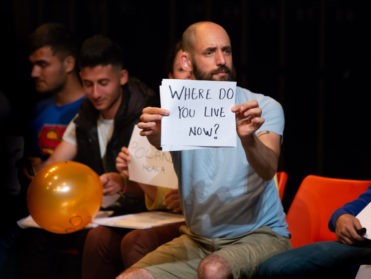
 “Quarantine and National Theatre Wales' new collaborative show English is an encounter more than a play, the audience sat in a large square, engaging in a wider conversation. Words and phrases are looped on a screen from A to Z, prompting conversations on subjects as diverse as apples and de-colonisation. “Performer Jonny Cotsen is hugely engaging as our host and performer, and the show comes to life when he’s in full storytelling mode. Cotsen is profoundly deaf and so his relationship with the English language is different to most in the room: an exploration of the word “empathy” was especially moving. Audience engagement is required throughout, however, and, sadly, the conversation occasionally fell flat until Cotsen came to the rescue. “Disturbingly, for two companies so committed to community, director Richard Gregory and team ignore its Welsh location. Playing in Wales, the word English has very different connotations than it would in, say, Manchester or London, and no attention is paid to Wales’ bilingualism and own unique culture. “In fact, the non-UK citizens in the room would have gone away assuming Wales was a county in England. The choice of words (afternoon tea, cricket, “ee by gum”) reflected only English values, with Welsh and Anglo-Welsh vernacular utterly ignored. This would be irritating were it an English company presenting in Cardiff, but for National Theatre Wales to be seemingly unaware of the nation it represents is unforgivable.)” Abridged from the full review which can be read at: Source: https://www.thestage.co.uk/reviews/2018/english-review-dance-house-wales-millennium-centre-cardiff/ * * * * Wales Arts Review was there: “English takes language, in its many forms, and dissects its very foundations. The provocative production, a collaboration between National Theatre Wales, Quarantine and Wales Millennium Centre, encourages its audience to open up into a conversation about language from a global perspective, along with the barriers and limitations it presents. “Through an A-Z of carefully selected words, Cardiff-based performer Jonny Cotsen, pauses where he feels appropriate, using words as a catalyst to tell his own stories of life as a deaf man, and leaves space for the audience to share their own experiences. “This innovative, improvisational approach means that each performance has room to stray off course. To some degree, the direction the conversation will take is in the hands of the audience. “The production uses conversations with migrants about their experiences when learning the English language as a source of inspiration, this is evident in the lexical choices made when compiling the alphabet. “We see words that are heavily loaded with the difficulties and injustices that migrants face, alongside playful, humorous words that derive from British culture. Jonny invites us to explore the global dominance of the English language, and the privilege that comes with being a native English speaker. “It is Jonny’s open nature and vulnerability that makes English such an intimate and thought-provoking experience. His performance feels natural and effortless, making the audience feel at ease and more likely to engage. He opens up about the challenges that language presents to him, and his methods of overcoming these challenges. “Although some parts of the production are scripted, Jonny admits that some are also entirely improvised by himself. This makes his performance even more impressive and authentic, even brave, as every performance has the potential to be completely different from the previous. “English is a lively, interactive experience for its audience, an element that could be both its greatest success and flaw. We are encouraged to delve into ourselves and explore what language is to us, share our associations and stories in contribution, and question its influences on our interactions with those around us. This is successful in that it creates a sense of community between those involved, there is beauty in what is shared here. “Empathy is a major element to the production, as we see what it’s like to have self-expression obstructed by the barriers of language, experience the frustration of these limitations for ourselves. “English is an important conversation that feels like it should never end, there is much more to be picked apart than can fit into 90 minutes of performance, you leave the room wanting more, to go back the next day and pick up where you left off.” Abridged from the full review which can be read at: https://www.walesartsreview.org/fov-national-theatre-wales-english/ * * * * The Arts Desk was there: “An apt subject for its audience, judging by the conversations flowing as we waited in the forgivable summer dusk. There’s a curiosity on the show’s content, with vague promises on building a contemporary Babel. English is a co-production between National Theatre Wales and Manchester-based Quarantine, a renowned innovative theatre group, so there were clear expectations from attendees. “As the doors opened and we made our way into the Millennium Centre’s Dance House, tonight’s Babel was revealed. Seating on four sides, with two big screens at either end; in the centre of the room, a collection of props left haphazardly, including a small potted tree, uninflated balloons, and a curiously big box. Our host for the evening, Jonny Cotsen, held conversations with some as they sat down. “Once settled, Jonny explained the concept for the show: as a profoundly deaf man, he has always had a unique perspective on the liberties afforded to those who can talk without issue. Being able to speak English in the UK is a privilege, unrestricted from expressing yourself and learning from others. 350 English phrases had been gathered and would be slowly projected on the screens; if they stirred a reaction, you could raise your hand and we would discuss it. “It’s high concept, and unfortunately, that most British of drawbacks - public shyness - held back much of the first half. Without it clearly explained that anyone could pause the screen, not just Jonny, and without adequate icebreaking, awkward silences were commonplace (ironically, “awkward silences” was one of the topics no-one jumped in on). “It was left to Jonny to anchor the show, and as a raconteur, he is magnetically fascinating. He’s warm and witty, with a lifetime of experiences and contemplations. A childhood of therapy taught him the mechanics of speech, but admits he still feels uncomfortable vocalising his thoughts. Indeed, it is his fear of not being understood, and the unusual pronunciation of some phrases, that succinctly demonstrate the luck of being confident in the language around you. “Certain phrases drew random thoughts, while others had planned routines, some of which were supremely effective. In particular, for “Empathy”, Jonny began handing out balloons to the audience, asking them to blow them up while he described his family tree in great detail. Distractions soon built up, as pumping music and balloon squeaks increased over Jonny’s voice, until it was impossible to stay engaged. When it finally stopped, Jonny was left trying to communicate by only mouthing words. A room full of people, all isolated and unable to converse. “Jonny later asked questions via pen and pad, of which everyone responded on their own. “Where are you from?”, “Where was your great great grandfather from”, “Where is home?”. This mass exchange brought some wonderful, inventive responses, with a special mention to the people who claimed their second languages were “dancing” and “Die Hard quotes”. The audience was finally comfortable in their role, and from here the conversation flowed from person to person – thoughts on language, debates on Spanish grammar, questions about foil.” “Abridged from the full review which can be read at: https://www.theartsdesk.com/theatre/english-festival-voice-wales-millennium-centre-review-%E2%80%93-lost-language Photo: Toby Farrow |
Reviewed by: Adam Somerset |
This review has been read 302 times There are 95 other reviews of productions with this title in our database:
|
