| A Guide and Look-back |
At Volcano Theatre |
| Volcano , Theatre of Wales , June 3, 2024 |
 The reviews of productions by Volcano can be read below:
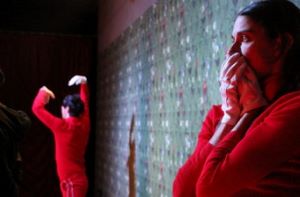
"147 Questions About Love": 07 August 2014 “147 Questions about Love” is a piece about intimacy. It does what it is. The lights are undimmed and the audience sits on stage in an ad hoc grouping on stools and cushions. The two performers are a few feet distant. The opening tableau has them pulling on a long piece of string that holds an apple. The performance without lighting or sound makes for a heightened sensory awareness. The crunch of teeth on an apple acquires a ringing volume in this context of quietness. “Paul Davies poses the questions, plenty of them, not necessarily about love. His first is about relationship, whether a pre-emptive apology might be wise, to prepare for future wrongs that have not yet been done. The tone is relaxed and speculative, the brow furrowing on occasion in quizzical consideration. Catherine Bennett is silent. She moves and flexes elastically, drops to the floor to become an owl of the rare group that burrows to make its nest. In time she too comes up with her own questions.” "At Home for the Weekend": November 19, 2005 “An ordinary three-storey house round the corner from Chapter Arts Centre in Canton has become the scene of some of the most interesting performance work in Cardiff, whether as the venue for a set of plays enacted in different rooms, part of an autobiographical exploration, a set of installations or a collection of dramas based on each part of the building. Now it is a kind of make-believe anthropological museum, around which we are taken as on an audio guided tour by the ever-surprising Volcano Theatre in collaboration with film-maker John Hardwick – not that this is, of course, an ordinary tour or an ordinary house.” "Destination": 20 October 2001: 29 September 2001 “Many of Brenhard's plays are ironic accounts about the safeguarding of an endangered order, about an alleged state of emergency which justifies any action for its preservation. Bernhard's thematisation of controlling relationships links real biographical experiences with a general insight into the structure of power over oneself and others…Although the three characters in DESTINATION are all imbued with specific details from Bernard's life his own ability to see his own history as meta-history allows the mother to be recognized as the war time Austrian state, the invited writer as the Austrian Anschluss (the voluntary merging of Austria with Nazi Germany) and the daughter as the Austrian nation.. “The play is directed by Kathryn Hunter. It's great to have her working in Wales.” "A Few Little Drops": 11 June 2007 “This is a celebration - incorporating live performance, video and sound installations - which revolves around the most precious resource on Earth: namely, water. “Produced in association with Swansea's Taliesin Arts Centre and performed on a purpose-built set in the open air courtyard of the National Waterfront Museum, this has to rate as Volcano Theatre Company's most successful production to date. The work takes the audience on a journey through a flood-ravaged house - once a family home but now a semi-derelict testimony to the power of water - and onwards to an outdoor expanse of water and a giant inflatable "wave". By now you will have gathered that this is a "promenade" performance, the twist being that one is free to wander, to retrace one's steps, to stop and stare or walk away.” "Hamletmaschine": 21 November 2019 “The two hours of the peripatetic production comprises three exits on to the High Street, a walk up the side passage and three entries via the rear, the former supermarket loading bay. En route the first time, a short introduction is given about the time of the play. In 1979 the Wall stands, Ulrike Meinhof and her collaborators are dead. The loading bay is lit in red, the carpet is red, and the four actors are in red tracksuits, tops and scarves. Gloves and trainers are in pristine white. A table holds four hundred red cola cans. Cola, and Mercedes, were the twin icons of consumerism of the era. Billy Wilder, in the year that the Wall went up, bizarrely made a Cold War comedy. Cagney in the lead of “One, Two, Three” played a soft drink executive.” "Hitting Funny": 29 April 2005 “Now they have a one-man show about stand-up comedy, which I suspect most critics will love and some audiences at least will hate – at a recent gig there were 35 walk-outs. To call Hitting Funny a show about stand-up comedy barely hints at what Philip Ralph achieves in 75 minutes or so of non-stop monologue. Basically it’s a lament for the power of the comic as political subversive – but that’s just for starters.” “Ralph asks uncomfortable, difficult questions in a play (and, we have to remind ourselves, that’s what it is) that is intelligent, startling and one of the best things Volcano has produced. His performance, under Paul Davies’s direction, is superb as he manages to be both a wildly anarchically funny stand-up comic and offer a critique of contemporary comedy. Brilliant.” "i-Witness": 21 December 2008 “The Rings of Saturn contains a powerful and moving account of the author’s collapse following his walk down the Suffolk coast. Reading like reality this passage is complete fiction. i-witness contains a playful account by Fern Smith of her re-tracing that walk, complete with amateurish black and white photos and delivered as though it was an enthusiastic talk to her local WI. Feeling like a parody this is in fact a true account of a real walk with her real photographs. Does it affect their validity if you take the one as reality and the other one as fiction? How in fact should we react to an erudite book that plays with our notions of reality? Should the different reactions we may have affect the book itself, or our ideas about other books, or other people’s reactions to the book in question?” "Macbeth, The Director's Cut": 01 October 2000: 18 October 2016 “'Macbeth: Director’s Cut’ is full of sound and fury: what does it signify? Volcano Theatre’s production is also full of smoke, image, and chaos. It does indeed cut to the chase, and takes us selectively through the Scottish play on a road paved solely with the crime of Macbeth, his Lady’s complicity, and their descent into madness. If Macbeth has murdered sleep, then this is the ensuing nightmare.” "Moments of Madness": 04 June 2000 “Volcano Theatre Company is well-named. Its productions are eruptions. In Moments of Madness this Swansea-based troupe claims Ron Davies's excursion onto Clapham Common as the inspiration for a state-of-the-nation piece - the Welsh nation, that is. “Five limber performers somersault, sing and soliloquise their way through episodes which begin with a satire on conference life and end in a bloody mutiny. They do so in a gleaming steel gym, shaped to resemble the hold of a ship, punctured by hatches and flaps which regularly, clangingly, shoot open to provide perches for characters, ledges for dotty objects - a pram, a rocking-horse, a plastic doll. But you'd have to be Merlin to follow the lava-like flow of consciousness here, or to work out, without recourse to a programme, that the show has been prompted by Ron Davies, whose interesting mysteries are neglected.” "The Most Excellent and Lamentable Tragedy of Romeo and Juliet": 22 October 2004: October 23, 2004 “Which is why the full title of show is The Most Excellent and Lamentable Tragedy of Romeo and Juliet (as so described originally) – with the names crossed out. This, then, is not about Romeo and Juliet, and indeed there is not a whit of elucidation of the original play, but about a group of people who at times appropriate Shakespeare’s words. “One of the many problems I have with this production, co-directed by Paul Davies and Fern Smith, is that it seems to be premised on the post-structuralist comments of a Swansea academic and a throwaway line from a superficial London theatre critic, both quoted as asserting that the world has been terribly mistaken for the last 400 years in its responses to the Romeo and Juliet.” "After the Orgy": 01 July 1998 “Volcano Theatre Company toured an earlier version of After the Orgy in 1994. This version is sharper, with an almost wholly different text. This is a show (rather than a play) that addresses the empty postmodern world through text, technology and spectacle.” “The heart of the show was an exploration of the voyeur, passively consuming and exploiting spectacle. This explains the controversial porn video which played throughout much of the show on a small television set, suspended, like Carrascoso, above the stage. It also explains the camera-rape of Lyon (its farcical replay making clear its reference to Peeping Tom). This incident was the most (only) disturbing part of the show, the audience drawing into easy identification with familiar territory, only to be wrong-footed into recognising their complicity in the exploitative values of the spectacular world.” "The Populars": 17 August 2019 “One of four frenetic dancers stops briefly to grab an audience member's hands, look them square in the eyes and say: 'Are you ready?' They're not given time to answer before their hands are flung across the dancer's sweaty face, onto his stubbly, sweaty neck and down onto his soaked chest. They're thrust aside before they can process what's happened. “The Populars manages to gather its audience of standoffish Brits into all sorts of random interaction with strangers, and best is that its actors don't make interactive moments feel contrived or like forced fun. To get a prudish audience to engage with one another is a great thing by all accounts, and Davies' show certainly has limitless energy.” "Private Lives": 01 April 2001: 26 April 2001: 31 March 2001 “Only four people walked out as knickers were removed, the young heroine tap-danced desperately and two men in underpants fought each other carrying easy chairs to the sounds of Led Zeppelin as a sedate story of two sets of lovers degenerated into chaos. “It also marks the impressive professional debut of Laura Rees, still a student at the Welsh College of Music and Drama, whose inspired performance alongside Eric MacLennan and core Volcano members Fern Smith and Paul Davies is simply a knock-out.” "Seagulls": 13 August 2017: 24 April 2015 “In Seagulls, visuals are everything. And the visuals are absolutely breathtaking. Combined with the text, it raises the question, ‘is the look and the feel more important than the content within a piece of theatre?’ No firm conclusions are reached. “Much of the action takes place beside a lake which forms a fully actualised part of the set, complete with an impressive quantity of water. Huge amounts of credit have to be given to Camilla Clarke, the set designer. Halfway through the performance the seating is switched from traverse to end on as a curtain is pulled back and the stunning design of the lake embedded in an old pulpit is revealed.” “Shelf Life": 2 May 2010 “The production’s theme of multiplying disjunctions is established from the start. The audience is free to wander the courtyard. A book of the finest French rococo art is left apparently casually on a step- in fact a technician is anxious lest I take its one pound price tag for real and make off with it. One side of the courtyard is clean and modern, the other a view of blistered paint, ivy-strewn discoloured brickwork and rusty pipes. High on the rim of the dome a crop-haired actor sits reading a book. “There is a centrifugal quality to the production. While never less than novel and unexpected it has a playfulness and elusiveness to it. But that elusiveness is the point. The demise of the library is an intellectual inheritance that is crumbling. Right from the start the performers have to cope with the intrusions of reality. It is not just the ambient noise of the evening Swansea traffic and the chime of a public clock; their voices are drowned out by police sirens and loud shouts of abuse from a passer-by.” "Talk Sex Show": 26 September 2002 “The kind of curious litany detailing the choice of crisp flavour offered in the post-modern world, delivered at the end of the play by The Man (Eric Maclennan), sitting with his nine inch comfy cloth stuck on penis hanging benignly and The Woman (Rachel Harrison) with her stuck on Durer-like paper pudenda – who, incidentally perform their sexual tableaux with a balletic verve – seems to herald the return of reason to a world turned upside down for an hour: where sexual practice is a Master of the means rather than a means to master.” "This Imaginary Woman" : 14 March 2003: 14 March 2003: 13 March 2003 “Certainly she is very brave in taking such a close, personal and moving experience as the death of her own mother as the starting point for this poetic work. In words and song with crashing accompaniment from Patrick Fitzgerald she describes her frustration with the progress of the illness, a long drawn out period of Multiple Sclerosis, (“I grieved for her before she died”) her anger and her grief.” "The Town That Went Mad" : 01 January 1998 “The debate about why Wales is a leader in the world of international contemporary theatre could and will echo around forever. What is indisputable is that it is. One company at the cutting edge is the Swansea- based Volcano Theatre. Its current tour is The Town That Went Mad. This was originally Dylan Thomas's Under Milk Wood and under that name received rave reviews. The company took Thomas's now somewhat limp prose and violently shook it back to life. Then the purists got upset and performance rights were blocked. “Undeterred, Volcano continued with the theme but withdrew the 'great man's' words, leaving a powerful dramatology of people inhabiting a world gone mad: and considering the furore, a refection which Thomas himself would have appreciated. Volcano has performed as much abroad as at home - if not more so. Last year it went to South America, Canada, Cermany, Norway, and two East European countries. This was on its own initiative.” "Unfinished Business": 23 August 23 2002 “What's offered here are threads to make a tapestry – it’s for you to do the sewing. If you feel lost, bemused by the clutter of living, wondering whether there’s any sense to be made of it then there’s the sketch made as you watch by The Artist (Maria Hayes) of a skeleton in black charcoal laid out beside a seemingly redundant coffin.” "Unknown Pleasures: Threshold" 04 June 2008 “Interdisciplinary performance artist Marc Rees is a man who can see beauty in the minutiae of movement, to the extent where he is able to transform the smallest gestures and details into something extraordinary. “Though billed as a piece inspired by the history of Swansea's Palace Theatre, this was in truth an exploration of just one period in its history: namely, the early 1980s, when it was a gay nightclub called Jingles. Rees - joined here by Wendy Houstoun, John Rowley, Stephen Donnelly and Rachel Walsh - explored the experiences of a young lad coming to terms with his own sexuality, and while it was something of a slow burn it has to be said that the work was conceived and performed with real intelligence and wit.” |
Reviewed by: Adam Somerset |
This review has been read 249 times There are 31 other reviews of productions with this title in our database:
|
