| A Look-back and Guide |
At Music Theatre Wales |
| Music Theatre Wales , Theatre of Wales , May 3, 2024 |
 05 March 2020: “Denis and Katya”
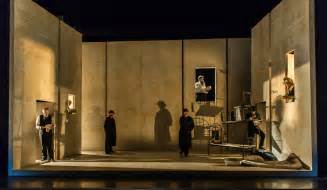
“Music Theatre Wales' “Denis and Katya” is first and foremost a blast of modernity, a report from today. That it is consummately sung and directed is as to be expected from the company. The point about having some art in the public domain is that it furnish a richness of ecology. Music Theatre Wales is one of the companies, like Ballet Cymru at Sadlers Wells and RWCMD at the Gate, where artistry of Wales is showcased beyond Wales. So too, in regular fashion, “Denis and Katya” heads for London's South Bank.” “The real events played out in a cabin in Strugi Krasnye, a town beyond Pskov. The family background of the teenage woman was harsh. The acts themselves were relatively minor, a small wounding, a few public shots, a television destroyed and thrown out onto the snow. The situation escalates with Spetsnaz forces surrounding. The difference is that it was streamed by the protagonists. Depersonalisation and anonymity run hand in hand. It is not long before an onlooker is commenting:“They should kill themselves.” 28 October 2018 “Passion” “In this collaboration between Music Theatre Wales and National Dance Company Wales, the story’s mythic narrative is dismantled. Orpheus and Eurydice are renamed simply Him and Her, and the work refashions their final colloquy on the borderline between life and death as a meditation on the idea of passion itself as an expression both of desire and suffering. The score engages in a dialogue with baroque tradition. A harpsichord underpins Dusapin’s quietly dissonant textures, while an offstage group of vocalists comments, like a madrigal consort, on the emotions at the work’s centre.” 18 October 2014, 29 October 2014 “The Trial” “Director, and designer Simon Banham, create a production with a look that is not strictly historical but emblematic of the galvanic shifts behind Kafka’s life. The older members of authority come with garters and braces, fob chains and frock-length coats. The thick beards are reminder that, in Stefan Zweig’s telling of the last days of the Austro-Hungarian polity, age was venerated and young men would grow beards to emulate years far beyond their actual age. Philip Glass’ attraction to “the Trial” was his seeing in Kafka a natural dramatist. It is a dialectic of individual versus state. K, a banking manager of high status, wears in contrast a close-cut, tightly buttoned jacket with high lapels. When he loses it- his physical stripping following his metaphysical stripping- a trio of giggling faces watch and sing to the fact.” “The omnipresence of observers is achieved by the set enclosing hidden doors and windows. Kafka’s plot is followed by Glass and Hampton in close detail and fields a host of characters, high and low, from a society where social structuring underpinned all interaction. The two inspectors who first interrupt K’s morning are revealed to have pay so low that the pilfering of underwear is perforce a norm of the job. Kafka’s life over an age of total change is indicated in his furniture. Bed and chairs of metal are of a pencil-thin modernity, a nod to the revolutionary work of the young Marcel Breuer just a handful of years away.” 04 October 2013: “Greek” “Based on Steven Berkoff’s 1980s reworking of the Oedipus story – a son unknowingly kills his father, marries his mother, and rips out his eyes when he realises what he has done – Greek is rooted in the author’s loathing of what he saw as the morale quagmire of the Thatcher era. Yet the themes of individual alienation within a broken society are sufficiently timeless that the transposition holds true today. “Yes, the language is foul-mouthed, the imagery brutal, the politics ugly and disturbing. But that is the intention and nothing is gratuitous. The audience clearly embraced it all giving an enthusiastic response to the rock solid performances and conductor Michael Rafferty’s handling of Mark-Anthony Turnage’s blazing score with its multifaceted melding of styles from Vaudeville to Weill, via jazz and soccer chants.” 18 April 2013: “Eight Songs for a Mad King/ Ping” “Michael McCarthy and Michael Rafferty, joint artistic directors, have had as good a recent period as any in Music Theatre Wales’ twenty-five year history. A new award, a July premiere at the Buxton Festival, and a new tour for “Greek”, that takes in Covent Garden, are all part of a busy 2013 alongside this emotive, physical double bill. “The score calls for squeaks, wails and whoops with vaulting jolts from bass to falsetto. But there is a persistent sad humanity that is ever-present. Dementias of many ilks have the ability to strip the consciousness of an adult back to its condition of childhood. Kelvin Thomas has a wide-eyed innocence to accompany his line “I mean no harm.” The terrible restlessness that may be the accompaniment to mental distress finds expression in “I am weary of this fate.” It is a record of a human in extraordinary circumstance that never forswears humanity.” 21 October 2010: “The Penal Colony” “One is used to praising the performance above the thing performed, and this is the case with Michael McCarthy's direction, Michael Rafferty's conducting and the powerful portrayals of Michael Bennett (Visitor), Omar Ebrahim (Officer) and Gerald Tyler (Condemned Man). They keep Music Theatre Wales’s huge reputation hoisted but, by default, show up Glass’s shortcomings as a composer-dramatist.” 08 December 2007, 27 July 2007: “Julie” “Belgian composer Philippe Boesmans has tackled a great, doughty monument of a drama, Strindberg’s “Miss Julie”. Music Theatre Wales’ touring production follows on from 2005 premieres in Vienna and Aix-en-Provence and under director Michael McCarthy and conductor Michael Rafferty it makes for a crisp, interval-less hour and a quarter that offers many pleasures. “The original play is theatre’s first representation of what was to be classified as manic depression a dozen years later by Kraepelin. This production moves the setting forward by thirty years and there is small sense of the social chasm between mistress Julie and valet Jean. In her scarlet, shoulder-less dress Arlene Rolph’s seductive Julie is less a possible cousin to Hedda Gabler than a fellow party-goer of Wedekind’s and Berg’s Lulu”. 20 May 2006: “House of the Gods” “The title is a bit of a giveaway but you really do need to know your mythology to make much sense of Martin Riley’s libretto, mythology that comes from the Bible as well as Irish-Celtic sources. “On the other hand it is quite possible to enjoy this gothic romp for its craziness, its sexiness and its free-ranging music from Lynne Plowman, the South Wales-based composer whose earlier collaboration with Music Theatre Wales and Martin Riley, Gwyneth and the Green Knight, was such a success.” 11 May 2005: “The Knot Garden” “Music Theatre Wales has continued its association the Royal Opera’s ROH2 project to bring the opera to life with a chamber and bold new Michael McCarthy approach in its Linbury Studio and then on tour reaching Wales in July. There is a powerful seven-strong cast including singers now well-established with Music Theatre Wales including the fine character singer actor Jeremy Huw Williams and others such as the excellent Helen Field who have distinguished careers elsewhere. “They are a close working ensemble who fairly belt out Tippett’s message – whatever that might be – and at times struggle a little over Michael Rafferty’s enthusiastic MTW players, using Meirion Bowen’s chamber score, and the at times erratic nature of that libretto and music. I am sure the percussionists stand fell over at one stage but I am equally convinced some of the audience didn’t notice the clatter.” 31 October 2004, 12 October 2004: “The Piano Tuner” “This new opera by Nigel Osborne and Amanda Holden is based on the best-selling novel of the same name by Daniel Mason and it does capture some of the flavour of the work as it rattles through the plot. This co-commission, between the Royal Opera House and its associate company Music Theatre Wales, is set in the times of Burmese colonial wars of the 1880s. Powerfully sung if a little too much of the wide-eyed naïve innocent by Giles Davies, the piano tuner Edgar Drake is sent by the army to travel to a Burmese outpost to repair an Erard grand piano. “The secret jungle outpost is run by Dr Anthony Carroll, richly sung by Steven Gallop who manages to convey some of the intrigue and depth of this maverick character. Carroll runs a fortified hospital in the jungle and is supposed to be subjugating the princes of the Shan provinces and suppressing bandits using the unconventional power of Bach and Schubert – thus the piano.” 02 November 2003, 31 October 2003 “Ion” Param Vir's supremely lucid and musically appealing Ion has been a long time in the making. The indefatigable Michael Rafferty - music director of the astonishingly versatile Music Theatre Wales responsible for this show - seems seamlessly to have moved from one band to another. Euripides' Ion makes a great operatic book. Vir came across it in translation by David Lan - known for his prize-winning TV drama documentaries and work with the RSC - and it was with him that he worked on clarifying the text and adapting it to musical form.” 22 July 2003, 16 April 2002: “Gwyneth and the Green Knight” “Newly commissioned from Lynne Plowman this is one of the nattiest new British operas in years. Plowman belongs with Judith Weir, Sally Beamish and the brilliant women composers' band whose achievements makes patronising redundant. Gwyneth is a societally incorrect, besmocked peasant wench who yearns to join King Arthur's Round Table. Disguised as a feller, she gets hired as Sir Gawain's squire and proves a far better bet than him. Enlisting the aid of the intermittently headless Green Knight and the ghastly boy Mordred, she routs Morgan le Fay and wins her fiefdom from the grimacing, knock-kneed Arthur (Richard Suart). “Plowman's brilliantly illustrative music – pointillist brass, bristling strings, quizzical percussion, mocking pizzicati – never falters. Add Martin Riley's pithily funny rhymed libretto and you have another Knussen's Where the Wild Things Are.” 23 October 2001, 03 July 2001: The Lighthouse” “Peter Maxwell Davies's The Lighthouse has so many points of contact with Benjamin Britten that it could be read as an open tribute. Like Peter Grimes, it begins with a court of enquiry, and is saturated with the sounds of the sea. “His music tackles frustration, violence and mounting terror very well, and that The Lighthouse contains some of his finest sullen, brooding seascapes. All of that came over well in this performance by Music Theatre Wales, conducted by Michael Rafferty. “The keepers' three big parody songs are clever, funny, even touching. They are also a neat way to smuggle in arias by the back door. Michael Bennett (Sandy) and Gwion Thomas (Blazes) performed their set pieces particularly well: Bennett's well controlled singing made his sentimental love song achingly sad; Thomas's tale of murder, theft and fatal deception was corrosively funny and horrific at the same time.” 16 November 2000, 09 July 2000, 04 July 2000 “Jane Eyre” “The opera investigates the relationship between Rochester and Jane, as well as the terrible secret of Rochester's wife, locked away in the attic. In Music Theatre Wales's production, Mrs Rochester is onstage almost throughout the opera; laughing, cackling and cursing from an upstairs window. Her character is the most significant of Malouf and Berkeley's changes from Brontë. By giving Mrs Rochester so important a voice, they turn her into a sympathetic figure. Jane and Rochester's love has to be even more powerful than it is in the novel if they are to overcome Mrs Rochester's influence. “Berkeley's music embodies an unrelenting sense of entrapment. Based around the most unstable musical interval, the tritone, every character's music is in the hands of an ominous chromatic grip. When Rochester and Jane agree to marry at the end of the first act, they cannot escape the dissonance that threatens to strip away their happiness. Mrs Rochester's music is even more obviously enslaved by this. And when Adèle dances and fondly remembers Paris, there is a suggestive undercurrent.” 18 July 1999 “Rape of Lucretia” “Music Theatre Wales made a compelling case for it with their new staging last week in Cheltenham. Following their tradition of bold, compact interpretations of chamber operas MTW has devised a stern, minimal production, with an open-box backdrop, three raised openings and a chaise longue. Michael McCarthy's production, like Simon Banham's designs, underlined the claustrophobic menace that tramples on domestic ease. Peter Hoare and Tamsin Dives as the Male and Female Chorus are no cool observers but shockingly involved. Hoare, especially, made every word audible while Dives invested all with fierce emotional realism. Kathryn Turpin as Lucretia, in a role first played by Kathleen Ferrier, had warmth and dignity, with Jeremy Huw Williams a properly lascivious and foxy Tarquinius. The on-stage players excelled, engaging with the demands of the score, now sensual, now hieratic, firmly guided by the conductor Michael Rafferty. See it in Buxton this week, or on the autumn national tour.” Picture: The Trial |
Reviewed by: Adam Somerset |
This review has been read 227 times There are 24 other reviews of productions with this title in our database:
|
