| “Exciting Repertoire, Premiere of “Folk” |
National Dance Company Wales |
| Folk, Tuplet, They Seek to Find the Happiness They Seem, Walking Mad , Culture of Wales , September 30, 2016 |
 Seeing Dance was there:
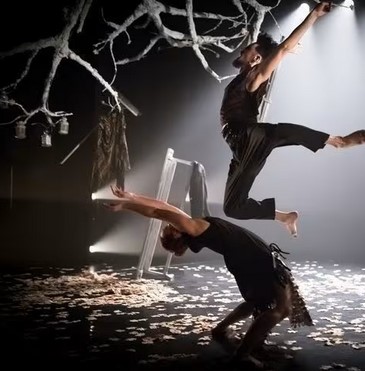
 “Tuplet takes a sideways look at rhythm, audible and visible, tossing in a few surprises and some humour along with way. Among the sections are one where we see the line-up of six dancers responding with specific movement to the calling of their names. It’s a really simple idea but done cleverly. The more it goes on, the more complex (names start to repeat and the order gets all mixed up) and better it gets, the dancers showing great sharpness and split second timing. Best, though, is a dance to a recorded explanation of what rhythm is, or could be, or might be. And “what would life be without rhythm?” as it asks. Great fun and a great start to the evening. “In Lee Johnston’s They Seek to Find the Happiness They Seem, we see Matteo Marfoglia and Elena Thomas at first gently dance together, but the way they deliberately avoid eye contact suggests there a few problems with the relationship. There the same lack of communication is kept when they later dance in perfect unison, Johnston creating some excellent patterns as he/she makes great use of the space. Even when they finally turn to one another, and as the light go down, the distance remains. “There’s nowt so queer as folk” as the saying goes, and the characters in artistic director Caroline Finn’s Folk do sometimes behave in some strange and very idiosyncratic ways, even if there is always the sense that they are a very close-knit community. “The opening picture is one of several striking images that Finn creates. The dancers are mostly gathered around a table, a bit like a very old family photograph. Their costumes, a little bit shabby, mostly muted greys and greens, all old-fashioned shifts and cowls, make it look like we’ve suddenly dropped in on some surreal fantasy world, a feeling that’s helped along enormously by designer Joe Fletcher’s gorgeous upside-down tree that hangs over the stage, a pile of deal leaves beneath. “As Folk progresses, Finn treats us to a series of dances, many of which developed from individual dancer explorations of their particular character. Movement conversations appear and disappear. Mood and movement vocabulary shift all the time, from gorgeous very physical duets to languid Hofesh Shechter-like group shuffling and more. You never know quite what is coming next. Best are the scenes where everyone comes together, or where everyone else stops for a particular couple or trio, especially that to music by Mkis Theodorakis (the music is as varied as the dance). “Folk ends with the sort of self-absorbed, near-beatboxing playing with rhythms that we saw in Tuplet. It creates a nice circle to the evening, although it has to be said that Ekman does it with rather more style.” Abridged, with thanks and acknowledgement, from the full review which can be read at: https://www.seeingdance.com/nat-dance-co-wales-folk-26092016/ * * * * The British Theatre Guide was there: “The evening begins strikingly, with a young man in a trilby descending the steps of the auditorium, making his way onto the stage and appearing to lift the curtain, revealing a bare performance space which is soon occupied by the broad fence which dominates the set. This is Walking Mad, for which Inger is designer as well as choreographer. “Sound-tracked by Ravel’s Bolero, we witness a love duet which appears to paint a troubled picture. The following segments involve the ensemble as a whole, nine dancers in total (six male, three female); one involving a laddish group in party hats seeming to pursue selected females; another with a woman framed in shadow (very effective lighting design by Erik Berglund) who dances solo, in near silence, before being intruded upon by one man, then another. “The fence, with its various openings, is often employed humorously, but sometimes portends doom. The Bolero phase of the piece ends with a celebratory moment involving the whole company. This is suffixed by another darkly beautiful love duet, seeming to end in isolation, danced to Arvo Part’s poignant Für Alina. “Following the first interval, Tuplet begins with video back-projections showing a babbling mouth and a toned stomach. A lone female performer dances by herself as the stage crew assembles the minimal set, which consists of six square, plastic mats. She is then joined by five others, in waistcoats and denim-style trousers (costumes designed by Nancy Haeyung Bae), for a series of vignettes, each separated by a blackout. “In one segment, a man dances to an audio description of his dancing; in another, each performer remains in his or her square, and moves only when his/her character name is called out. The soundtrack is largely electronic, comprising percussion and treated voices. “For the most part, the theme seems to be isolation, although there is interaction during a segment which is sound-tracked by a light-hearted conversation about the concept of “rhythm”. Towards the end, the back-projection shows vintage jazz musicians; the score is complementary and the tone seems lighter. It was this piece that I found most diverting, even without a coherent narrative—it was also the portion of the show which was shown to an audience of doubtless bemused schoolchildren earlier in the day. “Following another welcome interval, Folk begins with a figure apparently sweeping up leaves, beneath the roots of a tree which seems to be suspended mid-air, before joining his fellow performers in a nearby cluster as they begin, tentatively, to fully inhabit the space. “Finn describes her piece in terms of an exploration of group dynamics, and her dancers do tend to move in unison, those who break away—in one instance, jabbering incoherently—seem to both drawn back to the group and possibly punished for their independence. The music score starts out in easy listening Mantovani mode, slowly growing more challenging, taking in folk (complementing the rural theme set by Joe Fletcher’s set and Gabriella Slade’s costumes) and the serialism of Armand Amar, before it all ends on a somewhat downbeat note. “... moments of great beauty. The themes seemed universal: love, lust, abandonment, loneliness, difference, identity. The ensemble (Josef Perou, Camille Giraudeau, Matteo Marfoglia, Mathieu Geffré, Àngela Boix Duran, Elena Thomas, David Pallant and Chris Scott with apprentice dancers Josie Sinnadurai and Ed Myhill) are all great individual talents, but all of the choreographers seem to focus on dance as a collective rather than an individual means of expression.” Abridged, with thanks and acknowledgement, from the full review which can be read at: https://www.britishtheatreguide.info/reviews/folk-sherman-cymru-12579 * * * * Buzz Magazine was there: “The National Dance Company of Wales is currently touring with an engaging and exciting repertoire, focusing on a premiere of their newest work Folk. “Folk is a music box of dystopian delights presented with the detailed finesse of a Wes Anderson film. In her first work for the National Dance Company of Wales, Artistic Director Caroline Finn creates a community of misfits inspired by characters from 18th century paintings. Overhanging the whole work (in a literal sense) is an inverted tree that has shed its leaves. The pile of leaves, and muted colours of the scenography imply a moment of stasis in which autumn has not quite become winter. The costumes also reference a suspension of time; opulent materials moving towards a moment of decay. Are we observing the decaying minds of courtiers who have lost their position? “More than one dancer engages in physical and verbal conversations with themselves and the group; inarticulate expressions rather than mad mutterings. Time, purpose, and mood shift quickly within the work, from languid duets to trance like shuffles around the stage. At times atmosphere changes too quickly and I am left wishing the work was longer than its 25 minutes duration. However these small questions are brushed aside by the committed performances of the dancers who have a clear investment in the work and its implied narrative of kinship.” Abridged, with thanks and acknowledgement, from the full review which can be read at: https://www.buzzmag.co.uk/21497/ |
Reviewed by: Adam Somerset |
This review has been read 52 times There are 15 other reviews of productions with this title in our database:
|
