| A Remarkable Life in a Remarkable Time |
Theatre History |
| Angela V John- Behind the Scenes: the Dramatic Lives of Philip Burton , Parthian Books , March 2, 2026 |
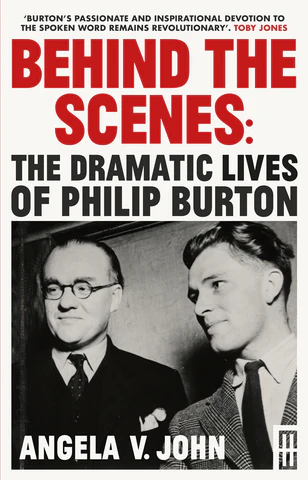 Philip Burton, 1904-1995, had a life of breadth spread across Wales and the United States. He was variously a teacher, dramatist, broadcaster, performer, lecturer, mentor and novelist.
 Angela V John's book should be read in conjunction with her prior book on the performing arts of South Wales “The Actors Crucible.” Her biography of Philip Burton is not just a record of a creative talent; it makes for an illuminating window into a South Wales of a particular time of a considerable cultural abundance. In his home area of Aberdare and Mountain Ash sixty percent of the men over the age of ten were employed in mining. It was a community suffused with culture, by oratorios by Handel, by debating groups, by choirs and by drama competitions. Others have left their testimonies about the era. Siân Phillips wrote in her autobiography “Like most Welsh children I was expected to sing in public.” When it came to her first solo her father taught her the words phonetically. It was in English which no-one spoke. Of the profusion of actors she recalled that “A lot of character actors had other jobs. An awful lot of Welsh solicitors had equity cards.” Joseph Keating, also from Mountain Ash, studied Euclid, French grammar, went on to write eleven novels, short stories and an autobiography. A play of his was performed in the West End and he stood for Parliament. The youthful Philip Burton had access to two theatres, one with a capacity of 2500. In them he devoured Shakespeare, opera, Gilbert and Sullivan. His first notable appearance on stage was as Othello. He won the silver cup for Best Actor at a drama competition in Pembrey. His teaching life was suffused with drama and Shakespeare in particular. On 10th October 1934 he took to the stage in a role of his own writing. The location was the New Hall in Aberafan where he played the role of family patriarch Edward Granton in “Granton Street”. Burton had set himself the task of writing a drama that obeyed the rules of the classical unities. The craft he displayed was considerable and the play went on to feature in drama competitions where it was a prize-winner. It was a broadcast for radio on 15th February 1937. Due to the interest of Angela V John herself it was revived eighty years later and premiered by Fluellen Theatre in Mountain Ash. It revealed itself as a crafted drama of politics of Wales, as well as a portrait of a dynasty in divergence across the generations. Lewis Davies is cited among those who wrote in its praise. The play has a particular animating force in the character of Uncle Jim “a man who can see three sides of an argument.” Burton moved from teaching to broadcasting. From 1937 to 1945 he worked on almost two hundred programmes, variously writing, acting and presenting. Saunders Lewis' drama “Brad” had a producer in Emyr Humphreys and a cast that included Burton, Emlyn Williams and Richard Burton, the once Richard Jenkins whom Philip had tutored and adopted. The book continues to portray sparkling facets from the culture of its era. The Radio Times in 1947 featured an article “How high is your brow?” with the question “Why is Beethoven better than boogie-woogie?” An opinion of the day viewed the drama of Sean O'Casey as “an acquired taste” compared with Shaw “more widely appreciated by the public at large.” That has not been the judgement of posterity. Philip Burton executed an abrupt swerve in mid-life. He moved to the United States. His life there, in New York and Florida, saw back-stage activity in theatre and the publication of a novel. In 1973 “You, My Brother Edmund” was about Shakespeare's brother and opened with the death of the young son, Hamnet. He also took to the stage with success with lectures on Shakespeare. In 1978 a characteristic audience of 1000 heard him speak about “Macbeth”. For two hours he spoke without notes and delivered speeches from fifteen characters. Burton was not alone in being a teacher of deep care who set a great actor on a course from mining community to film acclaim. In nearby Ferndale Glynne Morse performed the same role in the life of Stanley Baker. But the life of Philip Burton was much more than his episode as teacher, encourager and tutor to a fledgling actor. Angela V John is a noted biographer and she has captured animatedly a life unique in its course and make-up. References: “The Actors' Crucible” features below 13th October 2015 The publication of Philip Burton's “Granton Street” can be read below 28th October 2017. The productions of Philip Burton's plays 15th October 2017 and 21st October 2022. Siân Phillips' early experience appears in “Private Faces” (Hodder and Stoughton 1999). A footnote refers to “the Battle of the Brows” 22nd October 2022 Radio 4 archive. The programme sets JB Priestley against Virginia Woolf. https://www.bbc.co.uk/sounds/play/m001dd8y |
Reviewed by: Adam Somerset |
This review has been read 234 times There are 33 other reviews of productions with this title in our database:
|
