| David Edgar, David Greig, Cat Goscovitch, Jonathan Myerson & Natalka Vorozhbyt: Plays on Ukraine |
Ukraine Unbroken |
| Arcola Theatre and Nick of Time Productions , Arcola Theatre , March 23, 2026 |
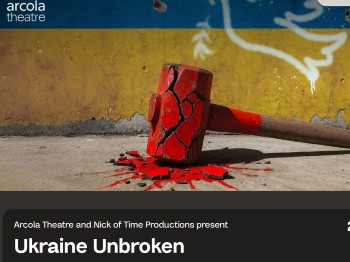 News from the arts of today is rarely hopeful.
 Over half of theatres are reporting deficits this year. Support from local authorities has dropped 55% since 2010. The Government of Wales has effected a 40% reduction. Policy-making towards the national arts institutions of Wales has been well publicised. In the place of new drama producers are landing on great films of old. A transcription of “Double Indemnity”, dishearteningly, comes to Cardiff this season. The Artistic Director of the National Theatre, below 9th March, fears that the wellsprings that nourish innovation and drama may well cease to flow. And yet. There are still points and places where theatre is doing the things that only it can do. At the Royal Court this year Rosie Sheehy led in “Guess How Much I Love You?” “The Ministry of Lesbian Affairs” is in the Olivier Awards nominations. And Nick Kent has turned theatre's unique dramatic stamp to Ukraine. * * * * Nick Kent has form. “The Great Game” was conceived at the Tricycle Theatre in 2009. In autumn that year it went to the USA playing in New York City, Minneapolis, Berkeley and Washington DC. Remarkably private performances were put on for Pentagon staff and military policy-makers. Additional performances were offered free to soldiers, wounded veterans and government staff. Michael Billington, premier critic of his day hailed it on 25th April 2009. “If there were any doubt about the Tricycle's status as Britain's foremost political theatre, it is silenced by this mind-blowing achievement. “Nicolas Kent and his team have commissioned 12 half-hour plays which make up "The Great Game" and which cover Afghan history from 1842 to the present. Over the next few weeks they will be accompanied by films, exhibitions and discussions.” The dramatists included the late Stephen Jeffreys with “Bugles At The Gates of Jalalabad”, David Edgar with “Black Tulips”, Ron Hutchinson with “Durand's Line”, Amit Gupta with “Campaign”, J T Rogers with “Blood and Gifts”, Ben Ockrent with “Honey”, Colin Teevan with “The Lion of Kabul”, David Greig with “Miniskirts of Kabul” Abi Morgan with “The Night is Darkest Before the Dawn” and Simon Stephens with “Canopy of Stars.” “The Great Game” was jointly directed by Nicolas Kent and Indhu Rubasingham, now of the National Theatre. * * * * “Ukraine Unbroken” is not on the same scale but is potent and urgent theatre. Two Davids, Edgar and Greig, return. The five plays are skilfully curated across time from the Maidan protests to the ravaging of Mariupol. Kent has found a powerful linking presence in the words, music and song of Mariia Petrovska. Inbetween the plays she plays the bandura, sings with a voice of lustre and adds concise words of comment and her own story. That takes in study at Manchester, a first-class degree in Popular Music Performance and Songwriting and a concert career. In Ukraine she has been with the Cultural Forces, who perform to troops on the front line. To be able to play the bandura in the 1930s, we are reminded, was cause for its musicians to be murdered on order from Moscow. * * * * “Demonstrations & Invasions” by Jonathan Myerson is set on 20th February 2014. A couple books into a room in the Hotel Ukraina. Its window looks out on the protestors among whom is their son. The husband is a parliamentarian, a financial beneficiary of the Yanukovych regime. The room is invaded by two brusque unnamed men. The ostensible man of authority is shown to be without power. Greater harsher powers of the state are in play. A rifle is unveiled from within a drinks trolley Mariia Petrovska gives the numbers. Forty-eight citizens in Maidan were killed by snipers. * * * * “Five Day War” has the dramaturgical rhythm, the structural prowess and springy dialogue to be expected from a master of theatre. David Edgar is that dramatist. He is in territory similar to that of “the Shape of the Table” in 1990. New candidates for power are off-stage while a regime is set to vanish. The location is a hunting lodge. Three mid-level public officials are being groomed to emerge as leaders of a new Quisling regime. The candidate for new president has not been decided by the outside powers represented by an unnamed agent. The dialogues slide over history and ideology but candour and depth are out of bounds. That, says the sinister organiser, would admit “the danger of defeatism.” The most cautious of the trio comes to realise his significance. He is a Ukrainian-speaker; his value, he realises, is not to wield authority for any civil value but “co-opted for dramaturgical purpose.” The dramatic irony is that whereas the regime collapse in “the Shape of the Table” was genuine this, we know, to be unreal. The collective fantasies collapse when the daughter of the Lodge's house-keeper presents a proscribed smartphone. She has been sent footage from Bucha. * * * * The second act is titled “War.” “Three Mates” by Natalka Vorozhbyt, translated by Sasha Dugdale and directed by Victoria Gartner, is a monologue. As ever this form reduces theatre to narrative, a particular thinning as its subject is three men with a richly dialectic dramatic potential. The setting is the capital under air bombardment. Three friends from the conservatoire have taken divergent paths. Jarek has bribed his way heavily to Vienna, from where anodyne texts are sent. Max is permanently at the front and a changed man. The narrator, Andriy, is in hiding from possible conscription. His tenor voice should be singing. Instead he says “I am nothing. I am nobody.” * * * * “Wretched Things” by David Greig leaps from the city to the battlefield. Three soldiers shelter in a besieged primary school; they encounter the body of a North Korean soldier with a slight breath still within him. The dialectic is over whether, at personal hazard, the wounded combatant should be carried to medical facilities. The sergeant's argument is that his nation wishes to be of Europe. The Geneva Convention is intrinsic to those values of Europe. The school still has pictures by infants on its wall. A soldier says that the six-year-olds would quite likely by now be in Siberia. This links to “Taken” by Cat Goscovitch, whose theme is the war crime of the child abductions. In a taut sequence of scenes the action moves from Mariupol to Russia. An invading soldier offers two weeks in a holiday camp in Crimea in the company of other children. The robbed mother takes a journey lasting days via Minsk to discover her thirteen-year old in uniform. She has been told by her abductors that her mother has abandoned her, her father no longer alive. The small hands of her age mean she has learned how to strip down a machine gun in 25 seconds. The militarisation of schools is the most unnerving part of Pavel Talankin's school record from Karabash “Mr Nobody vs Putin.” It is a starkly sober ending. But in spite of all the characters look upwards and see that the skylarks still sing above Mariupol. * * * * The actors are Clara Read, Jade Williams, David Michaels, Daniel Betts, Ian Bonar and Sally Giles. Michael Taylor is Set & Costume Designer, Matt Eagland is Lighting Designer and Joe Dines is Sound & Video Designer. At the beginning video screens provide concise information. In April 2025 the White House in the era of the 47th President removed any reference to the Danube Memorandum of 1994. The figures of casualties are given from Britain's Ministry of Defence on 25th February 2026. Across both sides they have passed 1,800,000. Theatre cannot reverse political acts or decision. But it can be a witness. “Ukraine Unbroken” is a record of how we felt. For us, who gather and watch on a March night, it is feeling, a bond of common feeling, from seating to stage, from island nation to the east of our continent. |
Reviewed by: Adam Somerset |
This review has been read 92 times |
