
|
Welsh Theatre Symposium - What is the future for theatre in Wales? |
 Welsh Theatre Symposium Summary
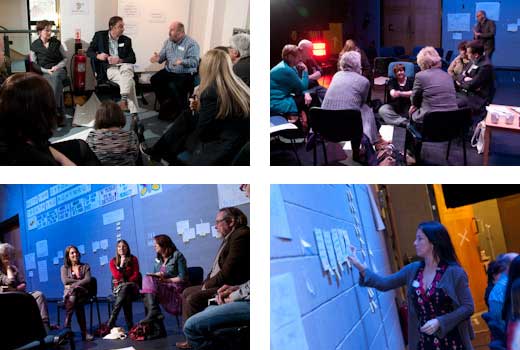
The Welsh Theatre Symposium - What is the future for theatre in Wales took place on the 14 March 2011 at Theatr Brycheiniog, Brecon. Attended by over 60 people it was hosted by The Theatres Trust, Creu Cymru and the Wales Association for the Performing Arts. The intention was to offer a space in which to consider ways forward for theatre in Wales. The day was split into two sections. The morning was chaired by Theatre Director, Phil Clark and included a series of presentations followed by questions and debate designed to offer provocations for later discussions. The Symposium heard presentations from Martin Sutherland from the Royal & Derngate Theatre, Jonathan Petherbridge from London Bubble and Andrew Davies AM. Open Space Technology Following lunch the Symposium adopted ‘Open Space Technology’ facilitated by Lucy Foster from Improbable Theatre. In Open Space participants were asked to identify topics that they want to cover and take responsibility for convening and recording sessions. Within the format of the day, sessions took place over two consecutive one hour time slots during the afternoon. 11 sessions were held (in alphabetical order): Collaboration Co-ordinate the youth theatre sector throughout Wales Ground rules for improving touring scheduling No new theatre buildings for Wales. Let’s mend the ones we’ve already got Professional small scale theatre in communities - Why it’s important in the theatre future of Wales The future for theatre in Wales is... something happening on stage that is exciting enough to get people out of their houses and away from their screens The only future is a green future Theatre is about people not places or buildings Welsh Language in the future of Theatre What part will young people play in the future theatre in Wales What role will Local Authorities have in the future of theatre in Wales? Any enquiries related to the notes below email suzanne.mcdougall@theatrestrust.org.uk ***************************************************** Session notes The following notes were provided by session convenors. Topic: Collaboration Proposed by: Deborah Keyser Participants: Sarah Argent, Arwel Gruffydd, Arnot Hughes, Dorothy James, Mai Jones, Mark Kelley, Deborah Keyser, Rhodri Thomas, Lynsey Wheeler 1. A successful collaboration should be about protecting the integrity and vision of all parties.
2. Not about empire-building (or mergers). 3. Trust is vital. 4. Some collaborations are mechanical and practical – almost contracting out of services – others are about relationships, s haring of knowledge. 5. Although trust is vital – monitoring is important. 6. Not always painless – there needs to be challenges and sometimes friction. And risk-taking – courage. 7. The unknown benefits are a major part of the eventual outcomes (makes it hard to get funding!) – a collaboration is bigger than the sum of its parts. 8. Helps to embed our work in the community and beyond our own sector. 9. It’s not all about doing the same with less money – some of it is about experimenting and exploring. 10. It takes time! 11. It’s not just about collaboration within Wales. 12. There is a role for leadership in collaboration – facilitating collaborations and helping partners who aren’t in a position to make those connections themselves. ***************************************************** Topic: Co-ordinate the youth theatre sector throughout Wales Proposed by: Phil Clark Participants: Phil Clark, Dorothy James. 1. The National Association of Youth Theatres (NAYT) is only funded to work in England. – Membership open to Wales but no remit to develop the practice. 2. Should Wales buy into NAYT. 3. What would be the benefits of mass collaborations / sharing between Youth Theatres in Wales. 4. What is the ACW and Local Authorities strategy for / position on Youth Theatre in Wales. 5. How do we support and retain the threatened youth theatres attached to the TIE companies. 6. If not through NAYT, how do we share best practice. 7. Does the Youth Theatre movement in Wales want to collaborate? ***************************************************** Topic: Ground rules for improving touring scheduling Proposed by: Chris Ricketts Participants: Geoff Cripps, Mai Jones, Chris Ricketts 1. Planning fora – annual? Add-on to an existing event? 2. Better use of the web as an information resource? 3. Consultation by new or larger project grant decisions. *****************************************************
 Topic: No more new theatre buildings for Wales. Let’s mend the ones we’ve already got Proposed by: Rob Firman Participants: Rhowan Alleyne, Nick Bamwell, Geoff Cripps, Elizabeth Fenwick, Rob Firman, Paul Morgan, Noel Rees, Mhora Samuel, Janet Smith. 1. Just because a building is old is it worth saving? How old is old? And who decides? 2. Old buildings present constraints that limit 21st century needs that couldn’t have been foreseen – Sometimes new build is better than a compromised refurbishment. 3. Audiences can become extremely loyal to their local theatre but still need a good product to encourage them to remain loyal. 4. We need to find a way of ensuring excellent governance of out theatre buildings. 5. We need to take maintenance of building fabric more seriously. It is the first sign of a business in decline if the building is allowed to decay. 6. We have to stop taking our existing buildings for granted. 7. Listed building status for all is not the answer ( or even part of it ) 8. If we take no action Darwinian evolution will kill the weakest. We need to help the buildings we have to adapt and evolve. 9. Is there a way of depoliticising funding for maintenance and entrust to a body such as CADW through central (WAG) funding or a maintenance levy on seat ticket prices. 10. We need to consider carefully what the criteria are that determine whether or not a venue is successful. ******************************************************* Topic: Professional small scale theatre in communities - Why it’s important in the theatre future of Wales Proposed by: Val Hill Participants: Sarah Argent, Julia Davies, Val Hill, Janet Huxtable, Louise Ingham, Dottie James, Kevin Lewis, Anne Plenerleith, Martin Sutherland 1. Accessibility: not everyone has a car; not everyone can travel, public transport is not good in rural areas, not everyone can afford mainstream ticket prices. 2. People feel more comfortable in the safe, known environment of their own community centre / village hall / school. 3. Can be an audience development tool for larger scale venues – a gateway to / first taste of theatre / nurture a passion 4. Transformation of non theatre space which is known to audience is exciting, philosophically inspiring / artistically exciting and magical. 5. Local people involved in the event as a social experience – interval refreshments, raffle, chance to catch up with neighbours etc 6. The small scale is not inherently inferior and should have as much status as mid and large scale. Different work is right for different contexts. 7. Issues surrounding theatre for young people – ACW expectations that the work should now be presented out of a school environment. Will schools bring pupils to theatres? Totally different experience to taking theatre to schools. Needs to be a flexible mix to ensure that as many young people as possible can experience theatre. 8. Will theatre venues be able to sustain a year round programme of productions for young people? Families bringing children? A mixed ecology of children to theatres and productions to schools. Who will cover the transport costs. 9. Dreams thrive at times of recession and need to be inspired. 10. Need to join up the participation and presentation for young people. What can we do? Talk to each other / collaborate / share ideas / pool resources Stay true to core values / beliefs and principals Harness audience support in a really positive lobbying role “Why we love it” .... not “please save it” Get funders / stakeholders to experience the work – take it to them if they won’t come to us - e.g. video presentations in council chamber. There cannot be a future for theatre in Wales where there is no work at the small scale. Small is beautiful ******************************************************* Topic: The future for theatre in Wales is... something happening on stage that is exciting enough to get people out of their houses and away from their screens Proposed by: Nic Young Participants: Sharon Casey, Richard Hogger, Deborah Keyser, Marian Morden, Chris Ricketts, Lynsey Wheeler, Nic Young 1.What’s on the stage is only half of the question – people want the experience around the performance, too. 2.Too much work is programmed that is not theatre– or where theatre is not the right medium for the content. 3.Raising production values – cinema analogy –so that even if the story isn’t enough, the visual/aural experience is. 4.No evidence that more physical approaches will get more people out. 5.A) Don’t programme for the sake of it – if it isn’t good enough don’t put it on. B) Learn from the work that does sell well – whether theatre or other artforms. C) Put the mechanisms in place to ensure that the work is felt to be good enough is available – producers/presenters collaborating. D) A ‘dance approach’ – one day get in for one day of performance – so that the quality of the presentation is as high as it can be. 6.It’s not going to be easy in Wales for demographic and geographical issues as much as because of what is produced. ***************************************************** Topic: The only future is a green future Proposed by: Rhodri Thomas (www.sustainwales.com Emergence Eginiad)
Participants: Phil Clark, Margaret Jones, Mark Kelly, Rhodri Thomas 1. Perception that green technology is too costly or adds additional costs. 2. No budgets for kit refit – LEDS. 3. Upfront capital costs too great for companies. Need loans. 4. Changing behaviour – audiences & staff - bus scheme links. E.g Sherman cool bicycle scheme for staff. How do audiences get to shows? Reduce car use. E.g Sherman cycle valet scheme. 5. If venues all had a commitment to a standard ECO Tech Kit e.g. 5 LED wash bars as minimum – all touring designers could work to that basic rig and minimise extra kit. Need a standard rig. 6. Theatre design courses should start from the basis of recognising the need to minimise energy & materials use. 7. Companies need an amnesty (cash incentive) to bring in old lanterns & do a refit – recycle lanterns – glass metal – precedent is compensation for radio mic replacement. Big venues/producing companies could act as the drivers of change & hire out green tech theatres with the new technology - need to be prepared to educate & showcase. We have new writing venues why not Green / Sustainability venues? 8. Theatre companies are keeping popular cheap clothing stores alive! Why keep buying new clothes produced in sweat shops. Could create a set, props & costume co-op with buy in from a group of companies. This will have strong political support. Sherman recycle nearly all sets, Guy O’Donnell in (Theatr NaN’og) NPT runs a set recycling scheme. Where do you get the info from to recycle sets – youth theatre, amateur co’s. Info should be on Theatre in Wales site. J Buchanan. Communal wardrobes & props – money making. 9. Theatre shows touring to villages & communities are more sustainable than multiple car journeys by audiences to urban venues. If the venue and the touring show work together you could run matinees when public transport is available – show don’t need to be always in the evening. Old people – transport scheme – show e.g. Uni versity of 3rd age to come to Brycheiniog for a meeting – why not stay for a show? Play to gathered audiences rather than try to bring them in. 10. Sustainability – energy use, waste, water use, efficient use of materials – all this is common sense and needs to be more than a tick box but a fundamental part of the fabric of theatre. 11. What does the experience of the last 30years on issues of gender & race tell us about changing behaviour in favour of a more sustainable future? Publish & highlight your green commitments & achievements. ******************************************************* Topic: Theatre is about people not places or buildings Participants: Lucy Bevan, Arnot Hughes, Anne Plenderleith, Chris Ryde 1. Every area should have a creative hub that is more than an auditorium. 2. Invest in people. 3. Theatre spaces should be flexible and serve people. 4. Work driven theatre rather than venue driven theatre. ******************************************************** Topic: Welsh Language in the future of Theatre Proposed by: Hannah Jones Participants: Arwel Gruffydd, Hannah Jones, Mai Jones, Carwyn Matera-Rogers, Annest Williams 1. Consistency in audience – connect the Welsh language audience in Wales – to do that on a large scale (which isn’t really happening at the moment) is the real challenge. 2. There are no developed arts critics in Wales? Those we have need to be passionate, trained, involved and unbiased with no agenda ...room to develop these people and measure what effect reviews have. 3. Best practice from National Theatre Wales’ marketing – need to develop a Welsh language network and internet community to begin a conversation with Welsh language audiences and artists. 4. Engaging with young people, reintroducing Wales as a place to create and produce work as well as the next generation of audience. 5. Surtitles – argument for and against ownership of language and hesitance of sharing the language and culture – does it undermine? 6. S4C to acknowledge how it can be a drain on theatrical resources by using skilful people developed from the theatre – need to acknowledge the need of a partnership and allow the theatre to take advantage of the relationship to move forward. 7. Welsh language organisation collaborations to happen organically and not forced or structured. 8. Large scale work – difficult because of the challenge of the Welsh language audience in Wales. Challenge is looking for/developing work that reflects the Welsh experience. 9. Challenge of creating touring work in Wales that ‘speaks’ to each individual area/community. 10. Cultural diversity in Wales – open discussion required. 11. Creating ambassadors outside an infrastructure that offer more credibility and leads to ‘bums on seats!’ ******************************************************** Topic: What part will young people play in the future theatre in Wales Participants: Sarah Argent, Hannah Jones, Martin Sutherland, Anne, Chris, Dorothy, Julia, Kevin 1. A youth theatre movement encompassing all sorts of variances 2. Young people should be empowered. 3. All professional funded companies should support young practitioners – Emerging artists. 4. Unofficial Welsh Theatre for Young People’s work. 5. Universities and colleges should tailor courses to enable their graduates to be fit for the profession. 6. Be brave, let young people run with their ideas. Jut be supportive as industry professionals. 7. Meet young people on their terms and communicate their ideas/share/help give space for them to develop. 8. Youth theatre work at all venues. 9. Ensure individual artists have a voice. 10. Bring an emerging artist with us to conferences. ***************************************************** Topic: What role will Local Authorities have in the future of theatre in Wales? Proposed by: Mhora Samuel Participants: Lucy Bevan, Sharon Casey, Janet Huxtable, Marion Morden, Nicholas Young 1. Delivering cultural entitlement - making written commitments to theatre in local strategies – can’t rely just on the will of councillors – especially where local authorities may have the will, but not the wherewithal. 2. Making audiences voices heard – and listening to what they want. 3. Developing audiences – especially where they have the responsibility for theatre programming and in response to communities needs – with quality mixed programmes. 4. Giving communities access to a local theatre by owning, managing and maintaining theatres properly – at the moment c.35 out of 51 professionally run theatres are run by local authorities: however acknowledged the trend towards moving venues from local authority ownership to independent trust status. 5. Ensuring young people have access to magical theatre in schools – through education authorities investing in theatre in education companies with known reputable companies that produce work that isn’t just issue based. 6. Supporting the work in the voluntary arts and theatre sector, but not as a get out for real investment in theatre. Don’t let Local Authorities away with ‘It’ll happen anyhow love...’ 7. Possible role in attracting and distributing external investment into theatre – but relies on skills and capacity of local authorities to access funds. 8. Providing leadership in relations with Arts Council – to ensure that there is wide access to quality theatre and theatre sector isn’t played off against itself. 9. As investors in cultural regeneration and theatre/arts infrastructure. 10. The sector needs to promote itself better to Local Authorities - Creu Cymru, WAPA, Arts Development UK (NALGAO), Theatres Trust should come together to facilitate a single message to local authorities stating how by working together we can ‘keep the lights on’, achieve the best programming in localities and deliver the best theatre experiences. ******************************************************************************
 For the original invitation for the event follow this link www.theatre-wales.co.uk/news/newsdetail.asp?newsID=3904</a> ******************************************************************************
During the morning session twitter was used to disseminate key points made by the speakers. The following tweets are from 14 March 2011 (in reverse order) TheatresTrust Here's the link to Theatre in Wales website for Welsh Theatre Symposium - and more to come http://bit.ly/ifJDHi #welshts TheatresTrust Thanks to everyone who participated today in Welsh Theatre Symposium. Agreed we all need to speak with one voice. #welshts TheatresTrust Finished a full afternoon in Open Space - notes from sessions will go up on Theatre in Wales website - link to follow #welshts TheatresTrust Phil Clark Chair of today's #Welshts event @Brycheiniog was interviewed this am on @BBCWales radio http://bbc.in/hvu9mv 0:44:21#artsfunding Ceriffwrdd Open Space session 1 in full swing. Welsh Theatre Symposium #Welshts Ceriffwrdd Nice canal theatr brycheiniog #welshts http://twitpic.com/49fdda pcmcreative @NTWtweets RT @TheatresTrust: Lucy Foster starts the Open Space looking at question 'What is the future of theatre in Wales' #Welshts TheatresTrust Lucy Foster starts the Open Space looking at question 'What is the future of theatre in Wales' #Welshts Ceriffwrdd Buffet lunch #welshts http://twitpic.com/49ex8v TheatresTrust @clouddancefest Thanks for the mention - we're going into Open Space after lunch #welshts SDC_BoxOffice Interesting tweets from @TheatresTrust who are attending the #welshts (Welsh Theatre Symposium). Handy for business work & V interesting too TheatresTrust Closing the session - Phil sums up - speak with one voice, know your audience, and the changing culture of audiences #welshts clouddancefest Very interesting tweets from @TheatresTrust at #welshts - applies to whole industry, not just Wales! TheatresTrust RandD - Board invested up front in a development dept and we all have responsibility for networking #welshts TheatresTrust Question - How did RandD manage capacity to develop private and public sector relationships #welshts TheatresTrust Gwent theatre - thank you Jonathan for giving us hope #welshts TheatresTrust Question - Gwent Theatre - we've had great support from audiences - looking at new ways of working - post cut #welshts TheatresTrust Jonathan - we have to speak to our audiences - and communicate to the voting public #welshts TheatresTrust The role of Higher Education in Wales is key #welshts TheatresTrust Question - Do audiences come as an after thought in Wales? And let's celebrate - Gywnedd has had investment in theatres #welshts TheatresTrust London Bubble - Creative, Education, Producer - and built back in an Administrator later. We all fundraise. #welshts TheatresTrust Volcano question - which staff did you keep? #welshts TheatresTrust Getting cut is NOT fantastic, we've had to work hard and had sleepless nights - think the unthinkable #welshts TheatresTrust Make friends with people who can really help you, chasing the arts funding relationship could be distracting #welshts TheatresTrust Never had a fundraising dept - but we were clear about the ask and looked at our financial value #welshts TheatresTrust Adopted 'Fan-made' theatre - now known as crowd sourcing, asked audiences to make the choice for next show #walests TheatresTrust After cut ratified, looked at options, had assumed closure - audiences boosted morale - ACE gave transition funds #welshts TheatresTrust Opened up channels of comms to audiences and stakeholders, didn't ask to protest, just asked for experiences with LB #welshts TheatresTrust Now Jonathan Petherbridge - the story of London Bubble's 'defunding' in 2007 #welshts TheatresTrust Andrew Davies asks can arts, voluntary sector and third sector look at new ways of working together #welshts TheatresTrust On the question of a duty on local authorities to fund culture, would need funding - unlikely right now #welshts TheatresTrust Develop long term relationships with funders and elected members - don't just come to us when you're being cut #welshts TheatresTrust You should be looking to influence the budgets from 2012 onwards - local elected members and key civil servants #welshts TheatresTrust Cuts in context - Wales ACW only 4 percent cut cf ACE 30 percent #welshts TheatresTrust Focus your organisation and work with your funders - Andrew Davies #welshts TheatresTrust Next on Andrew Davies #welshts TheatresTrust Cut the hysteria, realigned and ringfenced funding and activities to be clearer about impact on funders investment #welshts TheatresTrust Participated in wider partnerships in Northampton, artistic and cultural projects and took on mgmt of Corby Cube. #welshts TheatresTrust Recognised we had to start communicating our value better - economic and social impact @masutherland #welshts TheatresTrust Royal and Derngate - Retrained board to be advocates for the theatre, develop the business and fundraising #welshts TheatresTrust @masutherland talking about how the Royal and Derngate's 4 year funding agreement saved the theatre #welshts TheatresTrust Phil Clark - It's about urban and rural debate - the answers are in the room #welshts TheatresTrust Today should be about possibilities - not here to 'mourn' or moan Phil Clark #welshts TheatresTrust #Welshts Phil Clark introducing the Welsh Theatre Symposium TheatresTrust We'll be using #Welshts as the hashtag today at the Welsh Theatre Symposium Acknowledgements and thanks Geraint Thomas, Heidi Hardwick and Lee Collins at Theatr Brycheiniog Keith Morris at Theatre in Wales Ceri Nicols For further information The Theatres Trust 22 Charing Cross Road London WC2H 0QL T: 020 7836 8591 www.theatrestrust.org.uk Creu Cymru T: 01970 822 222 www.creucymru.com WAPA P.O. Box 443 Cardiff CF11 9YT T: 029 2039 7971 www.waparts.org.uk |
| web site: www.theatrestrust.org.uk |
| e-mail: |
Monday, March 14, 2011 |
|
Other related news stories on the Theatre in Wales web site : |
Older news
stories have been carefully archived.
2006 | 2005 | 2004 | 2003 | 2002 | 2001 | 2000 | 1999