|
An interview with Eleesha Drennan, choreographer of Phantoms Of Us and dancer with National Dance Company Wales
|
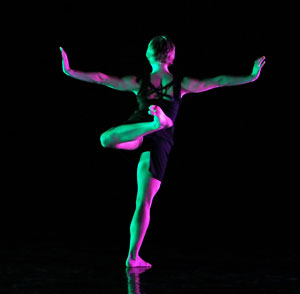 How did you progress from a dancer with National Dance Company Wales to a choreographer with your work featuring in the Company’s national tour?
It started off when I took part in Departure Terminal and Alternative Routes, two National Dance Company Wales projects where we were encouraged to choreograph our own works. In the workshops, we created group pieces and also solo pieces. When we have gaps between productions and tours I have taken advantage of having this time to explore and develop my work. With Phantoms Of Us, and the previous dance I created, Imbue, visual artist Sue Williams and I were collaborating for a year or so before.
How does it feel to take charge of your peers?
There is definitely a different dynamic than when we work with an outside choreographer. I hope we’ve achieved a sense of mutual respect. I have to take control – it is important to be quite clear with what you want but not to abuse that. I hope the dancers feel a sense of ownership as the dynamic between myself and them shapes the creation of the work. I have been very interested in the response of the dancers to my ideas. It is an ongoing process – as long as we are performing the dance, it will continue to keep being created. I am not going to suddenly re-write all the steps but little things may change. With dance it is important to keep things fresh and new. I am excited to keep that journey going through the tour. I don’t want it to get too comfortable.
How have you grown as a choreographer while creating this work?
I have learned that your original ideas can change a lot. I have also found that I have had to develop a clear understanding of my own language to be able to push the idea further.
I made Imbue for three dancers, but I was one of those dancers so with Phantoms Of Us I’ve learned a lot from being external to the piece. I have found the more you work with the dancers the more you develop an understanding of each other. You find non-verbal ways of understanding each other. Words can be misleading because other people can interpret them differently. I want the dancers to understand through the physical and not just the verbal, letting the movement speak for itself.
Why is it important for National Dance Company Wales to champion the work of young choreographers such as yourself, as well as performing productions from the world’s greatest names?
It is really important that the Company has a balance between working with established choreographers and investing in what the next generation of choreographers are creating. The renowned choreographers tend to be from the older generations and have worked hard throughout their long careers to get to where they are. However, if you only invest in the established choreographers then there will be nothing in the future. As a national organisation it is important to take risks. Part of the job is to be as cutting edge as possible, to push the boundaries and to keep things moving.
What is Phantoms Of Us about?
It is about a journey into the unknown and finding that instinctive power to guide us through it. We explore the human struggle that we can’t help but go through for so many different reasons. That struggle to move forward and the search to discover a sense of inner freedom and whether or not we achieve that. There is a question mark at the end of the dance. There is no complete resolution. It finishes with a lone dancer on stage leaving the question is she fully free or is she isolated?
However, there is a danger of me defining the meaning of the production. I want people to interpret it for themselves. Everything I create has a personal meaning to me but it could mean something very different to another person, so it is important to watch this kind of dance creatively. You need to switch off your intellectual mind, which we use so much, and look at it like you might interpret a poem. When I listen to a piece of music for the first time, I don’t want to be told exactly what I should think about it, and it is the same with dance. There is no right or wrong, even though it has a specific meaning to me. It’s almost like reading a diary – I wouldn’t read my diary to the public but hopefully it is a personal experience for people watching it too. I hope people will feel very different things.
Your dancers wear skin-tight, skin-toned body suits. Why is this?
Throughout the dancers’ journey they are searching for a greater understanding of identity. Their costumes give a pure sense of the body. When we take away the superficial identity – elaborate costumes, for example – it forces us to look within ourselves. There is something very powerful and beautiful about seeing a person in their purest form. Stripping away the layers of what we hide behind gives a real sense of vulnerability and if we dare to let ourselves be vulnerable we can access a deeper form of courage.
You have collaborated with visual artist Sue Williams on this piece. What is the significance of the images she has created?
The dance opens with giant bodily forms projected onto a screen from which the dancers emerge, and we come back to these images later in the piece. I call them the phantoms; they could be shadows, figments of the dancers’ imagination, or hollow representations of themselves. To me, they are reminiscent of cave type drawings and I like the idea of them being imprinted or projected onto the dancers. There is a sense of something overseeing you and empowering you, creating an almost fearful sensation.
Phantoms Of Us by Eleesha Drennan will be performed as part of National
Dance Company Wales’s autumn 2011 tour, alongside B/olero and Black Milk by Ohad Naharin and Quixoteland by Gustavo Ramírez Sansano. Full listings are below.
|
web site: |
e-mail: |
Tuesday, September 20, 2011 |
|
|
|
|
Older news
stories have been carefully archived.
2006 | 2005 | 2004 | 2003 | 2002 | 2001 | 2000 | 1999