
|
Folk Spring Tour: What Next for National Dance Company Wales? |
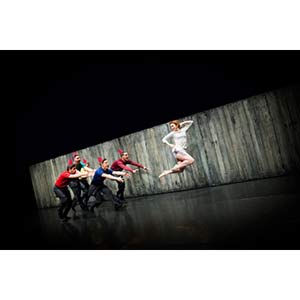
Our National Dance Company Wales, the contemporary dance ensemble based at The Dance House in the Wales Millennium Centre complex, has been through a period of major upheaval over the last couple of years, with the artistic direction team of more than a quarter of a century (Ann Sholem and Roy Campbell Moore), cutting their ties completely with the company they had steadily nurtured over thirty plus years, transforming a small-scale modern dance company (still called Jumpers Dance Theatre when they took over in 1983) into the middle scale Diversions, based first at the old Caricature Theatre in Cardiff, then at the Ebenezer Chapel (off Queen St) and then, pending their move to The Dance House (which was still in construction along with WMC main building) at an industrial unit near Cardiff Bay, before finally moving to the Dance House where they have been resident for over a decade. It was in 2009 that the company became National Dance Company Wales, to befit their position at the Wales Millennium Centre, which is effectively the nation's opera house and principal lyric arts centre. Sholem and Campbell-Moore worked hard to gradually lift the the company standard and place it firmly on the pan-European scene by commissioning works from interesting international choreographers, by touring widely in the UK, mainland Europe and beyond, and by attracting good dancers of different nationalities, whilst still affirming the company's identity as a flagship for Wales. However, in some ways NDCW is now cut free, with a brand new artistic director at the helm, and could go anywhere stylistically, Caroline Finn was appointed during 2015 and so is at the beginning of her time with the company. She is actually the second appointee after the Sholem and Campbell-Moore departure but is the first to take office. The original choice was the suitably international, Gustavo Ramirez Sansano, a Spanish choreographer emerged from the creative hotbed of Barcelona, who has worked with high profile companies all over Europe and in the USA, but he was unable get out of previous contractual commitments and could never took up his post, had he done so it would have surely taken the NDCW in a new and unexpected direction. But with fate intervening we have instead the English choreographer, Caroline Finn, as the new director. She also comes with international credentials, having studied at Juilliard in New York and danced with companies in Germany and in France (with Angelin Preljocaj and with Carolyn Carlson), and choreographed for companies across Europe. In 2014 she won the Matthew Bourne New Adventures Choreography Award. In 2015 she was commissioned by Chilean contemporary dance company, the 70 year old Ballet Nacional Chileno, to make a work based on Kurt Jooss' anti war classic, The Green Table. This is her first full season with NDCW and she has specially made a work for the company dancers called "Folk", which gives their new tour its name. There are five dances on offer and presumably these will alternate depending on the venue. The two works missing from The Sherman Cymru triple bill were Lee Johnston's curiously named "They Seek to Find the Happiness They Seem" and Jeroen Verbruggen's "A Mighty Wind". First up at Sherman Cymru was Johan Inger's "Walking Mad", a quirky work that makes good use of all elements of costume and set - Inger was responsible for these and so there is a reason for every item on-stage - the design is integral to and interwoven with the choreography. For music he chooses the much choreographed to "Bolero" (that intensely rhythmic and cumulative composition by Maurice Ravel) but to be fair, his version does have something new to say: it's quick and smart and shows the dancers off to their best, in particular the men of the company who really shine in this piece with their strength, flexibility and wide dynamic range. The stage is dominated by a six foot, wooden wall which, manipulated by the dancers, can fold in on itself, be laid flat and lifted up again and has doors concealed in its apparently sheer surface. The dancers, six men and three women, are revealed surprisingly and often humorously via the doors and by climbing over the wall and running out and around either end of it. At one point a woman is chased by a "posse" of men with crimson, conical "dunce" hats on their heads, stretching their hands out to catch the fleeing prey as they vocalise enthusiastically - there is an underlying sexual theme throughout with pursuing, rejecting, duetting, tricking -. Full of fast changes and characterful movement, there are sometimes subtle echoes of the style of the great Swedish choreographer, Mats Ek (not surprising since Inger directed Ek's wonderful Cullberg Ballet for a time and they say imitation is the sincerest form of flattery), in particular in a slow section when the wall folds in to suddenly become an oppressive triangle with a dancer forced into the apex and when Arvo Pärt's "Für Aline" replaces "Bolero" for the subsequent troubled duet between a man and a woman. Perhaps the most satisfyingly complete and well developed work of the evening, "Walking Mad" touches us with its mysterious sensuality, energy and humour. Its universal appeal will guarantee shelf life as a dance. The middle piece in this triple bill is "Tuplet" by Alexander Ekman. It's a work for six dancers and a couple of projectors on wheely stands that get trundled on and off the stage at different times in the work. It's a sharp and modern piece with lots of movement humour that strikes a chord with the audience and raises some well earned laughs. It's also a straight-up choreography that is absolutely clear and unambiguous in its intentions - not a hint of pretension here - it's direct communication building from a simple beginning where the six dancers stand downstage in a row on individual white squares of lino flooring, each in their personal squares of white light, and start building a rhythm together with the sounds they can make with their own bodies: through percussive movement, through their contact with the floor, with their voices - a true display of virtuosity -. The movement and rhythms increase in complexity until the dance opens out into the space and interacts with both film projections and the overlapping sound score (cleverly constructed by Mikael Karlsson and including snippets of dialogue and a vintage, live jazz recording). The projected film, which sometimes steals the show, includes documentary clips of crowds of people dancing rhythmically and a jazz band with drummer and singer performing. At one point in the sound score we hear American voices tell us conversationally that "...it's about the rhythm" in a deliberately comic case of over-kill and that it is - wittily and unambiguously. The final dance of the bill is "Folk" by Caroline Finn, a complete contrast to the previous "Tuplet" in every way, it's a piece full of ambiguity. The starting scene is promising, the setting low lit and dusky with a leafless tree suspended to one side and a sad individual sweeping together the fallen leaves underneath into a heap - we could be at the beginning of Beckett's "Waiting for Godot" - and it surprises us when a dancer emerges from the heap of leaves. The cast of nine (the full company including the two apprentices) reveal themselves as very different characters and it's clear they've collaborated with the choreographer in creating the movement (in her notes Finn mentions asking the dancers to take inspiration from 17th and 18th century paintings). Situations and interactions develop to a diverse string of music tracks that range from comic irony (Offenbach's Barcarole interpreted by Mantovani and his orchestra!) to folksy (Theodorakis' Zorba music) through more complex and moody, the dancers working as a rag-taggle group or breaking out into short solos. The choreography is very linear - it doesn't develop or visibly use the discipline of structure - it just goes, but not anywhere in particular. This lack of clarity doesn't give the dancers much opportunity to shine, apart from a solo by Ángela Boix Duran, who gives a really haunting characterisation in movement underneath the barren branches of the tree. At the beginning of their Spring season the dancers are on top form, strong, flexible and eloquent. As already mentioned, the men of the company are all excellent, we're entering a golden era for male dancers. It's worth mentioning that, amongst members from England, France, Italy and Spain, there are just two dancers from Wales: Josie Sinnadurai, one of the two apprentice dancers, who hails from Brecon in Mid Wales, and ex NDCW member, Chris Scott, currently dancing with The Royal Opera in London, but who has returned for the Cardiff performances of "Walking Mad" only. Finn, the new artistic director, will be getting to know Wales. We must wait to see how much she will use her international contacts whilst slotting into the stimulating and varied dance scene here. There are a number of good Wales based choreographers, both established and emerging, and it would be great to see a couple of those names on the roster of the company repertoire, so that the National Dance Company can truly reflect and represent 21st century Wales, rather than be an international company with a "National" moniker. Jenny March From a professional dance back-ground, Jenny March is a dance writer and critic specialising in Wales and Latin America. Throughout the noughties she was the only specialist dance critic and reviewer with The Buenos Aires Herald. Between 2009 and 2011 she also had a regular dance column in Planet Magazine Wales. She continues to contribute on occasion to The Buenos Aires Herald and to other periodicals in Argentina and Europe as well as contributing to Theatre in Wales." |
| web site: |
| Jenny March e-mail: |
Thursday, March 3, 2016 |
Older news
stories have been carefully archived.
2006 | 2005 | 2004 | 2003 | 2002 | 2001 | 2000 | 1999