| The Arts Dividend : Why Investment in Culture Pays |
Arts Council Uncovered |
| Darren Henley , Elliott & Thompson Publishers , November 20, 2018 |
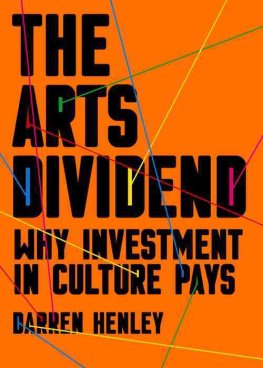 An opportunity to glimpse into the thinking behind Arts Councils is not common. Darren Henley of the Arts Council of England has written a crisp book stressing it is a personal rather than official perspective of the place of the arts within the public domain.
 It is a truism to say of the arts that they are various in mode, form, scale. Henley takes on a broadly held dichotomy early on. “I don't understand the distinction some make between “great” and “popular” he writes. “There are works of art that are ahead of their time, but few artists have striven not to be read, or to have their work leave people untouched. The greatest art is the most human. Given time, it will always reach its audience.” It is a bold statement. The theory is nice although there is no guide to cultural managers over selection. To fund or not to fund is still the question. Common words assume lethal meaning in discussion in the subsidised sector. “Accessible” has a pally ring to it. Lee Hall has written plays that have been seen by a lot of people. “Accessible”, says Hall, “is a lie perpetrated by those who want to sell us shit. Culture is something we share and we are all the poorer for anyone excluded from it.” Henley even kicks the word “subsidy” itself into the long grass. “But there's no subsidy. Personally, I cannot abide the term”, he says, “The Arts Council doesn't use public money to subsidise art and culture- it invests money for the benefit of all the public.” But each work attracts its selective public. The important thing is that there be a rich ecology, more easily achieved in a large jurisdiction like England than the vastly smaller ones of Scotland or Wales. Quality surely ought to be a yardstick. But aesthetic judgement over contemporary arts is a semantic and conceptual quicksand. It is a territory where authority is uncertain. Curators write nonsense. Academic departments juggle with conceptualising that lives awkwardly with the history of aesthetics. Professors pitch in with applications for performance. Their vocabulary is beyond the layman. Haptic, anyone? Arts council members may or may not informed about the domain. The domain is aesthetic judgement. Critics divide. Sometimes they indulge in a bout of collective breast-beating. The long-term valuation of “the Homecoming” was not that of the reaction at the time when it played Cardiff’s New Theatre. “We were all wrong” writes Michael Billington on page 355 of his authoritative book “State of the Nation.” Artists ought to be predictable and they are not. Martin McDonough is at the top of his game in film. His return to the stage, at the Bridge, met with critical loathing. Henley visits the fifth Manchester International Festival. The credits for “wonder.land” are formidable: Damon Albarn, Moira Buffini, Rufus Norris. When it arrives six months later at the South Bank it gets a one-star critical pounding. Henley cites Peter Bazalgette’s first speech as Arts Council Chair. “The arts create shared experiences that move us to laughter or to tears.” But sharing is a concept where the numbers are shrinking. Fin Kennedy has been charting the inexorable shift in England’s spending year on year away from theatre located in auditoria. The reasons are several, aesthetic fashion among them. Innovative form in one viewer’s eye is gimmickry in another. But formal novelty has a trend to drive down spectator numbers. The audience size which now gets to see Punchdrunk has fallen. Prices have soared at the same time that critical enthusiasm has sagged. Henley in his book travels widely both geographically and historically. He is enthusiastic about Manchester. The city under the regime of Leese and Bernstein has a sterling reputation for its quality of governance. He does not visit the West Midlands where the same does not apply. Birmingham Repertory Theatre has the greatest historical stamp of any theatre outside London. The city no longer provides the level of funding to cover the maintenance costs for the building that it owns. In the north-east he visits the Woodhorn Museum where the paintings of the Ashington Group are displayed. He is there because “the Pitmen Painters” toured the UK and did Broadway. But the group were amateurs and the paintings are those of amateurs. The one exception is Oliver Kilbourn who stands far above his friends. The historic interest of the Group is considerable but the artistic achievement overall is not. Henley draws from the work done by his Council. In the chapter “the Learning Dividend” he cites an ACE report from 2014 that taking part in drama and library activities improves attainment in literacy. Taking part in structured music activities improves attainment in maths, early language acquisition and early literacy. From the Cultural Education Challenge he repeats its conclusion: “every child should be able to create, to compose and to perform in their own musical or artistic work.” In the United Kingdom the schools in the Fro are alone in this. “The Innovation Dividend” is less convincing. In 2016 it was an easier and a more innocent time for the globe-spanning tech platforms. Streaming of arts events has been good for the rich. The prestige companies in opera and theatre have found themselves new audiences in cinemas around the world. The phenomenon is led by stars. Small organisations are crowded out. The Hampstead Theatre claimed remarkable numbers for a Stella Feehily play. But dipping in on a small screen does not mean lasting the full two and a half hours. If the book is high on enthusiasm its drawback is a certain blandness. “To my mind, if you want something truly popular, memorable and resonant art, it has to be the best.” It is a statement that goes round in a circle. Blandness is hand-in-hand with a lack of detail. “New financial models have the potential to unlock greater creativity in cultural businesses.” There is no detail. Arts organisations cannot raise equity and have limited debt facilities. As a statement it is opaque to the extent of frustration for the reader. “Positive reputations are hard won and easily lost, so continued investment is required if the benefits of this dividend are to be maintained over a long period of time.” Bland-bland. Decisions have to be made; the flagship companies are that, but there is no easy answer as to how much they ought to receive. Familiar stuff is regurgitated in pursuit of secondary goals. “Scientific evidence shows that taking part in artistic and cultural activities can improve our health...there are clear medical benefits in a number of conditions.” No references are offered. In fact disease could not care less whether a person reads a book or knows who Van Gogh is. There is a base muddle that reveals scientific ignorance. From an ACE Report. “Those who had attended a cultural place or event in the previous twelve months were almost 60% more likely to report good health, and theatre-goers were almost 25 per cent more likely to report good health.” This is just as likely the other way round, that the healthy go out. Sufferers of Parkinson's Disease or restless leg syndrome perforce are not at a theatre. Henley reveals himself as twenty years in broadcasting. The same infection can be smelt that is evident down in Mountstuart Square. “Technology enables us to create, distribute and market cultural products and services in new and exciting ways, many of which have yet to be imagined.” No examples are given. A pixellated version of a painting or a performance is not the object an sich selbst. It is a simulacrum. The infatuation with the not-actual-in-time-and-space reaches a conclusion. “Technology should be not seen as an add-on to what arts organisations do, but as a central pillar of their creative strategy.” But the word technology is a category descriptor. There are applications. They come in their millions and artists have to choose those that aid. “A central pillar of creative strategy.” It is language as display that says nothing. “The Arts Dividend : Why Investment in Culture Pays” says a lot, as much as any insider could put in as a statement of belief. But at the same time as it says everything it says nothing. In a culture of profusion the demand for funding, whether it be called subsidy or investment, outstrips supply. Arts Councils are allocation bodies. And to be in the public realm adds another dimension of complexity. Wales is unique in that the managers have to put up with the slippery instrument of the Ministerial “Letter of Remit.” To the outsider with no knowledge it is likely that decisions are reached in a way similar to other organisations: habit, past practice, compromise, balance, prior reputation. Lobbying, bias and politicking are all in the mix. D W Winnicott, the great child psychologist who became a surprise best seller, popularised the notion of “the good enough mother.” By analogy let the funder-rationer-allocators aspire to be the “good enough arts council.” That really is good enough. |
Reviewed by: Adam Somerset |
This review has been read 2560 times There are 18 other reviews of productions with this title in our database:
|
