| “No Discussion of Artistic Excellence, Let Alone Art” |
Arts Council Uncovered |
| Hodge Report on Arts Council Recommends Reform , Arts in England , February 9, 2026 |
 The Times published a letter on 10th May 2025 from Danny Moar, Director at the Theatre Royal Bath. He had been at a meeting chaired by Dame Margaret Hodge whom he described as “emollient and well informed.”
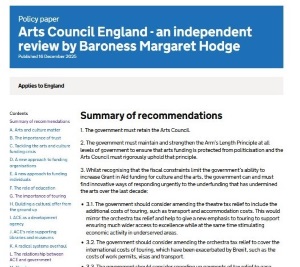
 But the letter continued: “Listening to my colleagues around the table...There was no discussion of artistic excellence, let alone art. It is clear the Arts Council sees the prime role of its clients is to be agents of social change rather than creators of wonderful experiences for its audiences. When will the Arts Council realise that its function lies in its name?” * * * * The Arts Council of England was reported as being tilted against smaller arts organisations. They were discouraged against making applications, the process being lengthy and dauntingly complicated. The requirements unrelated to artistic issues were of a particular difficulty. The report from Margaret Hodge, published on 16th December, was received with warmth. Ivan Hewett was the most uninhibited commentator referring to it as a “humiliation” for the Council. * * * * The report's core was that the Council must revert to the independence that is in its Charter. This duty is to be endorsed by the government. “The government must retain the Arts Council. “The government must maintain and strengthen the Arm’s Length Principle at all levels of government to ensure that arts funding is protected from politicisation and the Arts Council must rigorously uphold that principle.” * * * * FINANCIAL RECOMMENDATIONS “The government should consider amending the theatre tax relief, orchestra tax relief,speeding up payments of tax relief to ease cash-flow problems. “The government must consider enabling ACE to offer a wide range of financing options by having a trading arm. “This would enable public funding to go further by moving beyond repayable grants and introducing loans, blended finance, social impact investment and equity investment. “The government and ACE should consider devising a mechanism to bring money back to ACE when an NPO has produced a show that is a strong commercial success. In those circumstances ACE should enjoy a return through royalties, or a percentage of profits or a fee. “ACE should review legacy capital charges and title restrictions. These historical constraints impede organisations from securing private finance for capital investment. Such a review should look to establish a proportionate, time-limited framework to vary these charges, enabling organisations to leverage assets for urgent capital needs and unlock new investment.” * * * * FUNDING APPLICATION RECOMMENDATIONS “ACE should replace Let’s Create with a new, less prescriptive strategy that is both ambitious, simple and reflects the government’s ambition of excellence for all but that allows each organisation or individual to apply according to their strengths and the unique contribution they can make to delivering a vibrant and innovative creative sector that is consistent with the overarching strategy of the Arts Council. “There should be a completely new model for funding the National Portfolio Organisations. "Organisations would set out their unique contribution and the KPIs on which they would want to be assessed. The application would have to meet the ACE strategy and the KPIs would be negotiated. “All other monies should be devolved to new local and regional decision-making boards. These will comprise local artists, representatives of local community organisations, local education representatives and representatives from local government. “To provide stability, consideration should be given to enabling longer term planning and reducing bureaucracy. The government and ACE should consider the following changes: Lengthening the NPO cycle from three to five years. Having a rolling programme of applications. Assuring certain organisations, that meet the highest quality standards, that they will receive at least 80% of their funding in the next round. "ACE should radically reform its application and reporting requirements so that they are less bureaucratic and onerous for organisations but still ensure accountability for public money. ACE should also review its data requirements to demonstrate that the data it collects has a clear purpose and that the data demanded is appropriate for the different objectives of the different organisations and the different cultural disciplines. “ACE should review, simplify and reduce the number of its funding streams to make it easier and less bureaucratic for those applying for funding.” * * * * FUNDING RECORD “Between 2009-10 and 2022-23, per person public spending on culture by Arts Council England and Local Authorities fell in real terms, by 18% and 48% respectively. Some local authorities have completely cut their spending on culture. “At the same time the British Council has had to curtail its investment on culture, and NESTA, which enjoyed the benefit of a £250 million government funded endowment fund for the creative arts, has pulled out of funding of the arts.” * * * * GOVERNMENT CONTROL “With the current fractured political discourse, the need for an independent body seems even more important than it was when it was created in 1946. There have been attempts to exert more political control over ACE decisions in recent years and this has to stop. “The Arts Council must remain free from political interference. This matters. It ensures that artistic freedom is protected, that creativity is not stifled and that public trust is maintained. Political interference, even by those with the best of intentions, could lead to political bias, or even censorship. "Jennie Lee’s White Paper said “No one would wish state patronage to dictate taste or in any way restrict the liberty of even the most unorthodox and experimental of artists.” “This remains the case today and the almost universal plea from everybody who engaged with us was that we should protect the Arm’s Length Principle. "Democratically elected Ministers should set the overarching policy objectives but politicians should not have a role in making funding decisions. There was strong criticism of the previous government’s perceived interference in funding decisions during the last NPO round, and concern that the Arts Council did not defend the Arm’s Length Principle.” * * * * CORPORATE CULTURE OF COMMAND-AND-CONTROL “Whilst there was overwhelming support for the equality principles underpinning Let’s Create, responses to its implementation were often more negative. It was seen by many as a straight [sic] jacket; stifling artistic innovation and creativity. “People felt they had to tick all the ACE boxes to secure funding, rather than explain their artistic strategies and ambitions. People viewed ACE as a command-and-control funding body, rather than a leader and facilitator in the cultural landscape. “People felt that ACE was pursuing access to culture in an instrumentalist way and had lowered the priority given to the pursuit of artistic excellence. Art and excellence were sidelined. “I got close to the end of the application form before I was asked what I was proposing to put on stage,” one frustrated person said. Excellence and access to excellence were two principles that underpinned Jennie Lee’s view of the arts.” * * * * APPLICATION PROCESSES “There was almost universal criticism of both the application processes and the reporting demands. The larger organisations employed people simply to handle ACE funding applications, while the smaller organisations frequently outsourced the applications to a growing industry of funding experts. “So ACE money was being used to deal with ACE’s procedural demands, which in my view is wasteful. We all want a rigorous application process and strong accountability for spending public money, but the present processes are inappropriately long, complicated, bureaucratic – and expensive. government demands for information undoubtedly contribute to this unacceptably high level of bureaucracy. “In the last NPO round every organisation, whatever its size and whatever the artform, was required to provide the same information. People felt the application processes and the reporting requirements were not sensitive to differences in size and artform of organisations applying for funding. “So small museums that applied for funding provided the same information as a large theatre venue in one of our cities and towns. The systems were hugely and unnecessarily time consuming for everybody, from the ACE staff to the organisations, projects and individuals that ACE funds." * * * * TOURING DECLINE “Touring is facing a crisis. Funding cuts together with rising costs have forced many organisations to either stop touring altogether or to cut the number of days and the number of places they tour. “The cost of transport, the cost of overnight accommodation and the cost of moving everything from scenery to instruments to costumes has made touring increasingly unaffordable for a growing number of arts and cultural bodies. “A small rural theatre that attended one of our roundtables was facing closure because the visiting theatre companies could no longer afford to bring their plays to the only theatre in this rural area. If we really do want to ensure more and more communities access excellence, we have to rescue touring.” |
Reviewed by: Adam Somerset |
This review has been read 167 times There are 18 other reviews of productions with this title in our database:
|
