| Politics Good & Bad |
Public Event |
| Politicians and Historians , Hay Festival , May 30, 2013 |
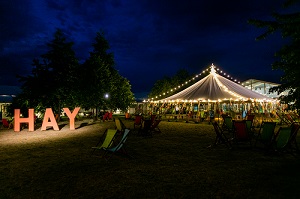 The Hay Festival, on the afternoon of its first Saturday, is sunny and seething. It is the day, in particular, on which the programmers have clustered a lot of history and politics. Wales’ National Librarian, until a few weeks ago, is to be sighted now as a plain enthusiast for books. The Minister of Education is on a platform, relaxedly off-duty, trading banter with a brace of historians and flying the flag for his native Rhondda. A BBC stalwart, who really knows his stuff, is sweetly hand-in-hand with a four-year old daughter. A television critic, blonde of hair and black of dress, flies past with purpose, as does the economist peer with the wild white hair and the editor-at-large with the wild black hair.
The programme for the day comprises sixty-four events. That makes inevitable some tough choices. Anne Applebaum on Eastern Europe coincides with Herefordshire MP, and backbencher of high principal, Jesse Norman. Applebaum’s husband was once one of the thousands of penniless Poles in exile after the Jaruzelski coup. Now he is among Europe’s most highly regarded Foreign Ministers. I miss her but get to four events that in their different ways illuminate the civic space. The range goes from the comfort of high theory to the genuine dilemmas of political practice. Primary knowledge is absent from the discussion between Jesse Norman and Geoff Mulgan. Hay audiences talk as they shuffle toward the exit. The cluster around me is in noisy agreement that The Locust and The Bee: Predators and Creators in Capitalism’s Future is unconvincing stuff. The book itself, of course, may well contain the meat. As a live event it has three demerits. First the body language is excruciating. Jesse Norman is one of the post-expenses-clear-out, parliamentary intake of 2010, and he has placed principle above promotion. Like the Member for Totnes, a health professional now barred by the Whips from contributing to health policy, he is my kind of parliamentarian. At Hay in 2012 he was deeply engaged with a Nobel prize-winner, steeped in humour, humility and a depth of primary research. These are absent, and the interviewee makes no eye contact with his host. In truth, Jesse Norman looks worried throughout much of what he is hearing. I have a lot of respect for Geoff Mulgan. He is hyper-bright and hyper-active. Twenty years ago he was writing percipiently on a taxation structure, that is unglobalised and under two hundred state jurisdictions versus a globalised corporate supply chain reporting to a single board. But the Hay talk sounds like not a lot more than classy journalism. The reduction of economic activity to a binary ontology comes over as crude. Acemoglu and Robinson went for a similar dichotomy in Why Nations Fail recently. The argument falters because it comes without illustration from primary experience. The normal company is like an average human being, a hot-bed of drive and ego, tetchiness and self-regard, routine and daring, with luck, circumstance and opportunism thrown in. A division into good-bad does not ring true. A popular hero in one country is a predator in another. See Huawei for a start. Mulgan goes for easy targets. He does not like the excesses of oligarch consumption. But it is far more interesting to ask why it is so important for his Party that a ghastly, unlit place like One Hyde Park needs to squat in London rather than Dubai or Minsk. Mulgan is backing new Studio Schools, which will fizz with creativity. But he was right there in Downing Street, when the education panjandrums decided to drop computing from schools in the public sector. That a solution to our ills is ‘visionary leadership’ says nothing. Mulgan has always had a wide-ranging mind. He reports interestingly from all over the world, an action undertaken by the Mayor of Sao Paolo or new US Companies explicitly writing social goals into their articles of incorporation. But he does not get the banks, not one bit. They had all the trappings of public companies but they operated as the biggest co-operatives on the planet. ‘Employee capture’ was the name of the game. Event 57 fills a timetabling gap and turns out to be something of a damp squib. One advertised participant is absent, a fact that goes without mention or apology. The event is not what is on the tin. The title is ‘the Eric Hobsbawn Lecture. The Age of Anxieties’ but it is not a lecture but a homage to Hobsbawn by two erstwhile colleagues. The first, by a historian for whom I have high regard, is eloquent and heartfelt. The second by a legal scholar of the highest distinction is reminder that expertise in one field is no guarantee of proficiency in another. As political commentary it hovers between the jejeune and the unsettling. The First Minister an hour later states that the challenge of an intention, specifically Wales’ inbuilt sustainability commitment, is ‘to take the Bill and turn it into something tangible.’ Politics is action. The impression from the visitor for Event 57 is of an utter disengagement from politics. The vocal argument is taken from a new book Philosophy and Resistance in the Crisis, an extension of an essay in ‘Critical Legal Thinking: Law and the Political’ of 2012. Both are coursed through with a category error, that subsumes all extra-parliamentary action into one. But to be in Tahrir Square is not the same as to be in Syntagma, and it is far removed from a family furniture store being torched in Croydon. The churn of Greek governments is celebrated as a good thing in itself, but not if all are stuck with the same policies. There is little relish to be had in the marching feet of Golden Dawn. The use of language is unsatisfactory on several counts. An incisive writer, in the form of Michael Lewis in Boomerang, has caught aspects of the rich detail that has led to the shipwrecking of Greece. Hay’s author does not do detail, but makes declaration that ‘Greece is going through what can only be called a ‘genocide’. Language is greater than a single human being and a true writer holds it in reverence. Genocide is too pregnant in meaning to be loosely tossed around as a metaphor for effect. This is the kind of book where an index will feature Jaspers and Gadamer, but does not trouble itself with Moody’s or Goldman Sachs. Habermas from 1935 is quoted with approval to the effect that ‘the naturalisation of spirit infected universalism and brought Europe to its near destruction.’ I have no idea what this means. A prose of high posture and grandiosity declares that ‘cynicism is the dominant ideology of the elites.’ This is the SWP with long words, also a short-hand for ‘we are much nicer people than those who actually engage in politics.’ The last two paragraphs of the book pile up one hundred and eight words of three or more syllables. The book can be sniffy about some accepted tenets of moral life. Fiction, when it works, gets it right in a way that tells. Thomas Mann hit it head on in his 1948 Doctor Faustus. The Hay platform took me straight back to his grisly group of characters, Kridwiss, Unruhe et al, emblems of the Weimar-era intellectuals in deep disconnection from political reality. I am, as it happens, an alumnus of the presenting institution and feel shame. At seven PM, Hay’s blackboard outside the Landmark 100 tent is marked simply ‘C. Jones.’ Geoff Mulgan in the afternoon has repeatedly drawn attention, and made comparison, with smaller jurisdictions. But the United Kingdom is never going to be an Iceland or a New Zealand, or a Wales. For a start C Jones is present on his own, with not a civil servant or policy wonk to be seen, just a Premier with a group of engaged citizens. He opens with a mention of the long queue nearby that has assembled to hear the Chancellor of Portsmouth University. ‘Even my wife has gone’ he says ‘She hears enough of me talking already.’ The ostensible subject is the Sustainability Bill, but as it has yet to be drafted, it is a little premature. The discussion moves about and, not for the first time, the grasp of detail on show is remarkable. C Jones knows his jurisdiction in a way that a Westminster counterpart could not. A polity like one from Tamar to Tyne (by the time the Romantics of UKIP have done their stuff) is simply too big. C Jones seems to know at first hand the traffic that can clog Newtown at the wrong time. He is clear in response to a local questioner that Bronllys needs more housing association accommodation. He knows the exact numbers for Wales without Brussels. And he speaks in plain language. Take out the CAP and ‘hill farming, forget it. It’s dead.’ An arts writer is an observer, not a government spokesperson, but the event in its spirit of openness and exchange, the good humour, the sense of mutuality between political representative and the represented is cheering. |
Reviewed by: Adam Somerset |
This review has been read 612 times There are 21 other reviews of productions with this title in our database:
|
