| A & B Two Centenaries: Abse & Burgess |
Public Event |
| Leo Abse Reformer & Parliamentarian , Politics and Society , April 28, 2017 |
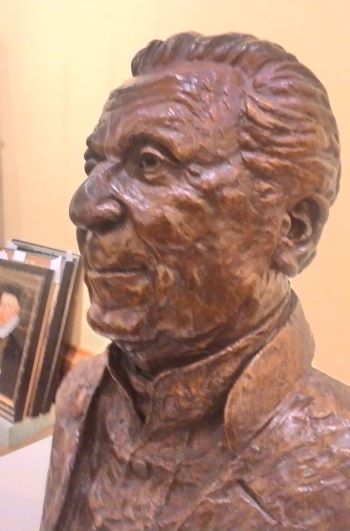 Sculpture is the most public of the visual arts. In March 2014 barricades of defenders formed in Kharkiv to protect a statue of Lenin against assault. Hundreds nonetheless were felled across Ukraine.
 The plasticity of sculpture, its physicality and three-dimensionality, exert force. The poet Dannie Abse once stood beside a head of Dylan Thomas head for a television documentary. It was, he said, an “astonishingly wild and haunted Dylan head staring into space, his tie awry, a cigarette drooping between his lips.” The dead”, he concluded, “can sometimes come alive for a moment.” It is the nature of sculpture too, its expense, that it tends towards those of perceived accomplishment. It leans towards subjects who are marked by age. That is no disadvantage. A face in its period of vintage acquires contours, folds and slackenings that are absent in youth. I am in the company of one such face. An upper chamber of the National Museum of Wales, used for storage, has fifteen canvases leant against its walls. Storage boxes of wood hold other artworks; twelve long rolls of cardboard are containers for prints. But my attention is for Leo Abse, whose bust stands on a white plinth. The head of Abse is cocked slightly rightward. The richness of expression, and also its lability, lie in the net of musculature that adjoins lips and eyes. The sculptor Luke Kenward has given his subject a pucker of indent at the corner of the mouth. The expression hovers around- but is not quite- a smile. Character in a face arises from its small asymmetries. The direction of sight of the left eye varies from that of the right by a small angle. It imparts to the viewer a gaze simultaneously both close and distant. Abse in this simulacrum projects a force of will and a gentleness of old age. The furrows on his forehead are etched deep. The cheekbones, also asymmetrical, are sharply prominent. Around his neck his characteristically flamboyant dress gathers. Like all good sculpture its complexity grows as the visitor circles around and sees new perspectives. My twenty minutes of company alone with Leo Abse are good ones. 2017 has been a year in which Leo Abse has been remembered as a parliamentarian. Ten years after the Wolfenden Report recommended the decriminalisation of homosexuality it was Abse who persuaded Home Secretary Roy Jenkins to give government time for reform. The Act rightly has had more attention than the man. It has gone unnoticed that it is also Abse's centenary, his birth date being 22nd April 1917. By contrast another centenary has been commemorated. The International Anthony Burgess Foundation in Manchester held a three-day conference to commemorate the centenary of the author, born 25th February 25th 1917. There is no record that the two men ever met. In 1967, the year that the Sexual Offences Bill passed into statute, Burgess' life was its customary whirligig. He was hard at work at home, his daily schedule an unvarying eight hours at his desk. In his capacity as critic a new translation of the “Rubaiyat” of Omar Khayyam by Robert Graves was one of the books to receive his attention. Among the places he visited that year were Nashville, Boston, Amherst and New York on a reading tour of his novel “Tremor of Intent.” He visited the two sides of Berlin, describing the lethal barrier that divided them as “a bricolage of decayed buildings.” Abse was the consummate backbencher who never hankered for ministerial office. Burgess by contrast declared his own apolitical stance. “I had never had strong political beliefs”, he said giving it a characteristic emphasis: “If I was a kind of Jacobite Tory, like John Dryden and Samuel Johnson, this was because socialism was positivist and denied original sin.” Nonetheless, the two men are linked in several ways, not least by an uncommon piece of vocabulary. “Catamite” appears in the first sentence of “Earthly Powers”. “It was the afternoon of my 81st birthday, and I was in bed with my catamite when Ali announced that the archbishop had come to see me” is the most famous opening line of a novel in the last part of the century. Abse used the same word to describe the relationship of Daniel Defoe to the monarch in a strange book of literary exploration. Abse too was an author, outside his parliamentary life, of six books. The contemporaries, A and B, were subject to the same cultural influences and four other factors unite them. Abse was born in London and Burgess in Lancashire. But both felt an estrangement from the main flow of an historic Englishness. Burgess amplified his Catholicism to represent a divergence from mainstream culture that went back to the Reformation. Abse told Tam Dalyell, a fellow backbencher of independent mind, that his surname was not shared by any other family of Jews in Western Europe. Nor did the family resemble the Ashkenazis who formed the majority in Britain. He declared his family to be Phoenician in origin, resident in Tyre long before the Jewish arrival in Canaan. As a young MP Abse had received advice from another AB, Aneurin Bevan, to cultivate irreverence. Bevan returned home to Jenny Lee in the evening and reported Abse's response: “however the English ruling classes might appear to a Celt, to a Phoenician they are mere parvenus.” A vein of showmanship ran through both men. Burgess was made for the television age, popular with producers of chat shows for his energy and powers of spontaneous articulateness. Leo Abse was a dandy whose dress preference made his distinguished tailors of Dover Street nervous. Nonetheless, Kilgour, French and Stanbury made the fine clothes that were requested. A favourite outfit was a brown and black Prince of Wales check suit with cuffed sleeves, a lapelled waistcoat and no turn-ups. Abse's appearance was completed with a huge amber signet ring. Of his tailors' work Abse said: “since I've been elected one of the ten best dressed men in Britain, they're getting into the spirit.” The intellectual scope and interests of both men were of a breadth to startle. The subject matter of the Burgess books vault across the continents and the centuries. The journalism has an air of authoritative knowledge that dazzle. In the Commons Abse was the first parliamentarian to initiate debates on genetic engineering, the dangers of nuclear power generation, in vitro pregnancy. He was an authority on suicide, delinquency, adoption, the prison system, capital punishment, homosexuality, contraception, legitimacy of children, widows' damages, industrial injuries, disability, relief from forfeiture were all his domain. The change in the Divorce Reform Act of 1969, that allowed divorce after a marriage had broken down, was his. He despised the system that had prevailed before that necessitated the faking of adultery. And lastly there was Freud. Freud is a cultural titan, although not as titanic as he once was. An age of pragmatism and evidence has moved to cognitive-behavioural therapy. Abse encountered psychoanalysis as a teenager and he was saturated in its influence. “Politicians hate psychoanalysis,” he said: “They are all extroverts who affect that there is no internal reality, that reality is only external.” He turned his attention to another man with the initials AB, Anthony Blair. His book on Blair is in two versions, the original in 1996 and the revision “the Man Who Lost His Smile” in 2003. It is a compelling read of a wild strangeness. Even Tam Dalyell, his parliamentary comrade in arms, thought the treatment over the top. Abse on his leader is author of a book of 230 pages in which Gordon Brown has four index references and Freud has 22. The Prime Minister is a Freudian repository of narcissism and exhibitionism, But that is just a start. We are all in it, all succumbing to the “androgyny” that “infantilises the electorate.” A critique of the leader's “debased charisma” jumps to Akhenaten “lacking a phallus or more usually with an explicitly hermaphrodite anatomy.” New Labour's skill in creating a breadth of support is a “Sade-like desire to deny differences”. From there it is straight to Freud on fetishism. At the core Abse saw a case of a man “drenched in unconscious guilt towards his father.” Guilt is intrinsic to the religious consciousness. “There is no worse neurosis”, wrote Burgess, “than that which derives from a consciousness of guilt and an inability to reform.” Burgess put Freud in a novelised form as one of the three narrative strands that make up “the End of the World News” from 1982. Freud is first encountered in his Viennese flat, a prosthesis in his mouth for his cancer. A group of rough youthful Nazis is interrupted by Ernest Jones, Freud's Welsh biographer. Jones and the Gestapo are remarkably similar to Seamus Toomy when he encounters Nazis in “Earthly Powers.” Burgess sends his Freud into company with Kraft-Ebbing who deplores his theories of childhood sexuality. At the theatre Freud explains to the Breuers that the self-blinding of Oedipus is a metaphor, the eyes standing in for the testicles and self-castration. Back at home Freud wonders over whether the terrible accounts he hears of abuse within a family may or may not be imagination. Burgess illuminates this first world of psychoanalysis with colourful relish. Ferenczi faints on hearing the case study of the Rat Man. Otto Rank is an adoring acolyte. Freud and Jung share case studies of verbal association and transference. But the fissures escalate. Adler provokes argument. Zurich and Vienna vie to be the headquarters of the International Psychoanalytic Association. Eventually Stekel declares: “We are sick of your dictatorship. We hereby declare a reformation.” The master is helped to escape Austria and Burgess' Freud ends in exile in Hampstead in discussion with Ernest Jones. War confounds all the rules about the father-son relationship. Maybe, says Jones, it is the route out of sexual repression. The novelist on Freud is an explorer and a critic where the parliamentarian is a disciple. But legislators should not be judged by their strange books. The writer in the Abse family is brother Danny. The posthumous reputation of Anthony Burgess twenty years on is high but still lacking a definition of outline. Back in 1993 Malcolm Bradbury recognised the vast volume of output as “the great postmodern storehouse of British writing”, and its author, “An important experimentalist... an encyclopedic amasser.” Andrew Motion laid down the critical challenge that has remained. “There's so much by him and no-one reads it all and partly because, for all its brilliant technique, it is not always easy to see where the centre lies.” But the work is being republished and attention, as evidenced by the conference, is high. For politicians the legacy is more clear-cut. They are their deeds. Dannie Abse said of his brother that “he can rightly be termed Britain’s top reformer of the twentieth century, having inspired nine Private Member’s Acts.” They had a purpose in common, all “designed to heal troubled personal relationships…eschewed by more timorous politicians.” The best assessment of those in public life is made by their political peers. Leo Abse received as fine a commendation as there might be from a Prime Minister. James Callaghan: “you do more good in terms of human happiness than 90% of work done in parliament on political issues.” That is an epitaph to treasure. Leopold Abse 22 April 1917 – 19 August 2008 |
Reviewed by: Adam Somerset |
This review has been read 22 times There are 21 other reviews of productions with this title in our database:
|
