| A Look-back and Guide |
Actor Theatre Book |
| Actors , Books on Acting , March 29, 2026 |
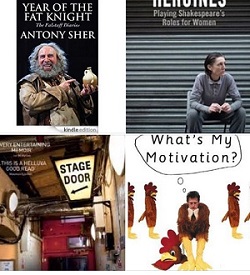 Books by and about actors reviewed below:
30 March 2026: Luke Evans "My Unexpected Journey" * * * * 4 April 2024: Declan Donnellan “The Actor and the Target” “Adolescents discover that the more they want to tell the truth, the more their words lie. They can feel doomed to generalisation, an abyss where their unique voice will remain unheard...there is always a gap between what we feel and our ability to express what we feel.” That gap- the world within our head and its oft uncomfortable encounters with what occurs without- underlies much of Donnellan's discussion of theatre. It is not always easy for the reader who is not an actor but, like poetry, it is never less than stirring. “We cannot force ourselves to see. We can manipulate ourselves not to see, and are expert at that. We can only force ourselves to “look at” things. But “looking at” is quite different from “seeing”. The difference between looking at and seeing is crucial for the actor. Seeing pays attention to what already exists. Looking at is more safely about me, which I can turn on and off like a tap.” * * * * 26 September 2019: Michael Simkins “What's My Motivation?” “Actors are ripe for pummelling by managements. The hazards of the acting life are as numerous as they are varied. Simkins must be the last word on the terrible fate of the poor players who encounter the Director with the Concept. And all the time, for the reader, it is squirmingly comic. “As a tale it ends well, on a high, acting alongside Malkovich in “Burn This”. If Simkins is finally there for a sell-out at the Hampstead Theatre, the route has been via Hornchurch, Harrogate, Billingham-on-Tees, Poole. He describes a journey from Potters Bar to Middlesbrough. A fellow cast member owns a VW Beetle to share the cost. But its floor has a hole in it and the mats rise on an inch of water. In a life of uncertainty the pursuit of love too is uncertain. But the Simkins romantic life also ends happily.” * * * * 31 March 2018: Harriet Walter “Other People's Shoes” “Look for the fear. Fear is a great clue to psychological motive. “Harriet Walter writes of the art where the self yields up its fixedness of being itself. “Since I was very young”, she remembers, “I have been able to watch someone and imagine myself inside them, moving their limbs, striking their poses and by some strange mechanism, getting an inkling as to their feelings and thoughts.” But she runs up against the limits of description. “It's hard to explain how it's done because it is not a systematised process; it is just part of our equipment.” “The genesis of every actor is its own. The book is not an autobiography but she is sharp on the differences and the commonalities in her parents. “What they also shared was a well-concealed but deep lack of self-confidence.” The adult child sees a common cause: “both had a dominant parent who had given them a sense of failure.” The effects of separation and private school in her own experience are dealt with economically. She writes of the elasticity of the teenage persona: “I started to capitalise on my versatility, being one thing to person, one thing to another.” * * * * 5 February 2018: Harriet Walter “Brutus and Other Heroines” “Playing men was not so much about putting on deep voices or blokeish walks; it was more about stripping away feminine gestures. We found so many of our cultural habits...were about accommodating other people and making ourselves less threatening. We tried to get into a mindset of entitlement; entitlement to be seen and heard. To take up space and dominate a room.” * * * * 19 December 2017: Michael Pennington “Let Me Play the Lion Too: How to Be an Actor” “When he is in Ronald Harwood's “Taking Sides” his preparation by way of historical research is substantial. Then he encounters his director in the form of Harold Pinter. Pennington reprises the tale of a young Alan Ayckbourn enquiring of the author what Stanley in “the Birthday Party” might be thinking but not saying. “Mind your own f***ing business” is the Pinter response. “He has the actor's take on previews, a habit more or less invented by Peter Hall. The cast's stance is split: “ however many previews they're never quite enough- except that by now they want to get the thing on and running.” He is both acid and confessional on the subject of awards. “You might as well compare someone who specialises in meringue glacé with someone who is good at gutting a fish on the grounds that they're preparing something to eat...comparing a performance of a Shirley Valentine with a Medea is about as stupid an activity as you can get involved with.” He is appalled by the anonymity of web opinion.”Public reviewing” he says “is a responsible job that should be done with care and an open mind.” * * * * 27 November 2017: James Hayes “Shouting in the Evenings” “James Hayes has a section headed “the Mighty Bodger.” In one year he acted in five Bogdanov productions. He homes in on the Calderon, the de Musset, the Brecht and the Shakespeare. Hayes was also member of the cast for “The Romans in Britain” and he retells the tale in all its dismal detail. The obituaries to Michael Bogdanov this summer past were filled with love and reverence. They were also polite. If a director of his time were his equal in tempestuous passage then we are yet to know. Hurricane Michael he was and here he is in the Cottesloe at the technical rehearsal for “the Mayor of Zalamea”. He decides the set does not work and it is got rid of. “This was a typical example” observes the actor “of Michael's fearlessness.” “Later he qualifies this. “I have often felt that Michael is the greatest hit-or-miss director in England.” (That “England”- sic.) “When his productions work they are a joy to be in and behold. Goldoni's glorious comedy”- this was the “Venetian Twins”- “gave him a wonderful opportunity to exercise his outrageous sense of fun and anarchic sense of comedy.” * * * * 20 December 2016: Robert Sellers “Peter O'Toole the Definitive Biography” Every great acting presence possesses an alchemy of its own. In the case of Peter O'Toole to read the biography is to be reminded of the experience. In “Lord Jim”, on a giant cinema screen in 1965, the camera looked deep into those unique eyes with their fathomless wells of suffering. O'Toole's film record has like all film records its highs and lows. His General Tanz in “the Night the Generals” is to be seen regularly on the Sony film channels. “The Stuntman” of 1980 vies with Truffaut's “Day for Night” to be the film industry's best ever film about itself. His film director Eli Cross is a masterpiece in a master film that is too rarely seen.” * * * * 22 July 2015: Anthony Sher “Year of the Fat Knight” “The drawings, Sher reveals early on, date back to 1996 when art therapy was part of the regime at a clinic for cocaine dependency. It is the reverse, he says, of psychotherapy, giving the image primacy over the word as the route to self-expression. As for Sir John, his is the Shakespearean role that is a paradox, a star role that many a star avoids. Sher cites Oliver’s waspish comment on his reasoning for not taking on Falstaff. His own first reaction is severe. “Me as Falstaff? Short. Jewish, gay, South African me as Shakespeare’s gigantically big, rudely hetero, quintessentially English, Fat Knight? It made no sense.” * * * * 1 December 2014: David Weston “Covering Shakespeare” “Covering Shakespeare” is a successor to the author’s “Covering McKellen” which won the 2011 Theatre Book Prize. David Weston’s opening line speaks of “a mishmash of facts and reminiscences.” That may be. But one person’s mishmash is another’s rich and varied peregrination through personal, theatre and occasionally national history. “Benedict Nightingale, in his foreword, declared himself at a loss when seeking an adjective to capture Weston’s earlier book. “Covering Shakespeare” similarly eludes genre. Among the actors and directors who parade by the score through Weston’s career high and low is Michael Simkins. Like Simkins Weston is an actor with a second gift for writing. 2014 will not have produced a wider, more spirited, or simply more enjoyable theatre book. To borrow a line from “Measure for Measure” “he that hath made you hath made you fair hath made you good”.” * * * * 6 July 2014, 5 July 2014: Simon Callow: “Being an Actor” The one that has lasted and lasted. The low: “unemployment is “the primeval slime from which actors emerge and to which they return.” The high: “It wasn't to be seen. It wasn't to impress. It was to do it, to revel in this newly discovered joy, to romp around in the adventure playground that I myself had become...the happy accident of hitting my own centre...The circle was now complete. The intellectual understanding fused with the sensation. Not only was I doing the right thing, I knew what it was, so I could it again. It was mine.” * * * * 28 August 2013: Michael Simkins “the Rules of Acting” Simkins' tone is distinctive, the end-of-third-year summer showcase “horrid, frightening, sphincter-tightening, occasions at which it’s all too easy to feel like a total loser.” * * * * May 2013: Paul Harvard “Acting Through Song” “Youtube” he writes “is a curse for the modern actor.” On the one hand a performance from the past casts too great a shadow on the present. On the other the internet is a simulacrum of a performance. What you see is not how it was. He is quite right. For the actor preparing, for example, “the Drowsy Chaperone” Summer Strallen doing “Show Off” on Youtube may be irresistibly tempting but is of small advantage. “Harvard’s exercises are illuminating for the non-performer. “Walking the Punctuation” sharpens awareness of the precision of vocal timing. He has a nice metaphor of the audience as a dancing partner. Some of his insights are applicable across the arts. “Concentration destroys attention” he writes, acknowledging a debt to Declan Donnellan. This is akin to the painter who steps back over and over to gauge the effect from afar that the strokes of the brush have made close up.” * * * * 7 September 2012: Andy Nyman “the Golden Rules of Acting” Andy Nyman is twenty-five years out of Guildhall. He has driven vans and lorries, entertained at children’s parties, worked in retail and done magic. And he has acted. His lean honed guide has the authenticity of being written from the frontline. For any actor numbed by the technical rehearsal there is no need to feel guilty. They “are always” says Nyman “slow, soul-destroying and miserable.” Hard partying, alcohol and other substances will erode the capacity to learn lines after age fifty. If you are working, savour every moment of the job. You will never know how far away is the next one.” * * * * 24 January 2012, 25 January 2012: Tom Rubython on Richard Burton “And God Created Burton” is a hymn to rampaging heterosexuality. “The 20-year flung herself into the arms of her 33-year-old lover. As she pressed her lips against his, Burton had no choice but to respond in kind.” No choice is to be had with all this pulchritude on offer. One wife is “a very striking woman, who always made a brilliant first impression, particularly for those men who appreciated willowy, small-breasted blondes.” First wife Sybil meanwhile has a secret. “She was a very down-to-earth housewife in the best Welsh tradition.” * * * * 13 January 2011: Simon Callow “My Life in Pieces” On the effect of drama school: “You will learn to live with language in all its many forms in way that that the whole temper of the times denies. You will learn how to access and use parts of your body and your brain that you scarcely knew existed. You will discover rhythm and tempo, absent for the most part from daily life. You will learn to look at life with the keen eye of someone who has to reproduce it. You will learn, as Brecht said, to drink a cup of tea in forty different ways….You will have to think about history, about the past, about the present and the future, and you will have to ask why the theatre has been central to the life of society for more than two-and-a-half thousand years.” * * * * 5 December 2009: Michael Munn on Richard Burton “The most revealing aspect of Munn's book is the degree of pain that Burton suffered. It is known that in late life he had to undergo a perilous operation for a spine coated in crystals of alcohol. The alcohol had a cause. It had started, Munn says, when a prank of a laced drink caused the student Burton to fall down a staircase. The event was the cause on and off of pain for the rest of his life and Munn records later effects on stage and film sets.” * * * * 5 October 2009: Richard Eyre “Talking Theatre” “Eyre guides his interviewees towards their experiences with directors. Victor Spinetti is enormously revealing on the work that went into “Oh! What a Lovely War.” As for Joan Littlewood, says Spinetti “She watched a lot and listened a lot and used what was coming from us, but she had a framework in which to put that.” The production moved thousands but was made in a spirit of “She'd say “Our job is to entertain. We're seducers.” Judi Dench goes to the heart of the relationship of actor to script.”The thing about acting is: you don't play what's on the page. What you play is like that cake called mille-feuille, which is made of thousands of layers of that thin pastry. It's as if the line is the bit of icing on the top. The bit you're playing is the fifty-ninth bit of pastry. So that what you're saying is one thing, what you're meaning is another.” Eyre asks “is it difficult to talk about acting?” Dame Judi: “I don't think we should talk about acting because there's nothing to talk about, really. It's as if we are blank canvases. It's the play and the author and the author's intention that energise the actor. It's only when you're telling the story that you're doing your job; after you've done that you've done that there's nothing really to talk about.” |
Reviewed by: Adam Somerset |
This review has been read 889 times There are 20 other reviews of productions with this title in our database:
|
