| A Performer's Tale: Teenage Isolation to Stage & Screen Success |
Actor Theatre Book |
| Luke Evans- Boy From the Valleys: My Unexpected Journey , Ebury Books , March 30, 2026 |
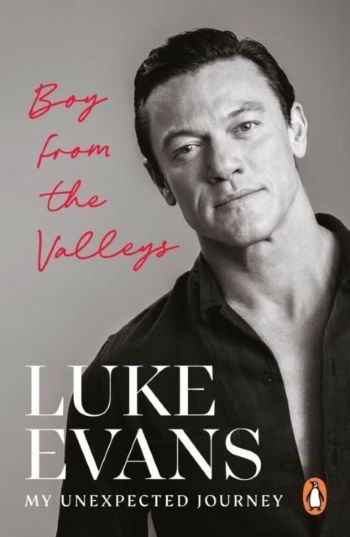 “My Unexpected Journey” is bracketed- its opening and closing- in a theatre. It was the occasion of Luke Evans returning to act on stage after an absence of more than a decade.
 “Backstairs Billy” in the winter of 2023 was a critical and popular hit. He writes how the energy required in the eponymous central role would send him back to the dressing room drenched in sweat. The production was a marvellous one. The fact of his time in film made a difference. Two Japanese fans, he records, went to the first thirty performances. The film years- the USA to New Zealand for “the Hobbit”- are described with an accelerating gusto. Their ingredients are serendipity, excess, wonder. The actor, surprised at each new turn and opening, confesses to feeling at times a sense of imposter syndrome. The pace grew: five films in 2009, another four in 2010. The speed is driven by his change of agent: “Once I'd signed with William Morris it was as though someone hit the fast-forward button in my life.” It also propelled him into new encounters. He recalls a weekend with Don, a businessman, who carries several bags of white powder and declares “the joy of travelling private!” The weekend overall, on a yacht in Ibiza, is alarming. “I was so scared by the experience it would take me a good ten years to go back to Ibiza.” His earlier career on the London stage is powered by a relentless industry. A night of performance at the Donmar Theatre is preceded by rising at 9:00 in the morning for a day stint in a restaurant. He has a gift for musical theatre. “Taboo” of its day is loosely based on Boy George and the era of punks and New Romantics, Steve Strange and Lee Bowery. After roles in musical theatre he makes an unexpected transition to drama with a revival of Peter Gill's “Small Change.” The experience is wholly new with two pages given to the experience of Gill as a director. The focus on the rhythm of the dialogue is intense. Gill uses a metronome to set the discipline of the speed of delivery. He confesses the anxiety: “Imposter syndrome had kicked in the second I set foot in the room . ..I can't exaggerate what a giant leap it was for a musical theatre performer to get a job like this.” If the professional years are recounted as a Candide-like picaresque swirl the account of childhood to the time of leaving home as a teenager is in sobering contrast. School, and life, in Aberbargoed is one of constant bullying. The fact of being within a Jehovah's Witness family adds to the isolation. Gatherings of the faithful run to the tens of thousands of Witnesses gathering at the Stadium, then the Cardiff Arms Park. There is much music in the house: the Beatles, Bay City Rollers, Bowie, Petula Clark, Cliff Richard. He finds a Roberta Flack CD with a cracked case for £1 in a bargain bin in Woolworths. He plays “The First Time Ever I Saw Your Face” “whenever I was feeling lost and alone and it was like a release for me. It taught me about the power of music.” His entry to a bigger world is, like so many others before him, via the Eisteddfod route. Escape from the suffocation of religion comes with the encouragement and the early prizes that music is able to give. He takes music lessons with Louise who enters him into competitions of German lieder, Italian aria, Welsh hymns, and pop ballads. “When I returned home that night it was with an armful of trophies engraved with my name” He has left school unqualified. Louise recommends the Studio Centre and a Diploma in Musical Theatre. Consciousness of his sexuality early on is coupled with the knowledge that it makes him a person to be excoriated in the eyes of his parents' faith. A household favourite “My Book of Bible Stories” has a picture to scare. Lot's wife is mid-way to being turned to a pillar of salt. “I discovered the reason the people of Sodom and Gomorrah were considered so abominable was because they were homosexuals.” The difficult path to emancipation begins on shopping trips to Cardiff with his mother. He slips away to the Chapter and Verse bookshop. A single book can be smuggled back home tucked in the back of his waistband. The first literary encounter, and sense of connection, is surprisingly E.M Foster. He reads with a thrill the blurb on the back of a copy of “Maurice”. Luke Evans was born in 1979; his description is a jarring reminder of how harshly the treatment of a child might be just a few decades ago. As for visits home the Witnesses have severed his roots. To be disfellowshipped entails that he be shunned. “I should be sharing my life”, he writes, “with my childhood friends, but I can't because the religion has forbidden them from speaking to me.” |
Reviewed by: Adam Somerset |
This review has been read 224 times There are 20 other reviews of productions with this title in our database:
|
