| "Turns the Language of Performance into the Language of Words" |
Theatre Critic Book |
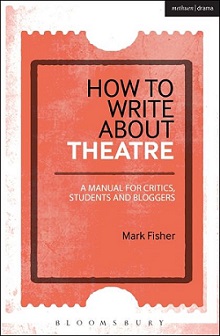
| Mark Fisher: How to Write About Theatre , Bloomsbury Methuen , September 27, 2024 |
 A year ago, 27th September 2023, the Arts Council of Wales announced there would be a review into English-language theatre.
 The time of the review is ripe this season; the Council will have a report to consider in the weeks before Christmas. The review ponders territory that reaches beyond theatre and its makers. Art needs writers in its audience. Culture is conversation. In that public conversation culture reaches completion. But the making of writers to make the conversation is not easily done. A lot is written about theatre but how to write about theatre by contrast is little written about. A university in the mid-west some years back attempted a dedicated programme on the subject some years back. It did not flourish. The former German Democratic Republic (1948-1989) tried to get beyond bourgeois reviewers and train a cadre of attuned writers. A writer, Erich Loest, had the task of training the new reviewers. “It was horrible,” Loest wrote, “I was unhappy. They were even more unhappy...After half a year the whole thing collapsed.” Wales has had one programme on theatre criticism. The National Theatre of Wales in February 2010 launched a six-month initiative of induction and mentoring for future critics. It was successful, its values flowing through this site for one. Mark Fisher has written a formidable book on the topic. One of Scotland's long-standing critics, he has fashioned a book that is as equal in its deftness of touch as in its comprehensiveness of treatment. He ranges from literature of old to the modes and styles of bloggers. In a look at responses to Tim Price's “Teh Internet is Serious Business” he cites a review written in a dialogue replete with emojis. Fisher's own prose, of a limpid clarity, opens: “Writing about theatre is an act of translation. It turns the language of performance into the language of words. More precisely, it turns the languages, plural, of performance into the language of words. Every show speaks in many tongues...you will find yourself moving from the rich Babel-like conversation of live performance to plain, two-dimensional prose. Things will get lost in translation.” He reaches to an early practitioner. Sir Richard Steele, the most illustrious literary figure to be buried in Carmarthen's St Peter's Church, was both playwright and critic. In 1793 he wrote in a preface to his play “The Conscious Lovers”. “It must be remember'd, a Play is to be seen, and is made to be Represented with the Advantage of Action, nor can appear but with half the Spirit, without it; for the greatest Effect of a Play in reading is to excite the Reader to go see it; and when he does so, it is then a Play has the Effect of Example and Precept.” As for the distinctions and boundaries of comment Fisher sees the critic as one who roams wherever is necessary “bringing in history, philosophy, aesthetics, sociology and anything else to illuminate the experience.” “Mary Stuart”, one of the greatest plays ever about power, may be enjoyed without reference to philosophy. But Schiller’s adherence to the Kantian categorical imperative underpins his dramatic necessity that the lead character confess to a private crime. If a critic points it out they are merely making evident something that the work contains. Likewise Shaw may be enjoyed, on his rare outings these days, without a knowledge of Nietzsche. But Nietzsche adds a light. "The Crucible" has an innate grip. To know of Joseph McCarthy adds density. All human activity is steeped in history and framed within principle and convention. Fisher traces the evolution of theatre criticism. Its intellectual fulcrum was Italy. The ideas of Horace in his “Ars Poetica” prevailed. The rediscovery of Aristotle led to the publication in translation of the “Poetics” in 1498. A set of rules emerged and the role of the critic was to judge the extent to which the work complied with precedent. It was a notion of aesthetics that Orhan Pamuk's novel “My Name is Red” displays. The practice of writing about theatre at all was slow to start. The first newspapers in Britain commenced in the 1620's. Tentative comment on theatrical performance began seventy years later in the Gentleman's Journal. The first journal devoted to theatre was launched in 1734. The Prompter was written by Aaron Hill and William Popple, came out twice a week and featured articles on theatre managements, government, acting, audience behaviour and the suitability or not of subjects for dramatisation. Another generation was to pass before periodicals in the 1770s began reviewing productions regularly and consistently. Satire, an ever sign of cultural vitality, was quick to follow. Sheridan in 1779 had some fun in “the Critic”. Far too much focus on morality ran its complaint- “insipidity succeeds bombast.” In other developments of the time the Morning Chronicle went on to give William Hazlitt his first platform as parliamentary reporter and then a critic. This dual interest foreshadowed the careers this century, for better or worse, of Ann Treneman and Quentin Letts. Developments were similar elsewhere. In Dublin in 1748 the Tickler began to publish reviews from the Theatre Royal by Paul Hiffernan. In Scotland the Edinburgh Theatrical Censor lasted for twelve issues in 1803. It had an aim to be “a valuable repository of living opinions” intended to serve as "a vehicle for the communication and diffusion of those refinements, which tend to the well-being of a civilised community.” Across the oceans developments were similar. William Lyon Mackenzie for the York Colonial Advocate and Joseph Howe for the Novascotian became the leading critics for Canada. The Australian took the lead in covering Sydney's theatre. New Zealand had the Gazette in Wellington and the Spectator in Auckland. Theatre reviewing in the American colonies predated the Republic. The Pennsylvania Gazette began to publish theatre reviews from 1757. Critics were still yoked to the necessity to judge theatre by its compliance, or not, with theory. This placed the critic of the Universal Asylum and Columbian Magazine in a dilemma in 1790. Royall Tyler's “The Contrast” was a landmark as the first professionally produced production by a citizen of the United States. The reviewer was obliged to write “We cannot by any means pronounce this a perfect comedy. Little or no adherence has been paid to rules.” But with a new century everything, as detailed by Mark Fisher, was to change. (To be continued.) A guide to this sequence of books by theatre critics can be read on the first link below. |
Reviewed by: Adam Somerset |
This review has been read 868 times There are 22 other reviews of productions with this title in our database:
|
