| “The Critic Needs to be Alive to the World" |
Theatre Critic Book |
| Mark Fisher continued: How to Write About Theatre , Bloomsbury Methuen , October 3, 2024 |
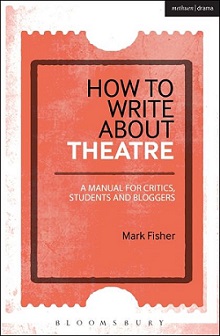 The brief for the review of English-language theatre from the Arts Council of Wales is short, to the point and dispenses with the verbal fog that bedevils the flourishing of public culture. An arts culture of commentary and feedback is not made explicit.
 A O Scott in his “Better Living Through Criticism” put it as: “Criticism is art's late-born twin. They draw strength and identity from a single source.” Scott is an American. Closer to home Gary Raymond paid tribute to the power of the critic to shape culture. In 2013: “If I go to see a Rothko in the Tate, I don’t need to read a review to know what that is, but the truth is I would never have understood Jackson Pollock’s paintings were it not for John Berger’s essay on Jackson Pollock. So criticism is part of the experience of art – it’s the conversation. And the conversation is the important thing.” The first article on Mark Fisher's book took in the German Democratic Republic, Sir Richard Steele, Horace and Sheridan. His excellent book, both compressed and comprehensive, continues. Andrea Wulf's 2022 book about the clustering in Jena of formidable talents and intellects, “Magnificent Rebels”, was very well received. Her subtitle was “The First Romantics and the Invention of the Self”. Fisher homes in too on a key figure in Jena to explain the sea-change in aesthetic interpretation. Karl Friedrich von Schlegel, a central figure in Jena, posited a new aesthetic concept. Art-works were their own organic creations. Alessandro Manzoni, writes Fisher, “came to the conclusion that every work had its own reason to exist and should therefore be judged on its own terms.” In the preface to “Il Conte de Carmagnola” (1819) Manzoni wrote: “Any work of art contains within it the elements necessary to enable anyone to form an opinion on it. In my view they are the following: What did the author set out to do? Was this a reasonable ambition in the first place? Has the author achieved what they set out to do? “Failing to look at every work from this angle and insisting at all costs on judging every piece according to a set of rules (the uncertainty and universality of which is open to question) is to risk taking a wholly wrong approach to a piece of work.” Manzoni was attacked, his cause taken up by Goethe. In the journal that he edited, "Ueber Kunst und Altherthum", he supported the supremacy of the artist over the adherence to formal rules. “Productive criticism is a good deal more difficult. You would ask “What did the author intend? Is this intention reasonable and prudent? And to what extent has it been successfully carried out?” In 1821 this was revolutionary; it became the template for the later critical century, led by William Archer and Bernard Shaw. A new century brought to the fore critics like George John Nathan, Dorothy Parker, Alexander Woollcott, Harold Clurman in the USA, Katharine Brisbane in Australia and Herbert Whittaker in Canada. This critical approach had its rebuttal in 1954 with Whimsatt and Beardsley's argument of the intentional fallacy. Barthes and Foucault went a stage further a decade on. In fact the division is not clear-cut. The work, if it is of sufficient thematic quality, contains intimations outside the maker's cognisance. See, for instance, “Inside the Penal Colony”. Fisher's continuing chapter headings show the pragmatism of his approach. The seventeen that follow include “How to write for your readers?”, “How to structure a review”, "How to write about acting” and “How to write about emotions”. The references delve deep and wide. Kenneth Tynan said the purpose was “to give permanence to something impermanent.” He also said of a good critic “one who perceives what is happening in the theatre of his time” but a great drama critic is one who “also perceives what is not happening.” John Lahr is described as “less of a critic than a benevolent, long-distance dramaturg. He is in good company. Fisher vaults the centuries to give him an affinity with G.E. Lessing, employed as an in-house critic at the Hamburg National Theatre in 1767. Peter Brook is remembered for his designation of the “deadly critic”, “who did not love theatre or did not express that love with critical clarity.” Critics as champions are recalled: William Archer for Ibsen, George Jean Nathan for O'Neill, Stark Young for the theatre of Japan, Harold Hobson for Beckett. The role can go further to become that of cultural commentator. In Australia Katherine Brisbane extended her writing to board structures, state government funding policies and Equity campaigning. Her purpose, writes Fisher, “she wanted the theatre to thrive. That meant a desire to see the highest artistic standards on stage and the most conducive political set-up behind the scenes.” The tool-kit of the critic is various. Fisher writes of the critic as unconstrained ego and in contrast the conscientious critic. This figure, he says, will have knowledge of things prior to their fusing of words. These start with the previous work of the creative team, the history of the producing company and the presenting theatre. Knowledge extends to “the science, history, philosophy, aesthetics and politics that underpin the show, the inspiration behind the show, as well as other work that has tackled a similar theme.” When it comes to classics there is the script to be known, and its production history, and academic status, current and previous. With adaptations a familiarity with the source material is required along with that of other adaptations. But knowledge in itself is insufficient. The stuff of writing is words. On wordcraft he writes: “The advantages of a wide vocabulary are plain. The more words you can draw on, the more precisely you can express yourself... a review is a sketch, giving no more than a sense, a rough idea, a generalisation of what it was like...Choosing the right word, however, can make the review less approximate. There's no reason the right word should be fancy or obscure; it just needs to get you the furthest distance in the shortest time.” In this treasure trove of a survey other critics come recommended. Irving Wardle comes first with “Theatre Criticism” from 1992. Others that follow include Alan Ayckbourn's “The Crafty Art of Playmaking”, Steve Waters' “The Secret Life of Plays” and David Edgar's “How Plays Work”. Since Fisher wrote his book this list has been admirably joined by Stephen Jeffreys. Fisher commends John McGrath; his “A Good Night Out” will change the way you think about theatre.” The last line of the last-but-one chapter has a fine resonance to it. “The critic needs to be alive to the world just to keep up with it.” Reviews of the books by David Edgar, Stephen Jeffreys, John McGrath can be found in the sequence “Theatre Writer Book.” |
Reviewed by: Adam Somerset |
This review has been read 699 times There are 22 other reviews of productions with this title in our database:
|
