| A Look-back and Guide |
At Opra Cymru |
| Opra Cymru , Music and Performance of Wales , June 10, 2024 |
 The record of Opra Cymru on tour below:
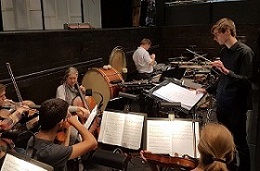
 8 June 2023: “Cosi Fan Tutte” “Welsh National Opera- usually a sensible organisation- has this year not been immune. Its great weight descended upon “the Magic Flute.” Mozart and Emanuel Schikanader were found wanting, their offence to have lived in another century. In that condition they held that night and day were a commonly observed diurnal division. The company, in its twenty-first century wisdom, put them right, night and day being a binary separation constructed by a hegemonic class. The production also managed the feat, said its observers, of draining "the Magic Flute” of all joy. Happily, Wales has artists whose calling is fidelity to their art and their artistry, a true galwad. Opra Cymru, in its high-up Gwynedd redoubt, gives honour to Mozart where Cardiff Bay dealt out disapproval and dishonour. The Arts Council of Wales should, in these days of re-evaluation, look closely to that first noun in its name. This “Cosi Fan Tutte” is a confident and consummate production, on a par with the company's previous high watermark, “Oniegin” of 2014. “The company of this “Cosi Fan Tutte” has swelled from the first productions to a number to fit. Conductor Iwan Teifion Davies has seventeen musicians to give the score a volume that is its due. The six principal singers are backed by a chorus which is both young and of resounding quality. “It is a soufflé of frivolity. Erin Gwyn Rossington's Fiordiligi and Erin Fflur's Dorabello sing duet after duet of melodic joy but are to be little judged as dramatic representations. This was not the case in 1790. Lorenzo da Ponte's plot, the male testing of fidelity, was criticised for its dishonouring of women. Beethoven was among those who disapproved. After its first performances in 1791 at Vienna's Burgtheater it was lost to the repertoire for a century. “Director Patrick Young brings an assured confidence and panache to the production. The set, complex and flexible, is built around the lines and angles to be seen in a late Kandinsky painting. When John Ieuan Jones' Guigliegmo and Huw Ynyr's Ferrando make their appearance as tempters in disguise they are in the waistcoats and saggy cheesecloth trousers of Woodstock groovers. (This is a second year the Aberystwyth stage gets to chuckle at the silliness of faux-hippies.” * * * * 22 September 2022: “Cyfrinach Y Brenin” "Cyfrinach Y Brenin" flies for a reason; the company has gone back to its roots. The principles that made its "Macbeth" a gust of fresh air in the presentation of opera in Wales are repeated here. The last tour before the pandemic in 2019 took Opra Cymru in a new direction. The ensemble was expanded and the production put on a big stage. The result was less movement and, for all the musical qualities, a lessening of performance verve. “Under Patrick Young's direction the space is used to its maximum for movement and animated performance. Erin Gwyn Rossington sweeps on in brilliant whites as a doctor full of confidence. Beca Davies' cook wields her chopping knife with a ferocious energy. Daw Steffan is the king, in a rich satiny kingly costume, who has to carry his secret with a deep mournfulness. Elen Llwyd Roberts, in full fool regalia to the coned hat, is the jester who loses her taste for jest. “Every performance is its own event. Early on in the action the King extracts a long dangly thing from his soup dish. The audience likes it a lot. "Beth yw e?" asks the voice of a four-year old. Some among the audience are very young. "Bogey- eergh" comes the answer of another. It does not happen in Covent Garden or the WMC but this is engagement. “Opra Cymu is a tight organisation in its Blaenau Ffestiniog home. The company for this production is completed by musical director Iwan Teifion Davies, technical manager Bridget Wallbank and stage manager Beatrice Wallbank.” * * * * 2 May 2019: “Fidelio” “Fidelio” was born in unusual circumstances, its opening performances playing largely to the soldiers of an occupying army. Liz Saville Roberts contributes to the programme “Mae hefyd yn addas i ni yma yng Nghymru bod thema o ryddid wrth wraig y gwaith hwn.” And there is another fit for our days. Leonore is the first woman protagonist in the canon to be unencumbered by frocks and sweetness, a passion caught by lead Catrin Aur. “Founder-director Patrick Young is able to tap into talents of the highest quality. Mererid Hopwood is the pen behind the libretto. Catrin Aur is a well-known name on this site from “Don Giovanni” and “Albert Herring” among other productions. In a piece of directorial chutzpah Y Gweinidog is played by Ceri Williams, back in Wales from the Deutsche Oper in Berlin. “But then the company is also about the young. Marzelline is sung by Elen Lloyd Roberts, a recent graduate. Jacquino is sung by Huw Ynyr, who is on the point of graduating from RWCMD. One of the pleasures of being a long-term watcher is to see young talent ascend. Iwan Teifion Davies is conductor of the seventeen musicians.” As for Patrick Young, his collaborators- indeed all who struggle to bring opera to audiences in Wales- Florestan's first aria speaks for all of them. “Willig duld' ich alle Schmerzen, ende schmählich meine Bahn; süßer, Trost in meinem Herze, meine Pflicht hab ich getan.” * * * * 20 November 2017: “Wythnos yng Nghymru Fydd” “What is all the more remarkable is that it is the brainchild of a minnow of a company fuelled by musical depth and experience, zeal and sheer entrepreneurial chutzpah. Opra Cymru's contribution to the culture has been hailed before on this site ever since “Macbeth” in 2012 soared to take its place in the best of the year. “So a lot of build-up. Patrick Young has fused a potent cluster of collaborators to take this production on its journey north to south. “Wythnos Yng Nghymru Fydd” plays in Barry in a venue of alarmingly large capacity. As a director he has an advantage of working with singers, like Gwawr Edwards, from previous productions- she was a scintillating presence in 2013's “Barber of Seville”. The eleven-strong Ensemble Cymru in the pit brings authority and reputation to Gareth Glyn's score. Mererid Hopwood is librettist and the University of Bangor has brought its heft too to the production. “As material for opera Islwyn Ffowc Elis’ scenario is unique. His vision of the future as bifurcated, part Shangri-la and part neo-Fascist, is not so far from other authors. Wells' Morlocks and Eloi are akin, even in this anniversary year of Swift the Dean's Houyhnhnms and Yahoos. The design displays a future of lovely brightly-coloured satins while the syringes that apply the PX300 drug are of a horrendous size. The author's vision of the linguistic future is probably both true and untrue. Its degradation is less likely to be a sole remaining speaker in a Bala siop chip. More likely is a shift to a kind of inexorable multi-sourced Papiamento. Our universe is entropic and humanity a migratory species.” * * * * 31 March 2016: “L'elisir d'amore” “Donizetti's most often performed work was originally set in a rustic village in the Basque country of the 18th century, but director and Opra Cymru founder, Patrick Young (keen, I'm told, to make the art form more accessible to the audiences of Mid and North Wales) has set his "Deigrin" in rural Wales - when the lights go up on the action we could be just down the road at an agricultural show in Llanelwedd -! The naturalistic setting is created in the first act with livestock pens (including around the ten piece orchestra, who are penned in like sheep or cattle), folding chairs and high flats, indicating the wooden walls of a barn or a farm show stand. In the second act these flats are replaced by the flimsy walls of a very small marquee, as for a village wedding, and the orchestra are now enclosed by barriers of bunting festooned calico. “The cast are costumed in a way totally familiar to rural Wales, especially Nemorino, the tenor lead, a farm worker in wellies, Parker jacket and peaked cap. We soon understand he is besotted with Adina, an impetuous and wealthy young woman farmer who has a more roving eye and is fascinated by the story of Tristan and Isolde (Esyllt) and the fatal love potion. When the swaggering Captain Belcore arrives on leave from the local army barracks (another local resonance for Mid Wales, where Brecon is home to the Infantry Battle School and a wing of the Gurkha regiment), he quickly scores with Adina and asks her to marry him, whilst Nemorino wishes he had Esyllt's elixir to help him win Adina's heart. Enter the travelling "quack" doctor, Dulcamara, plying his dubious wares to the locals. It's a wonderful situation comedy with twists and turns that all work out in the end with tenor and soprano leads re-united and happy. “Patrick Young's choice of setting for the opera is so counter intuitive that it could add an inadvertent element of humour to the production but the laugh is on the audience because from the very first scene we realise that this is going to work. The young cast carry it off with total plausibility and in an easy, modern style. Nemorino, the lead tenor role, is interpreted by Rhodri Prys Jones who has the great gift of a seemingly effortless and natural voice - a true pleasure to hear - singing with intensity of feeling, his Nemorino is at first an annoyingly petulent teenager who in the second act, when push comes to shove, drops his adolescent attitude and becomes a man. His moment of truth being the "Una Furtiva Lacrima" aria.” * * * * 4 September 2014: “Onieign: Gaeaf Goebeithion” “Opra Cymru’s fifth annual tour comes with a difference. Jâms Coleman has been at the piano for previous productions of Verdi and Donizetti. But Tchaikovsky needs more and Coleman, while still at the keyboard, is musical director of a group of six musicians. Artistic director Patrick Young has augmented keyboard and strings with Dewi Garmon Jones on French horn and Jonathan Guy on clarinet. The sound that emerges under Coleman’s leadership fills Rhosygilwen’s hammer-beamed Oak Hall with both scale and texture. “Opra Cymru’s production comes in its regular and inimitable form. A thirty-inch high stage is placed in the centre of the Oak Hall, the audience seated on four sides. Entries and exits are minimal. Offstage cast members take up front row seats and are themselves observers of the action. “Much power in the singing from ensemble and leads; Angharad Lyddon is a feisty Olga and Alex Vearey-Roberts a commanding Lensky. The central figures, the lovers-that-fail-to-be, are played by Matthew Durkan and Stacey Wheeler. Their final meeting ripples with loss over a course not chosen, a life that might have been lived. Tatiana’s letter scene is framed with some strong French horn. One of the longest soprano solos in the opera canon the performance is a compelling triumph.” * * * * 14 September 2013: “Barbwr Sefil” “The company has also stepped up musically. The heart of the Opra Cymru concept of democratic opera is the audience-performer connection. That means that the Aberaeron Hall’s own stage remains behind its elegant curtains, and the audience is seated on three sides around the company’s own stage. For 2013 the company of nine singers has a lesser space to itself as a section of the square stage has made way for a musical quartet. The lone pianist who carries an opera is a heroic figure, but the presence of a quartet is a leap in musical texture and depth. The overture is lit up from the start by the counter-play between Eleanor Lighton’s flute and Jonathan Guy’s clarinet. “A good production grabs its audience within minutes. Phil Gault’s Figaro is a presence of relaxed insouciance and his first aria earns a round of applause. Elgan Llỹr Thomas’ first aria, sung to just an accompanying few notes of guitar, blends intensity with sweetness of tone. From a stage just eighteen inches high the sound of the human voice achieves a closeness and immediacy that is distinctively Opra Cymru’s own. The first act closes on a dramatic high with the comically farcical failed arrest. Nine voices are on stage to glorious, roof-raising effect.” * * * * 22 September 2012: “Macbeth” “As in “Don Paskwale” in 2011 the company tours with its own stage, a low six hundred square feet. The cast sit on one side, the audience on the other three. Director Patrick Young's term for the style is a democratisation of opera. Whether it is democratic or not, he has made a powerfully physical experience. The first notes are sung six feet away from the audience. To hear an unleashed tenor at this distance is to experience an instrument of nature of some force. The acting, too, this close-up is a physical presence, of real muscle, teeth, saliva even. “Macbeth” opens with a confident swagger and never falters. The witches are young singers in micro-kilts and black boots. The production is in martial monochrome, greys and blacks, combat trousers tucked into military boots. Design and props are minimal. A few fold-up chairs and a table are brought on for the banquet scene. Death is dealt out with the tiniest of daggers. There is a chillingly effective use of some cardboard masks. “Otherwise, it is the unadorned force of human voice and movement. Phil Gault is a tormented Macbeth, Huw Euron a Banquo who makes an imaginative spectral return. Eldrydd Cynan Jones is an imposing Lady Macbeth whose highlights include a dramatic coloratura at the banquet and a final haunted, hand-washing scene. The emotional peak is the lament by Elgan Thomas as Macduff over the deaths of his family. The ensemble is completed by Lucy Gravelle, Nel Gwynn, Angharad Watkeys, Hedd Griffiths, Robin Hughes and Rhodri Jones. The sound that the full company achieves together is thrilling.” * * * * 10 September 2011 “Don Pascwale” “Opra Cymru is about as raw, and as cheering, as opera gets. The cast do their costume changes behind a screen a few feet from the audience. To play the doctor Malatesta Iwan Davies gets a simple white lab coat. The set is a small table, a couple of chairs, a vase of flowers. The company travels with its own five hundred square foot stage. It is only a foot above the ground. When Robin Lyn‘s passionate Ernesto unleashes his aria- “Ah, un foco insolito/ "A fire unfelt before"- he is only six feet away. That closeness brings out textures of tone in his tenor that large venues do not have. The first applause of the evening comes for Ceirios Haf’s opening aria. She is in a silver Japanese print dressing gown and purple slippers. Polishing her nails she sings So anch'io la virtù magica/ I too know your magical virtues." Maybe the applause is for the quality of her vaulting coloratura. There may be a little touch in it that she comes from Llanarth three miles away.” Pictured: “Un Nos Ola Leuad” in rehearsal. |
Reviewed by: Adam Somerset |
This review has been read 230 times There are 11 other reviews of productions with this title in our database:
|
