| NT Director Warning: "We Will Kill the Future of Theatre and Betray Jennie Lee" |
Public Culture: Public Communication |
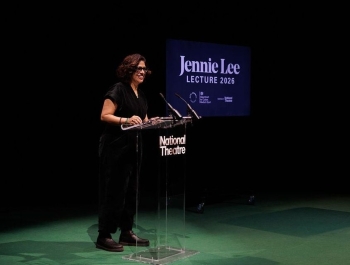
| Indhu Rubasingham Delivers Jennie Lee Lecture , National Theatre London , March 9, 2026 |
 Lisa Nandy, Culture Secretary, delivered a speech in February 2025 in honour of Jennie Lee and an epochal White Paper on the Arts.
On 26 February 2026 two hundred representatives from across the arts gathered at the National Theatre. Indhu Rubasingham gave the second Jennie Lee Lecture organised by Arts Council England and DCMS. The address comprised 3700 words. It covered a spread of topics. Its highlights: JENNIE LEE It’s an honour to deliver this lecture celebrating Jennie Lee. A woman who gave decades of passionate and often controversial commitment to the arts, fuelled by the radical belief that people of all ages and classes deserved access to the very best in art. She was incredibly proud of all that Britain had achieved in arts and culture, and recognised – as many of us do – that creative arts are one of our supreme contributions to the world. She campaigned for governments to give artists both their provision and their freedom: including the freedom to create art even if their funders disapproved. She wanted a world that allowed artists to develop work which challenged as well as entertained. This model – offering generosity whilst anticipating built-in friction – is one which is harder for us to absorb today. She wrote that by making art, we “track down the loneliness among communities of people, whether old or young, experienced in the arts or rather shyly making their first tentative approach.” Her vision was radical. She understood that the arts were not just a luxury for the few, but for everyone: she saw them as a vital force for unity and for dialogue – even in a time of financial bleakness for post-war Britain. Jennie Lee knew that democracy was not only built in parliaments and polling stations but also in theatres, galleries, libraries, and civic centres. She spoke of how “in any civilised community the arts, serious or comic, light or demanding, must occupy a central place. Their enjoyment should not be regarded as remote from everyday life.” One of her most radical ideas, and one which many of us uphold today, was that the pursuit of artistic excellence does not need to come at the expense of enabling greater access to the arts, that we must bring the best to the most. STORY I’m struck by something the filmmaker Daniel Kwan said in a piece in the New Yorker. He argued that humanity’s most important creation wasn’t the internet or agriculture, but the collective stories we tell to understand ourselves, and each other. Kwan says that it’s these stories which allow us to trust each other, and to build up the systems and institutes that allow us to live together in societies. We now live in a world divided by thriving disinformation, populist politics, alternate realities and, surprisingly, loneliness. Theatre is becoming one of the few remaining places where we gather and face complexity together, where we embrace nuance. It is the place, as Jennie Lee recognised, which counteracts the isolation modern life creates. Jennie Lee also recognised the arts were interlinked. She understood that world-class institutions and emerging amateur artists are not in competition; that grand stages and village halls, national galleries and local choirs nourish each other. In preparation for this lecture, I found myself asking: where is the spirit of Jennie Lee in our sector today? PERSONAL JOURNEY I can trace everything – doors opened, beliefs formed – to moments in time when the world of theatre became real to me. At sixteen, it was a work experience placement in stage management at my local theatre, Nottingham Playhouse, where I became curious about how everything was brought together for these magical moments on stage. I witnessed the creative ambition and the community of people that brought it together – much of it underpinned by grants from the Arts Council to fund regional theatre. My time there changed the path of my life. Whatever I thought I was going to be ended the moment I felt the power of theatre. It was also the first place I encountered contemporary writing. Which felt immediate, relevant and alive. It was The Normal Heart by Larry Kramer. A play about the AIDS epidemic which was touring from the Royal Court in London. It was political and emotional, and I remember writing down lines from the play on my programme as soon as the house lights came up. In my teens, growing up in Mansfield, a place far, far away from New York City and San Francisco, it brought home the terrible injustice of the AIDS epidemic and the gaslighting and ostracism of the gay community. The anger in this play demonstrated it all so powerfully – a true call to arms. It was urgent – I hadn’t realised theatre could be that. ...Walking into Stratford East for the first time, I felt utterly intimidated as well as exhilarated. Feeling the presence of Joan Littlewood and the legacy of Theatre Workshop. And the thinking that developed there, about local audiences being crucial to what was on stage, and whose stories were reflected back from the audience, has stayed with me ever since. I directed my first show at Theatre Royal Stratford East. I was 24 and it was a piece of new writing. I didn’t have innate self-belief. I wasn’t self-made. I needed nurturing, and space to grow. And it was the Arts Council, and the sector it was funding, that gave that to me. My first connections with the National Theatre were through the New Work Studio and they were exhilarating: most memorably a directors’ workshop with Peter Brook, as well as an opportunity to spend three weeks workshopping a new play by a first-time writer. After an extensive freelance career, predominantly in the subsidised sector, I became Artistic Director of the Kiln, formerly the Tricycle Theatre. The next eleven years in Kilburn allowed me to work with an excellent team, opening our doors wider, welcoming more voices, more communities, more possibilities. None of this was planned. I never expected to become a director, to lead the National Theatre. To have the honour to deliver this lecture, to an audience of this magnitude. NEW WRITING . I’m deeply grateful for everything we receive, which underscores the importance of the Arts Council and the government’s commitment to investing in theatre. And the incredible generosity of our supporters. But this is an ongoing challenge, for all of us. At the heart of this renewed commitment must be investment in backing creative risk and in new writing. Playing safe will be the end of us. If we are conservative in style, in content, in process, we might balance the books today, but we will kill the future of theatre and betray Jennie Lee. We are seeing a steep reduction across the sector in new writing. I feel this is the clearest and most troubling sign of what’s happening. We already know from BBC News research that, in 2024, the number of plays and musicals staged by the UK’s main subsidised theatres dropped by a third, compared to ten years previously. Research done by our New Work Department specifically on new writing further illustrates this. They looked at new plays and adaptations by subsided producing theatres across the UK, as well as those in London which regularly programme new writing. Between 2014 and 2024, there was: A 70% decline in theatres receiving open-to-all submissions throughout the year A 76% decline in new writing festivals A 44% decline in playwriting courses As well as a 44% decline in new work on stages outside of London, and 30% in London These numbers paint a stark picture. Anyone looking at this will conclude that new work is in crisis. Without concerted intervention to protect the resources and pathways for our playwrights and theatre-makers, particularly at the start of their careers, we risk losing writers who want to and can write for our country’s biggest stages. We risk losing the future generation-leading playwrights, to take up the baton of the finest our country has produced, such as Tom Stoppard, Caryl Churchill, David Hare, Alan Bennett, Roy Williams, David Edgar, Moira Buffini, Beth Steel, Natasha Gordon, Jack Thorne, Rebecca Lenkiewicz, James Graham, Winsome Pinnock – to name a few. These writers have carved and reshaped the face of British theatre; like me, so many of their journeys to our stages were on paths paved by public subsidy, and the opportunity and belief it enabled. Our failure to mark this moment as a tipping point risks our betrayal of the legacy, pride and heritage of this country – of our leading cultural influencer William Shakespeare, our national playwright. Let’s make and insist on a new national commitment. Not a sticking plaster, not emergency relief. Let’s commit to strengthening nationwide access to theatre. Let’s boost and rebuild the talent pipeline, and protect the risk-taking that fuels British creativity, an area of great national pride.” Excerpts cited with thanks and acknowledgement from the full speech which can be heard at: https://www.nationaltheatre.org.uk/news/indhu-rubasingham-delivers-2026-jennie-lee-lecture/ |
Reviewed by: Adam Somerset |
This review has been read 270 times There are 15 other reviews of productions with this title in our database:
|
