| Brilliant production, uneven text |
At NYTW |
| National Youth Theatre of Wales- Canrif / Century , Aberystwyth Arts Centre , September 7, 2009 |
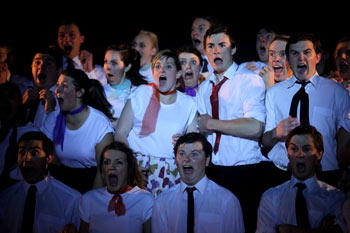 The National Youth Theatre has exercised a change in artistic policy with its 2008 change of director. While I would love to see “Café Cariad” re-staged, it is good for the company and it is certainly good for the players. A plot-led drama by necessity has a hierarchy of acting parts, leads, secondary characters, supporting cast. Here everyone in the forty-five strong cast gets to perform significantly. It is a production without stars but with not a false note in performance.
 For 2010 the company has an exciting promise, a script generated from its members. For this year “Canrif” has a pageant structure, starting from pre-history, then long sequences selected from twentieth century history. It is an artistic ambition reminiscent of the writing of John dos Passos. Even the title “Canrif/ Century” itself evokes dos Passos’ massive 1961 “Midcentury.” Tim Baker is a magician. That he and the production team have had two and a half weeks to bond a company and fuse this level of energy on stage is startling. A proportion of the text is admittedly declamatory and narrative but nonetheless the diction is crystal clear, the choreography razor sharp. I expressed a wish last year for more song and “Canrif” delivers it in floods. For Mold and Cardiff audiences I won’t reveal how World War Two is treated except to say it is a surprise and an aural treat. The set (Guto Humphreys and Alex Robertson) is simple but malleable, flats and backcloth with jagged Expressionist lines painted in Baselitz colours. The twentieth century is presented in a sequence of long tableau scenes. The enactments of Senghenydd and Aberfan are moving beyond description. I deliberately selected to attend the first schools matinee. The effect of a production can always be heard by listening to an audience; not a sound or a shuffle was to be heard. I checked out a group, from Ysgol Dyffryn Teifi, as to their reactions to the first half. They were absolutely gripped, particularly by the history that was less familiar. The suffragettes in prison are brilliantly realised. This is the second time recently, after Rachel Lenkiewicz in “Her Naked Skin”, where the horrors of force-feeding have been dramatised. Nonetheless, “Canrif’s” history is selective. Tonypandy is in but the Anti-Jewish Riots in Tredegar and the attacks on Chinese homes and businesses in Cardiff are out. It was if the text needed the characters to be ennobled. It is not a bad aim in itself and goes back at least to Euripides. But a humanity that comes without flaw is psychologically untrue, historically skewed and ultimately anti-dramatic. The text had repeated dichotomies- “haves/ have-nots”, “submit/ fight”- but they were dichotomies without dialectic. I was reminded of a knighted playwright’s words “theatre is the best way I know of having an argument with myself.” The rendering of the second half of the century is no less brilliantly rendered but the script’s main purpose is to seek out a thread that finds virtue in a collective impotence. As such it is highly selective. At a time when a prominent MEP is publicly declaring the inferiority of the NHS to US healthcare Aneurin Bevan is simply edited out. Linguistic fracture is a genuinely potent subject for drama. Just see Pinter’s “Mountain Language”. But episodes of conflict are juxtaposed with Civil Rights confrontations and it is not a juxtaposition of equals. Facing down Llanelli Council is not the same as defying Governor Faubus of Arkansas. The visit of bailiffs is not pleasant but it is not akin to confronting Bull Connor or Jim Clark in Selma or Montgomery. “Canrif’s” representation of Civil Rights is a sketch by a visitor. For depth and hue a text like Alice Walker’s “Meridian” needs to be read. There are in any case analogies from all across Europe and the experience of Sorbs, Ruthenians, Catalans deserve to be dramatised. From September 1st a tenth of Slovak citizens now face fines of up to five thousand Euros for “promoting” their language in public. But there is hardly a reference to other countries outside America, no sense of a belonging to the dozens of European nations. The Greenham Common protesters are viewed as an end in their own right. But it was a Welsh prime minister and an impeccable social democratic German chancellor who requested the deployment of Cruise and Pershing. The SS-20’s were destroyed after the Intermediate-Range Nuclear Forces Treaty came into force. It was politics, and politics that involved both courage and concession, that removed the weapons. Protest was a part of it but not an end in itself. A long sequence covers the Miners Strike, depicted as a condition necessary for devolution. Political power is notoriously difficult to present dramatically and the only convincing portrayal recently has been Claire Price as Elizabeth the First. Mrs Thatcher and her Cabinet are portrayed with wit and visual flair but power, its use or misuse, is too serious to be reduced to mockery. The strike is presented as communal deprivation but history never comes simple. South Wales held firm to the NUM but the North did not. When David Wilkie died from forty-six pounds of concrete dropped on his vehicle he was driving a working miner to work. It was miners who were sentenced for murder. The word that Wales’ leader chose for it at the time was “atrocity.” For all the tactics that the state threw at the NUM, the sequestering of funds, the cancellation of benefits, it was the same state that reduced the charge to manslaughter. It may not palatable but the only history that comes without knots and discomfort and paradox is history that has been put to sleep. World War Two is, exceptionally, held to be a war that was “good”. A recent book has come out describing the sheer extent of destruction, rape and robbery that the Allies inflicted on France in its liberation. For a company of young people for young people fidelity to the discomforts of history is not only an artistic imperative but a moral one too. Canrif” is a brilliant, often moving two and three quarter hours. Director, design, lighting, music are blended together from an artistic team at the peak of its powers. Review by Adam Somerset ------------------------------------------- A response to the above review: As a member of the audience of Manon Eames' Canrif/Century at Aberystwyth Arts Centre last Friday, I must say that I find it hard to reconcile the experience with Adam Somerset's review. It's depressing to find that Mr Somerset would rather impress us with his own knowledge of 20th Century history than to address himself seriously to the themes of the play. The audience of which I was a member became intensely involved with Dai and Myfanwy as they progressed through the years, and everyone in the theatre felt personally involved, felt that we were sharing the experiences of the characters - as indeed we had in our own youths. Ms Eames has tackled a huge timespan and dealt with problems and concerns that are universal and just as relevant today as they were to our grandparents, and has accomplished it all with enormous skill in construction and dialogue. She has also accomplished that most difficult thing - to weave signposts and meanings into metaphor - which drives an unspoken message straight to our emotions. As the characters cope with the changes forced on them by an evolving century, we're aware of them digging down, delving into the earth, into our hearts ("ours" because we were there too), into our inner strengths. This powerful motif is revisited repeatedly, but seems to have escaped Mr Somerset's notice. This somewhat pompous review fails, really, as a serious appreciation of the play - of its themes, and how those themes relate to young people today. I thought the play was riveting, taut and innovative. It was a surprising and intense theatrical event which will leave resonances in the mind of anyone who sees it. One could never journey through the entire 20th century in an evening, but I think Manon Eames has made appropriate and perfect choices for this young company in her script. Mr Somerset rightly praises the power and intensity of the performers, but almost implies that it's spite of the material. Quite the opposite, I suspect – it's because of it. The final analysis of apathy amongst young people after 100 years of struggle for voice, for true representation, was, I feel, the trigger for the deserved standing ovation the performance received. I can tell you one thing – when and if these young people get a chance to vote, they’ll do so. Roger Mitchell. |
Reviewed by: Adam Somerset |
This review has been read 3276 times There are 30 other reviews of productions with this title in our database:
|
