| Falling Between Two Syndromes |
At NYTW |
| National Youth Theatre Wales - Diwrnod Heb Ei Debyg / No Other Day Like Today , Aberystwyth Arts Centre , September 4, 2010 |
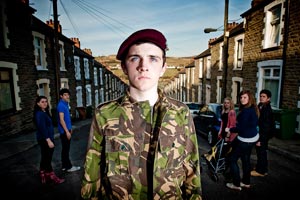 The artistic intention to sideline a professional playwright for NYTW's 2010 production was well trailed. In fact Tim Baker said that the decision had been made at the time of 2009's “Canrif.” In that sense a viewer who did not wish to see a company-generated script should best stay away. On the other hand the company is both receiving of the public shilling and charging a paying audience. On those counts “Diwrnod Heb Ei Debyg” asks to be judged on its aesthetic qualities as a finished piece. It is not a workshop or work-in-progress.
 Veteran critic of Welsh theatre David Adams put it succinctly a few years back. “There are always two issues about NYTW’s annual productions, issues that have bubbled away ever since the summer-school initiative started back in 1976: one revolves around the value to the young participants, the other about the quality of the finished product.” My view is not that of a dramaturg, or a youth development officer but the voice that writes on behalf of the theatre-goer who has devoted time and a few pounds for a night out. As an artistic yardstick a NYWT production should stand alongside what is produced by the other national youth theatres. As such the first half sadly is one of a script made of lead. Inward-looking and intellectually unambitious it lacks consistency of tone, momentum of narrative or distinctiveness of voice. It screeches for the discipline and the red pencil of the seasoned playwright and a dramaturgical presence that should have put audience first. The forty-plus young cast members perform singly and collectively with distinctiveness, energy and brio. Tim Baker’s direction and choreography as expected are electric. As a portrayal of a single community there is nothing wrong at all with a daughter or son of “Under Milk Wood.” But there is a line between tribute and pastiche. A line like “snow black-crow black” cannot but feel like the latter. I may well have mis-remembered a metaphor of the moon being a deflating cricket ball traversing the sky. But “scrabble across the yard like locusts on demerara sugar” grates with over-self-consciousness. Dramatic writing is no different from other genres. Its lifeblood is freshness of observed detail. This town is skimpily described. There is the council estate, the posh houses, a Tesco that has bust the local greengrocer, a Poundland-Superdrug high street, and, endlessly, the canal. A bargeman yearns at length for his love, “Where are you, my mermaid love?” “What’s the cure for love when you’re consumed by fire?” A mother who has lost a son says “My world stopped turning today which means no more sunsets.” This is not grief; it is grief’s belittlement. Lyrically the main musical number has its catch phrase “Ladies and Gentlemen/ The Age of Communication/ Has Only Increased Your Frustration.” On one hand this cannot be an acceptable lyric and on the other this stance to the online world has the smell of a tut-tutting, disapproving middle age. There are hints of allegory. The characters are in the main caricatures. The scene of a policeman addressing a class is inane. The mocking of a Surrey accent is infantile. The show leaves the town once, to skip to Helmand rendered without flavour or colour. The climax is grindingly obvious. The character based there, Rhys Williams, has only one purpose and that is to fit the makers’ ideology of victimology. Dead Great War generals walk again. It is the day of the hundredth anniversary of a mining disaster. That Welsh ministers have held considerable power in Westminster does not fit this vision. So no mention that they established public pensions, founded the national health service and stopped the jailing of gays. Admittedly this production is something of an experiment. But the objective is to give the company performing experience. All organisations waver once they deviate from pursuing their prime mission; an experiment, fair enough, but the young aspirants would be better served by a script from a professional that stretched and placed tough emotional and psychological demands. |
Reviewed by: Adam Somerset |
This review has been read 1580 times There are 30 other reviews of productions with this title in our database:
|
