 Producer Richard Jones's refusal to intervene in Wagner's The Mastersingers for WNO's inaugural production of the work is both act of homage and good sense.
Because his other three productions for the company have been out-and-out winners, one is inclined to take his hands-off approach as a good sign.
He doesn't even mess with the dodgy ending, in which cobbler-poet Hans Sachs proclaims the virtues of German-language art, except to have everyone on stage holding up portraits of its exemplars, including Bach, Haydn, Mozart, Beethoven, Richard Strauss and the artist Joseph Beuys, among many others.
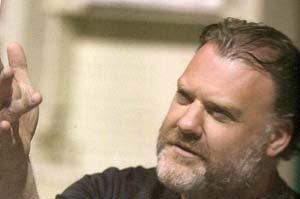
Sachs, superbly sung for the first time in his career by Bryn Terfel, is a complex character, nowhere more than in this ending, which at one time had morphed into a chilling a reference to national socialism. Tricky, Jones calls it, and leaves things at that.
The opera almost plays itself if the orchestra, as here under MD Lother Koenigs, never lets up in creating that ocean of gloriously swelling sound, and when Walther comes to deliver his Prize Song, Raymond Very presents himself not as a tired tenor (the opera’s a marathon) but one acting the part of a character as nervous as he is ardent. Nice touch.
Even nicer is the psychological interplay between the callow Eva (Amanda Roocroft) and Sachs, a figure of authority but, since Terfel is just 45, an attractive widower living alone albeit one in charge of his emotions.
The production is well cast, with Christopher Purves a suitably hapless Beckmesser, Andrew Tortise a delightful David and Anna Burford an attentive Magdalene. The enlarged chorus is admirable in an opera about singers and the stage pictures ample, the affray at night in act two momentous and the act one guild rituals to the point.
One looks at the end of Wagner’s juggernaut operas for signs of voices being unavoidably thrown about, but there wasn’t much evidence of that here, because Koenigs paced the narrative as judiciously as he maintained the emotional temperatures.
Paul Steinberg’s ironically folksy set - Jones places the action in a nebulous area oscillating between the 16th century and Wagner’s own time in order to ‘update’ the emotional interfaces - is nowhere more subverted than in the presence of David Soar’s spooky, platform-soled Nightwatchman (his batlike costume resurrected from a previous WNO life, apparently). That Soar sings his cameo magnificently is the epitome of how in this production even the smallest detail strikes home.
The ’Sgt Pepper’ front curtain, with its pictures of scores of German-speaking artists who exemplify the originality and determination of Die Meistersinger’s Walther von Stolzing, is the basis of a competition for audiences. How many can you name? As far as I could see, the face of Richard Wagner is unaccountably absent. |
