| Mozart with Fine Characterisation & Young Conductor |
Welsh National Opera |
| Welsh National Opera- Don Giovanni , Grand Theatre, Swansea. , October 21, 2011 |
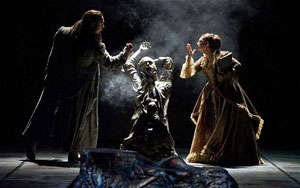 “Don Giovanni” received a lukewarm reception from the critics when it opened in Cardiff this month. On the evidence of the performance a couple of weeks later, it is hard to see quite why. With a charismatic performance at its centre, thrilling four and five-voice ensemble singing, a distinctive design and a young conductor leading the orchestra it brought the audience at Swansea’s Grand Theatre out in repeated applause.
 It may well be that John Caird’s production is better served by the smaller space of the Swansea stage with its greater closeness between singer and viewer. Certainly, when the two-dozen dancers appear it is clear that some nifty footwork is necessary by the principals to cross the stage. “Dark” and “gloom” were comments applied to David Hersey’s lighting design. John Caird is author of a recent door-stopper of a book, a guide for directors. He is quite clear about the several purposes served by lighting. His third point is simple: “to darken or disguise what you don't want the audience to see.” It is true that the overall lighting in this “Don Giovanni” tends to the chiaroscuro but it looks true to the concept. A giant moon and a starry sky overhang much of the action. But that is by way of statement that eternity hangs over the tawdry pursuit of sexual conquest and cruelty. When required, the stage floods with light in the full cast scenes. The smoke of Hell burns red. The principal conceit in John Napier’s design is the debt to Rodin. The Commendatore withdraws behind, and later emerges from, his monumental Gates of Hell. As a creature of vengeance, he is accompanied by a half-dozen other sculptures in metallic black carrying crucifix or bible. These central doors are flanked by black metallic sculptural blocks. Disconnected body limbs and trunks intertwine with greenery. This is the Sevillean environment that Don Giovanni has solipsistically built for himself. The cast at the curtain call is joined by a beaming James Southall. His bow is well-deserved at the end of his first conducting of the production. The score starts with a mighty sound and the Descent to Hell needs volume and sharpness. That quality has been pre-figured in the vigorous accompaniment to Nuccia Fociole’s Donna Elvira’s aria of anguish. Robin Tritschler is a thoughtful, deliberative Don Ottavia with his small rounded glasses. He knows what love is- “what grieves her is death to me.” His first act aria “Dalla sua pace” is the first to win the audience’s applause. Gary Griffiths’ Masetta has the quivering lip that is more anger than sorrow. David Soar’s Leporello is half observer and half co-conspirator in his master’s conniving. Citing Don Giovanni’s one thousand plus seductions in Spain he adds the stamp of the foot and the flourish of the arm from Spanish dance. When he protests “my master stole my innocence from me” it is the ambiguity in the character that we cannot judge if it be truth or evasiveness. In the costume design of John Napier and Yoon Bae Camilla Roberts’ Donna Anna and Nuccia Focile are in the dark tones, lace and velvet, of bereavement. Don Giovanni makes an undignified entrance, escaping down a ladder, his braces flapping around his thighs. He then acquires a grand full-length coat, cream on the outside, yellow within. It has a vaguely military Pontevedrian air to it with hints of an unearned grandiosity. Don Giovanni is the most written-about character in opera. David Kempster arches an eyebrow and puts on a supercilious smile when his victims are out of sight. He snatches back with a chuckle his offer of food to Leporello. The shallow twinkle in his eye sees all women as objects for calculation. It is dressed up in the spurious philosophy of polyamory. “I have such deep feelings I have to love them all.” Commentators have puzzled over Don Giovanni’s motivelessness. David Kempster’s characterisation is that of the man who cannot connect. The same type can be found in the plays of Neil Labute. They are not so common in life, but poke around the inner parts of any large organisation and they are not so rare either. David Kempster delivers glorious Mozart along with a heart which has a splinter of ice within it. |
Reviewed by: Adam Somerset |
This review has been read 2312 times There are 115 other reviews of productions with this title in our database:
|
