Welsh National Opera |
| elsh National Opera (A co-production with Danish National Opera)- I Puritani , Wales Millennium Centre , September 13, 2015 |
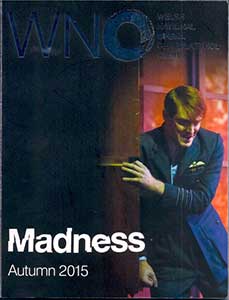 ‘Madness’ is printed in bold white lettering across the front page of the WNO’s 2015 autumn programme, telling us the theme for the season. In the company’s first ever musical, Sweeney Todd the madness of the demon barber is the driving presence in the narrative. In Handel’s Orlando the central character sinks into madness and jealous wrath when he is rejected by his lover. With the sweeping romance of the music and its demand for large performances from its characters opera would seem to be the ideal art form for the expression of this very sad human frailty. With Britten’s Peter Grimes the theme has continued into the twentieth century.
In I Puritani the young lovers are eventually reunited and soprano Rosa Feola and tenor Barry Banks in the roles of Elvira and Arturo celebrate with a duet that hits perfection. However, their love seems doomed from the start. Riccardo, a protestant military man feels his world has fallen apart as he discovers his betrothed, Elvira, also a protestant is in love with Arturo who is a catholic. Draped in his Orange Order sash David Kempster gets us all off to a fine start with his strong and captivating baritone. To highlight this tragic dilemma Belfast born Director, Annilese Miskimmon has set the opening scenes in a dilapidated gymnasium in Northern Ireland. The men assemble and the stage is awash with the bright orange sashes, symbols of the protestant order. A timely statement considering the way things are there at this present moment in time. With their banner unfolded and held high Riccardo recovers and leads his men onwards. Elvira’s uncle Giorgio, Wojtek Gierlach has a warmth and sensitivity that inform both his acting and his fine bass singing. He tells her she is to be married to Riccardo. She reacts with ‘overwhelming passion’ and we are given the enormous treat of this matchless soprano of the diminutive Rosa Feola. She strengthens and takes our breath completely away with each aria she sings. Her acting is equally true and captivating. Even when reacting silently her strong presence continues to engage us. Bellini’s music underpins the tensions as they progress. His bravura Bel Canto seems to mix with a style heard in early twentieth century ballrooms at times in counterpoint to the action. All this is under the impeccable control of maestro Carlo Rizzi, who makes a much-welcomed return. The WNO orchestra responds with their usual fine musicality. There has been a strange lady flitting about the place, Enrichetta. A somewhat less than enigmatic performance from Sian Meinir. She turns out to be the widow of the executed King Charles I. We learn that she has been sentenced to death. Arturo determines to save her. Eventually Riccardo allows them to escape. It is the seeming abandonment that turns Elvira’s mind and provides us with such exciting vocalizing. Now that we are in Cromwellian times the orange sashes are replaced with white laced Protestant collars of the seventeenth century. Director, Annilese Miskimmon has taken us back into the historic origins of the story. We see Arturo as a silk clad cavalier. This is all rather confusing; it makes the opening act, in modern times, almost meaningless. The director doesn’t appear to have her usually firm hand on this production; there is some untidy and unnecessary chorus movement and choreography. But with the WNO chorus on top form as ever, the perfectly executed music of the orchestra and the remarkable hair-tingling, wonderful and unforgettable singing of Rosa Feola the audience left knowing they had had a great time. |
Reviewed by: Michael Kelligan |
This review has been read 1277 times There are 115 other reviews of productions with this title in our database:
|
