| Out of Europe- “hill farming, forget it. It’s dead" |
A Political Diary |
| First Minister and Natural Resources Wales , Hay Festival , May 25, 2013 |
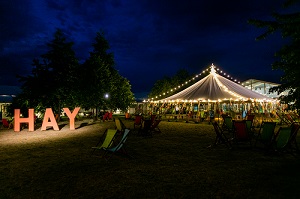 The Hay Festival, on the afternoon of its first Saturday, is sunny and seething. It is the day, in particular, on which the programmers have clustered a lot of history and politics. Wales’ National Librarian, until a few weeks ago, is to be sighted now as a plain enthusiast for books. The Minister of Education is on a platform, relaxedly off-duty, trading banter with a brace of historians and flying the flag for his native Rhondda.
 A BBC stalwart, who really knows his stuff, is sweetly hand-in-hand with a four-year old daughter. A television critic, blonde of hair and black of dress, flies past with purpose, as does the economist peer with the wild white hair and the editor-at-large with the wild black hair. * * * * Hay’s blackboard outside the Landmark 100 tent is marked simply ‘C. Jones.’ C. Jones is present on his own, with not a civil servant or policy wonk to be seen, just a Premier with a group of engaged citizens. He opens with a mention of the long queue nearby that has assembled to hear the Chancellor of Portsmouth University. ‘Even my wife has gone’ he says ‘She hears enough of me talking already.’ The ostensible subject is the Sustainability Bill, but as it has yet to be drafted, it is a little premature. The discussion moves about and, not for the first time, the grasp of detail on show is remarkable. C Jones knows his jurisdiction in a way that a Westminster counterpart could not. A polity like one from Tamar to Tyne is simply too big. C Jones seems to know at first hand the traffic that can clog Newtown at the wrong time. He is clear in response to a local questioner that Bronllys needs more housing association accommodation. He knows the exact numbers for Wales without Brussels. And he speaks in plain language. Take out the CAP and ‘hill farming, forget it. It’s dead.’ An arts writer is an observer, not a government spokesperson, but the event in its spirit of openness and exchange, the good humour, the sense of mutuality between political representative and the represented is cheering. * * * Emyr Roberts is newly appointed Chief Executive for the newly created Natural Resources Wales. He is refreshingly steeped in detail. He really does know larch disease, red kites and effluent hazard. He does a capable job of introducing the new amalgamation. His is also, for Hay, an uncommon bilingual voice, pointing out that ‘Cyfoeth Naturiol’ has a rather different sense to it. His interviewer dryly responds that his introduction has sounded as if assembled by officials. A nuclear power station environmental officer in the audience expresses surprise that such a range of obligations can be executed with no more than two thousand staff. The formation of Natural Resources Wales, says the First Minister, has logic behind it. Cabinet wants a unified opinion rather than three organisations with views at variance. But, says an insider in the audience, organisational culture does not wither when it is merged into a larger organisation. It may but, from the empirical evidence, only with brutality. If the top two managerial layers are out, en masse and within a week or so, it can work. That is the private sector way. The interviewer wonders whether the environmental debate, which ought by rights to be in the public arena, may vanish behind closed doors. Natural Resources Wales has a massive remit. Tight-packed, cash-generating conifers versus biodiversity, dolphin colonies versus visitors with outboard motors, these are political decisions. The proposed marine conservation zones around Llyn are, say their opponents, going to cost ‘nearly’ two thousand jobs and ‘nearly’ sixty million pounds. These ‘nearly’s’ are not good, but it is unclear from the lively question-and-answer session quite where the politics are now located. |
Reviewed by: Adam Somerset |
This review has been read 708 times There are 39 other reviews of productions with this title in our database:
|
