| A Look-back and Guide |
Theatre Director Book |
| Directors on Directing , Theatre of United Kingdom , October 14, 2023 |
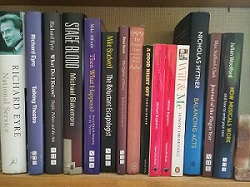 The books by directors vary. In the main their theme is memoir although John Caird's book at 700 pages takes the form of a weighty guide to young directors. The advice runs from audition and casting to the show up and running.
 The tones also vary, Mike Bradwell the most ribald by a degree. “I wanted to make theatre with words and three-dimensional characters and argument and metaphor and story-telling and jokes and life and laughter.” As a credo that has a lot to be said for it. There is a lot of combined wisdom to be read. Mike Alfreds asserts the primacy of form: “A lot of contemporary art has removed itself from narrative and linear logic..But without the form created by plot, theatre and storytelling merely echo our confusions and uncertainties rather than searching for a sense to them.” The links are: 27 October 2022: Christopher Haydon “The Art of the Artistic Director: Conversations with Leading Practitioners” “The author can roam to New York and Chicago. But a recognition of the other theatrical traditions in the other nations? Belfast? Glasgow? Not a chance. Jackie Wylie is a serious gap, although he does get to Wales. At the time of writing Arwel Gruffydd was the most seasoned artistic director. His track record can be seen here in “the Arwel Gruffydd Years”, Theatr Genedlaethol 30th September 2021. But Theatr Genedlaethol simply does not register on the metro-map. “Tamara Harvey by this time had done her “Uncle Vanya”. Bethan Marlow had written “the Mold Riots” and Emily White “Pavilion.” But, almost inevitably, Haydon makes his way not to Carmarthen or Mold but to Castle Arcade. His interview there catches a memorable line: “I'm trying to forget that it's a national company.” * * * * 28 July 2022: Peter Brook “The Empty Space” "It's always popular theatre that saves the day...theatre in back rooms, upstairs rooms, barns, the one-night stands.: a beautiful place may never bring about explosion of life; while a haphazard hall may be a tremendous meeting place. This is the mystery of theatre. "Along with serious, probing and committed work, there must be irresponsibility... Fun continually needs a new electric charge...Frivolity can be its charge: high spirits can make a good current, but all the time the batteries have to be replenished: new faces, new ideas have to be found." * * * * 7th October 2021 Richard Eyre “Changing Stages” “The theatre resists theory even more than poetry: whatever you think, feel, or say about it, its only test is in performance...rely on the evidence of the text, not on speculation, and specious psychological theory.” “It is an art that can never dissolve its reliance on the scale of the human figure, the sound of the human voice, the disposition of humankind to tell each other stories.” “It happens in the present tense...there's a sense of occasion in any theatre performance and of participation in a communal act: you go into a theatre an individual and you emerge an audience.” * * * * 07 November 2017: Nicholas Hytner “Balancing Acts” “I am less interested in plays that mirror my own way of looking at experience than in playwrights who dumbfound me with their conviction and authenticity. “If you direct someone else's play, your job is to be useful to it. If you have nothing to say about it, if it means nothing to you, if you think that all you need is to get out of the way, you end up draining the life out of it. But directors too determined to use a play as a vehicle for their own preoccupations can send it down a dead end where it locks its audience. When you discover a personal stake in a play, you need to balance your connection to it with your need to connect it to an audience.” * * * * 01 June 2017: Dominic Dromgoole “Hamlet Globe to Globe” “The subject matter of the Globe's global travel is vast with material that might fill several books. The destinations kick off with Amsterdam, Bremen, Wittenberg and eleven venues seven Baltic countries. A distinguished visitor has been seen at the Globe itself prior to the great journey. President Obama is visitor to mark the four hundredth Shakespeare anniversary. The tally is 185 countries. Roseau, Managua, Monrovia, Freetown, Antanarivo, Bishkek, Dushanbe, Vientiane, Lesotho: the locations and their range awe.” * * * * 25 May 2017: Michael Bogdanov “Shakespeare The Director's Cut Volume 2 The Histories” “Richard II was ripe material for the stage for his cronyism and readiness to murder and three other plays were performed in Shakespeare's time. Elizabeth did not care for its portrayal of a court filled with favourites and flatterers. At the end Bogdanov sees much sympathy in the fallen king. “I did waste time and now doth time waste me/ For now hath time made me his numbering clock." “Falstaff dominates the next stage. The nine early years in Ireland were crucial for Bogdanov and he sees the fat knight as decidedly un-English. He likens him to Dylan Thomas or Brendan Behan. He has little time for Prince Hal and has a swing at Michael Billington over what he sees as a textual misreading of a Hytner production. The war in France was won more by luck than judgement. Harfleur is the scene of atrocity.” * * * * 21 May 2017: Michael Bogdanov “Shakespeare The Director's Cut” “Hamlet may well be a figure of existentialist doubt. Bogdanov cites Brecht and the “Organum” approvingly. The centre of the play is the war. Norway has to cross the territory of Denmark to make war in Poland. A speech by Marcellus is too frequently cut. The subject is “the daily cast of brazen cannon/ and foreign mart for implements of war.” The histories as a whole “are a litany of fraternal and paternal slaughter.” As for the lean figure in black Gertrude says of her son “he's fat and scant of breath.” The prince is aged thirty. The actor Richard Burbage weighed seventeen and a half stone.” * * * * 12 December 2016: Dominic Dromgoole “Will and Me” “Will and Me” comprises two parts. The bulk is autobiography, the life intermingled with the experiencing of Shakespeare. The last eighty pages, the record of a walk from Stratford to the South Bank, are less successful. Travel writing looks easy and is not. The main interest comes via insights from Dromgoole's companion-in-walking. Thomas Kemp apparently morris-danced his way from Norwich to London. He wrote his venture up with regular swipes at Shakespeare and his fellow actors. The walkers of today debate whether theatre has moral purpose. The tangle of nature around them prompts Dromgoole to believe “Art is not about giving meaning to mess. It's about reflecting mess.” “So little is known about Shakespeare. In a Britain utterly split his father was a covert Catholic, carrying out a Protestant public office, while receiving mass in secret. His cousins were executed, their heads on poles at London Bridge at the time of the playwright's own arrival in the city. His father fell from professional grace for reasons unknown. Dromgoole likens him to Dickens, Chekhov, Ibsen and Miller who “all had fathers whose heady ambitions led to bankruptcy and disgrace.” * * * * 05 December 2014: Richard Eyre “What Do I Know?” “What Do I Know?” comprises fifty-two occasional pieces. They include eulogies, programme notes, introductions to plays and diary selections. Richard Eyre is a unique figure. He recorded his years of stewardship of London’s National Theatre, years of great accomplishment, in “National Service.” Eleven years on the book still reads very well. As revealed in this new collection he has also worked creditably in film and television. A diary piece follows the wayward process- erratic would be a euphemism- by which a film lurches haphazardly towards that elusive “go” green light. The film under discussion is “Iris.” Less is said about “Notes for a Scandal” a significantly greater film with a lot of emotional punch to it. “The longest piece, forty pages, is the diary that accompanied the filming of the television series “Changing Stages.” Eyre has a view on diaries. “Whatever their merits, all diaries are self-vindicating, full of evasions, self-justifications and self-recriminations.” It is an exhilarating journey with a theatre practitioner blessed with a seemingly Olympian view. Eyre has been everywhere. If the subject is Arthur Miller he has walked with him in the shadow of the pillars of the Brooklyn Bridge. He is with Peter Brook at the Bouffes du Nord in Paris and in New York to see Liam Neeson who is richly knowledgeable and fluent on the theatre of Ireland. Eyre’s next stop is William Dafoe and the Wooster Group. He even gets to visit the last Comptroller to the Lord Chamberlain or, more bluntly, theatre’s censor. The holder reveals that the office was one of Pooh-Bah-esque breadth. While the holder was principally engaged in the management of royal events the extensive and prolonged bargaining over the number of “firks” in a script was a peculiar addition that the job entailed.” * * * * 19 February 2014: Max Stafford-Clark “Journal of the Plague Year” “Frank gives the impression he is far from any executive role. He has to wait for policy on “cold spots” to emerge from others. “Until I’ve seen that guidance, I’m loath to make suggestions and comments.” When a suggestion of a Richard Bean script comes with a cast of nineteen- clearly unfeasible for the time- he dodges any comment at all and passes it on to a colleague. His managerial assistance to the Director on the evidence of these selected letters can be stated as being null. “Out of Joint has a particular element to its operations, and costs, in that the company incurs high rehearsal and development time. Frank might offer benchmark comment, as to how other companies compare. What the Director receives is advice that “the business plan needs to be effective- at, amongst other things, marshalling resources, expending them and generating income.” To this reader it comes over as, “You’re on your own. You won’t get any help from me.” If the R-M is so little prepared to enter a relationship, with grit and substance to it, the reader is left wondering what all this travel cost is really for.” * * * * 22 January 2014: Mike Alfreds “Then What Happens?” “Then What Happens?” is underpinned unsurprisingly by a powerfully individual aesthetic. “The purest space from which to tell a story is an empty one.” On design Alfreds is clear that “any technology or design that is decided upon should only occur after rigorous questioning proves its necessity.” The importance of interaction is stressed, albeit in a manner where it is an extension of the actor’s art and responsibility. Alfreds writes a page on the subject of “audience autonomy”, essential reading for any theatre-makers minded to treat their audience as a plaything. Alfreds’ audience is there for a most basic of reasons, enjoyment- “ the deeper their sense of fulfilment, the fuller by far their pleasure.” * * * * 08 January 2014 Michael Blakemore “Stage Blood” “Michael Blakemore surveys a field of high ego and strife and remembers what it is all about: “the quiet perseverance, swinging between belief and doubt, that brings art into existence in the first place.” * * * * 17 October 2013 Peter Brook “The Quality of Mercy” “All his plays, which is what makes them so remarkable, correspond to the ancient Indian definition of good theatre, which is that plays appeal simultaneously to the people who want entertainment, people who want to understand psychology and social reality, and people who really wish to open themselves to the metaphysical secrets of the universe.” “Shakespeare becomes something different to every age. He has this negative capability of becoming anything and anybody. It depends which angle you look at him. You can say that's because he's comprehensive or broad-minded, he's conservative, he's radical, he's revolutionary, he's reactionary, and he's progressive. Any label you choose to set on Shakespeare will in some sense be valid. That's partly because he is so extraordinarily comprehensive in his sympathies and understandings, but mostly because he revels in contradiction.” * * * * 11 October 2013: Nick Hern “My First Play” “Nick Hern himself is at the Royal Court to see John Dexter directing a Wesker premiere. Dominic Cooke directs Louise Page’s “Tissue” in a university chaplaincy with a student Ruth Jones. The writers give testimony to theatre’s sheer power of presence. Ella Hickson sees a production of Ron Hutchison’s explosive “Rat in the Skull”. At age thirteen she has had small idea of the cast. A search a couple of decades on reveals Roche to have been played by an actor with a handful of a name, a young Benedict Cumberbatch.” * * * * 08 November 2012: Russ Hope “Getting Directions” “Matthew Dunster sends a note to his “Troilus and Cressida” cast: “My rules on approaching anything are simple: CLARITY-STORY-DRAMATIC EFFECTIVENESS. I want it to be clear and exciting.” * * * * 14 January 2012: William Gaskill “Words into Action” “Enlightening illustrations are taken from his own work. He describes why N F Simpson’s “A Resounding Tinkle” (1957) works even if the author’s notions of stagecraft are scanty. An early Joint Stock production, “Speakers”(1974), has Heathcote Williams staging Hyde Park’s Speakers Corner. He presents “Macbeth” paradoxically in brilliant white light. In 1984 he directs a magisterial “Way of the World.” Nearly a whole page is devoted to the stresses for a particular speech to be spoken by Maggie Smith as Millament. He describes in fascinating detail the walk that is used in Noh theatre. It leads on to the role of silence. It is the element of theatricality where the recorded media are most ill at ease. Its use vaulted last year’s production of “Roots” to its five star critical rating.” * * * * 26 November 2011, 28 November 2011: John Caird “Theatre Craft” “One of your most important functions as a director is that you represent the audience's interest in a play...thus, when your first audience walks into the theatre, they replace you.” If they react “in a way that you cannot approve or understand, you mustn't blame them...you have simply imagined them incorrectly.” * * * * 04 August 2011, 04 August 2011: Mike Bradwell “The Reluctant Escapologist” “The Reluctant Escapologist” is ripe with tales. Mike Leigh is to be found in the unlikely environment of Bermuda, directing a “Galileo” with a cast largely comprised of gin and yachting expatriate amateurs. The Minister for the Arts visits the Bush Theatre the night that a sozzled Bulgarian climbs in via the fire escape and threatens all and sundry with a broken bottle. Joan Littlewood wants nothing to do with the “calcified turds”, who inhabit the repertory and West End theatres. Later, in receipt of a Lifetime Achievement Award, she is refused entry to her own party at the Waldorf. The doorman mistakes her for a cleaner. In Birmingham, David Edgar is to be seen in frock coat and top hat on top of a table singing “I am the man, the very fat man who watered the workers' beer.” A young Michael Billington is encountered in the reported role of Publicity Manager at Lincoln Theatre Royal.” * * * * 10 May 2010: John McGrath: “A Good Night Out” “Theatre is the place where the life of a society is shown in public to that society...where that society's assumptions are exhibited and tested, its values are scrutinised, its myths are validated, and its traumas become emblems of its reality rather than a place to experience a rarefied artistic sensibility in an aesthetic void...It shows the interaction of human beings and social forces. “Any serious piece of theatre...questions all assumptions...scrutinises contemporary reality with a sense of history and without fear of engaging in politics.” * * * * 07 October 2009: Richard Eyre “Talking Theatre” “Talking Theatre” comprises 42 interviews across the spectrum of theatre. That spectrum includes nine directors. Richard Eyre focuses in particular on the influence of key figures, Shakespeare, Brecht, Beckett and Edward Gordon Craig. “Richard Eyre himself has a talent with words. Encountering Peter Brook in Paris he observes “his self-exile appears to have inoculated him against the infection of self-doubt, the vagaries of fashion, the attrition of parochial sniping, the weariness of careerism, and the mid-life crisis that affects most theatre directors (not always in midlife), which comes from repetition, from constant barter and compromise.” |
Reviewed by: Adam Somerset |
This review has been read 878 times There are 23 other reviews of productions with this title in our database:
|
