| Peter Brook: In His Own Words |
Theatre Director Book |
| Peter Brook , , July 28, 2022 |
 A GUIDE TO ALL THE REVIEWS OF BOOKS BY THEATRE DIRECTORS CAN BE READ BELOW 14TH OCTOBER 2021.
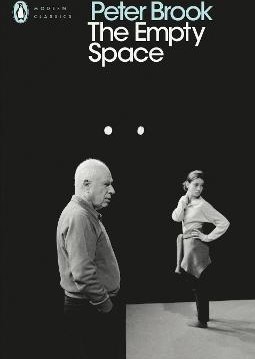
Review of Peter Brook: The tributes and the memories for Peter Brook have been deep and have been broad. There are other words to echo, those written by Brook himself. He wrote ten books; the words they contain are noble and resonant. His first was "the Empty Stage" published in 1968, by which time he had a 23-year record as director behind him. The book was based on four lectures delivered at the Universities of Hull, Keele, Manchester and Sheffield. In his last paragraph Brook wrote: "as you read this book, it is already moving out of date. It is for me an exercise, now frozen on the page." But the metaphor of "frozen" misleads. It is the glory of writing to live outside time. In 2022, at 54 years of age, every page contains lines to energise and to scintillate. These are some to cherish: From "the Immediate Theatre": "This is the essence of theatrical thinking: a true theatre designer will think of his designs as being all the time in motion, in action, in relation to what the actor brings to a scene as it unfolds. In other words, unlike the easel painter, in two dimensions, or the sculptor in three, the designer thinks in terms of the fourth dimension, the passage of time. [102] "With any other arts, however deep one plunges into the art of creating, it is always possible to step away and look at the result. Acting is in many ways unique in its difficulties because the artist has to use the treacherous, the changeable and mysterious material of himself as his medium. [117] "Music is a language related to the invisible by which a nothingness suddenly is there in a form that cannot be seen but can certainly be perceived. Declamation is not music, yet it corresponds to something different from ordinary speech...The texture of language is reaching towards the experiences that Beethoven imitated in patterns of sound- yet it is not music, it cannot be abstracted from its sense. Verse is deceptive." [120] "The director is there to attack and yield, provoke and withdraw until the indefinable stuff begins to flow...The director must sense where the actor wants to go and what it is he avoids, what blocks he raises to his own intentions. No director injects a performance. At best a director enables an actor to reveal his own performance, that he might otherwise have clouded for himself." [109] "The director tries to preserve a vision of the whole, but he rehearses in fragments and even when he sees a run-through it is unavoidably with foreknowledge of all the play's intentions. When an audience is present, compelling him to react as an audience, this foreknowledge is filtered away and for the first time he finds himself receiving the impressions given by the play in their proper time-sequence, one after another. Not surprisingly he finds that everything appears different." [128] "An audience that by chance brings an active interest and life to its watching role- this audience assists. With this assistance, the assistance of eyes and focus and desires and enjoyment and concentration, repetition turns into representation. Then the word representation no longer separates actor and audience, show and public: it envelops them: what is present for one is present for the other, The audience too has undergone a change. It has come from a life outside the theatre that is essentially repetitive to a special arena in which each moment is lived more clearly and more tensely." [140] From "the Holy Theatre": "It is the wish for optimism that many writers share that prevent them from finding hope. When we attack Beckett for pessimism it is we who are the Beckett characters trapped in a Beckett scene. When we accept Beckett's as it is, then suddenly all is transformed. There is after all quite another audience, Beckett's audience: those in every country who do not set up intellectual barriers, who do not try too hard to analyse the message. This audience laughs and cries out- and in the end celebrates with Beckett; this audience leaves his plays, his black plays, nourished and enriched, with a lighter heart, full of a strange irrational joy. Poetry, nobility, beauty, magic- suddenly these suspect words are back in the theatre once more." [59] From "the Rough Theatre": "It's always popular theatre that saves the day...theatre in back rooms, upstairs rooms, barns, the one-night stands.: a beautiful place may never bring about explosion of life; while a haphazard hall may be a tremendous meeting place. This is the mystery of theatre." [65] "Along with serious, probing and committed work, there must be irresponsibility... Fun continually needs a new electric charge...Frivolity can be its charge: high spirits can make a good current, but all the time the batteries have to be replenished: new faces, new ideas have to be found." [70] "The closer we move towards the true nakedness of theatre, the closer we approach a stage that has a lightness and range far beyond film or television. [87] From "the Deadly Theatre": "A critic has a far more important role, an essential one in fact, for an art without critics would be constantly menaced by far greater enemies. For instance, a critic is always serving the theatre when hounding out incompetence....The appalling difficulty of making theatre must be accepted: it is, or would be, if truly practised, the hardest difficulty of all: it is merciless, there is no room for error, or for waste...Yet this with its frightening exigencies is served largely by casual labour...We tend to drop in on the theatre offering love instead of science. That is what the unfortunate critic is called to judge." [31] "The critic joins in this deadly game when he does not accept this responsibility, when he belittles his own importance...This goal should be the same for artist and critic- the moving towards a less deadly, but, as yet largely undefined, theatre. This is our eventual purpose, our shared aim, and noting all the sigh-posts and footprints on the way is our common task. Our relations with critics may be strained in a superficial sense: but in a deeper one the relationship is absolutely necessary. [32] "It is woefully difficult to write a play. A playwright is required by the very nature of drama to enter into the spirit of opposing characters. He is not a judge; he is a creator..The job of shifting oneself totally from one character to another is... a super-human task at any time.[33] "Although the dramatist brings his own life nurtured by the life around him into the work the choices he makes and the values he observes are only powerful in proportion to what they create in the language of theatre. Many examples of this can be seen wherever an author for moral or political reasons attempts to use a play as a bearer of a message. Whatever the value of this message in the end it only works according to values that belong to the stage itself. [38] "We have largely forgotten silence...we are unaware that silence is also permitted, that silence is also good.[47] Page references from the first imprint MacGibbon & Kee Ltd, 1968. Peter Brook: 21st March 1925-9th July 2022 Peter Brook's book on Shakespeare "the Quality of Mercy" is reviewed below 17th October 2013. |
Reviewed by: Adam Somerset |
This review has been read 709 times There are 23 other reviews of productions with this title in our database:
|
