| National Theatre Wales: “I'm trying to forget that it's a national company” |
Theatre Director Book |
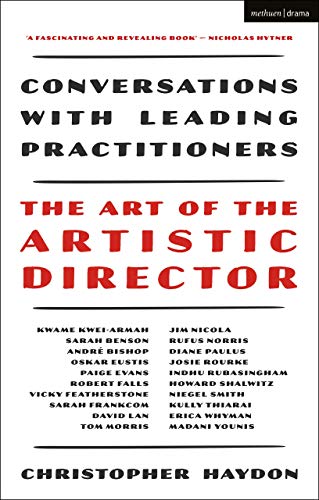
| Christopher Haydon “The Art of the Artistic Director: Conversations with Leading Practitioners” , Methuen , October 27, 2022 |
 A GUIDE TO THE SEQUENCE "THEATRE DIRECTOR BOOK" CAN BE READ BELOW 14TH OCTOBER 2021
It is a week without theatre; a return then to a book published just before the pandemic. In the ensuing time of disease, disorder and distress it was little reviewed. “The only book of its kind available” ran the publicity, which is true. It is marked out more by what the interviews with a range of artistic directors do not say than what they do. Christopher Haydon is himself an artistic director rather than a writer. There is no attempt to scope the generic elements of the role. He has an incuriosity about psychology, management or the politics of culture. The interviews focus on the backgrounds and careers of the interviewees but they read more as a series of features than a book building up to reveal a few key themes. They show their date, certainly with an over-topical concern with the 45th President of the USA. Other books have spoken of the role of artistic director being rooted in paradox. There is the intensity of collaboration. Richard Eyre, reviewed below 13th September 2013, from his ten years at the National Theatre: “to work at something you feel is worth doing, in the company of people for whom you feel admiration and affection, for the benefit of people who endorse what you do, is just about as good as life gets.” But Eyre is also reaching out for the Prozac pack and “distracted by a thousand other issues from the main thing...oppressed by the building, the administration, the expectations, I find it so difficult to concentrate upon the work.” That sounds a kind of truth that these interviews do not touch on. John Caird too, below November 2011, has a melancholy air to his account of the profession: “the theatre world is full of unhappy directors or directors who are only happy from time to time.” Patronage is power and power is isolation. “Though you may have many actor friends", writes Caird, "some of them intimate friends, you will always remain on the outskirts of their fraternity.” An issue of theatre is who gets to speak for it. Haydon asks Rufus Norris “do you feel that a significant part of your role involves being a public figure and advocate?” Norris: “the advocacy side of it is very important. But it's very hard to speak as the voice of theatre until people respect you, and people won't respect you until you've earned it. There's no shortcut to that.” Although he adds “ultimately it's about finding a balance between ego and humility.” In Wales theatre's leadership has passed northward. John McGrath was energetic as advocate and communicator. Since his departure the once active social media side of the site has collapsed. BBC Cymru Wales now goes straight to Liam Evans-Ford for advocacy and comment, reinforced by his Chairing of Creu Cymru. The book does open a window onto theatre of the USA which is not common. Andre Bishop at the Lincoln Center, Oskar Eustis at Public Theatre, Paige Evans at Signature Theatre, Robert Falls at Chicago's Goodman Theatre, Jim Nicola at New York Theatre Workshop, Diane Paulus at American Repertory Theatre, Howard Shalwitz at Woolly Mammoth, Washington DC, Niegel Smith at Flea Theatre, New York all feature. The names from Britain are well-known and all are interesting on their routes to where they were at the end of the last decade. Vicky Featherstone, Sarah Frankcom, Kwame Kwei-Armah, David Lan, Tom Morris, Josie Rourke, Indhu Rubasingham, Erica Whyman and Madani Younis are among them. “Conversations with Artistic Directors” is also revealing of the culture in one respect. The author can roam to New York and Chicago. But a recognition of the other theatrical traditions in the other nations? Belfast? Glasgow? Not a chance. Jackie Wylie is a serious gap, although he does get to Wales. At the time of writing Arwel Gruffydd was the most seasoned artistic director. His track record can be seen here in “the Arwel Gruffydd Years”, Theatr Genedlaethol 30th September 2021. But Theatr Genedlaethol simply does not register on the metro-map. Tamara Harvey by this time had done her “Uncle Vanya”. Bethan Marlow had written “the Mold Riots” and Emily White “Pavilion.” But, almost inevitably, Haydon makes his way not to Carmarthen or Mold but to Castle Arcade. His interview there catches a memorable line: “I'm trying to forget that it's a national company.” Methuen is one of three leading publishers of theatre. So there it stands, in the solid form of a book, a sentence of record for theatre's history. |
Reviewed by: Adam Somerset |
This review has been read 786 times There are 23 other reviews of productions with this title in our database:
|
