| Shakespeare, Spiritual, Secular or Both? |
Theatre Event |
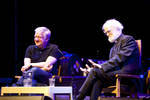
| Rowan Williams and Simon Russell Beale , Barclays Wealth Pavilion, Hay Festival , May 28, 2011 |
 When Mario Vargas Llosa ran for the presidency of Peru he wrote of the deep difficulty that the writer experiences in adapting his language for public discourse. Orhan Pamuk too has written of “difficulty expressing my political judgements with emphatic clarity…This is because I know I am bound to reduce my thoughts about life to the music of a single voice and a single point of view; I am, after all, a novelist.” It is tribute to the Archbishop of Canterbury, both to his integrity and learning, that rarely is his language, that necessarily addresses human and religious complexity, switched to that of the sound-bite, the yes/no, on/off reductionism that is the staple of public utterance.
 Ask him if he has ever doubted God’s existence and the answer will be “There have been times when I have found it hard to give any content to it, even if I couldn’t imagine living without it.” It is a kind of dialogue that works to open up areas for exploration, that invites the questioner in, that opines that enquiry is rich but difficult. His is an analogue voice in a digital age, and of some resolution. It is also a voice that is anathema to both the usual practice and expectation of public commentary. But for the discussion of literature it is a voice that fits thrillingly. Among the pleasures of Hay’s hour-long dialogue is the continuous spinning of memorable phraseology. Perhaps it is long practised but it has all the effect of spontaneous generation. Beatrice and Benedick are “two people coming to a deeply ethical, deeply transforming relationship.” On the question whether the playwright might be more Catholic than Protestant, or vice versa, Shakespeare “did not give his heart to systems of any kind.” “A Winter’s Tale” is suffused with “an anarchic, causeless grace that just happens.” Prayer may occur often in the plays but Shakespeare is “pre-occupied with the lies we tell ourselves, the self-deception.” In “Macbeth” Rowan Williams sees “the frozenness” and “the murdering of the possibility of pity.” The two figures on stage are both dressed in black but the visual contrast might have been designed by a director. (We may presume it was not.) Rowan Williams in clerical dress and white collar sits back relaxedly. His physical movements are infrequent and economical. The confidence in his intelligence is total. The creation of thinking is almost visible behind those glasses and across that distinctive forehead. Simon Russell Beale is an actor. The authority he holds is neither that of erudition nor of position. In an open-necked black t-shirt he moves his arms, he scratches his head, he addresses his audience in confidence with “You may know this” and “I expect you may have seen this.” On the topics of acting or Shakespeare he can hardly open his mouth without something sharp, insightful and well-crafted coming out. “Hamlet”, he says, has lent itself well to adaptation to a totalitarian political setting. It took on a subversive quality in Rumania’s blackest days. But Shakespeare is also “playing a lot of games with religious culture.” It is no coincidence that Hamlet’s university is that of Martin Luther. He makes comparison of a scene written by Shakespeare to one made by Solzhenitsyn of Stalin in a tiny bed deep in the Kremlin in his novel “the First Circle.” On the soliloquies Richard the Third ceases, he notes, once he has gained the crown. Those of Hamlet cease on his return from England. Something has happened to the character there but it is a problem for the actor that he can never know quite what. Shakespeare, he says, is stronger on fathers and daughters than on mothers. It is as if in children he has a greater personal investment. In discussing Iago or Othello or Prospero from the view of the actor Simon Russell Beale is always interesting. He also has an engaging modesty. Of Edgar in “King Lear” “Another part”, he says, “I didn’t do very well.” The conversation may cover hell and grace, muse whether a stance might be more Stoic than Christian, or ponder the character who prefers death to forgiveness. But it is never ponderous. A play has so many messages that it is “jammed like a call centre”. Leontes and Hermione may well be re-united after sixteen years of separation but “what do they say to each other that night after dinner?” Intelligence need not mean earnestness. Shakespeare’s plays, says the Archbishop, are filled with friars, “machiavellian cardinals, idiot vicars.” These “idiot vicars” are foundation for a seam of irreverence in British literature that runs through to P G Wodehouse. After this conversation of insight and vitality the questions from the floor are in truth a little lacklustre. In response to a notion of “Shakespeare being the embodiment of humanity” – whatever that may mean- the response is crisp. It may dismay us but the “late Shakespeare was not a very nice man, with his hoarding of grain and buying up of property in Stratford.” A question asks whether either speaker “identifies” with a particular character. Simon Russell Beale demurs. An actor is, after all, all of them. As for Rowan Williams, that brow ruminates. “Lear”, he says, “Macbeth”- pause- “although I’m nor sure if anyone would wish a serial murderer for the Archbishop of Canterbury.” The question of Shakespeare and attribution is eternal. Simon Russell Beale says he is sure that by the time he ends his days he expects maybe seventy percent of the work will be attributed to Middleton or Peele or whoever. And he doesn’t care. Too true. I don’t care either. Literature thankfully is not the art world where an unpleasant oligarch will only write his ludicrously large cheque if the signature is right. With Shakespeare it is the plays that count. That Archbishop and actor take pleasure in each other’s company is manifest; it is a palpable feeling that spreads to the large audience. Like the best of commentators they leave in their wake a double sensation. The first is that of seeing the work with eyes more open, the second is that of feeling more alert, more receptive, more alive. |
Reviewed by: Adam Somerset |
This review has been read 3084 times There are 25 other reviews of productions with this title in our database:
|
