| Women Writers, Actors, Directors, Producers in Dialogue |
Theatre Event |
| Rep 100 Weekender: Women in Theatre Conference , Birmingham Old Rep , March 25, 2013 |
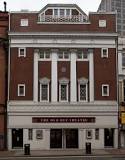 Station Street in Birmingham is home to the Old Rep Theatre and its neighbour, the equally venerable Electric Cinema. On the corner, the Crown pub once had its walls and windows a-shaking to the young Ozzy Osbourne playing his first gigs. The southern side of the street is currently dwarfed by the cranes and concrete of the vast building project that is the station's redevelopment. Nonetheless, the Rep is maintaining its role as an artistic fulcrum some measure beyond its relatively compact size.
 This winter has seen a series of events in celebration of the theatre's centenary. In 1903 the company was inaugurated with a production of W B Yeats' “the King's Threshold.” High up backstage the original office is holding an exhibition that traces the timeline of the last hundred years. It is a work of art in itself. In place of the standard panels and graphics of corporate communication, it has all been hand-written by volunteers in chalk on blackboards. It is all portable and hopefully may find a future home. The roll call of names awes; from Shaw, Ffrangcon-Davies, Gielgud, Leighton, and Granger through Christie and Schofield, to Suzman, Callow, Rickman and Gambon. The young Peter Brook started his career here in 1945. The auditorium is housing a two-day conference event. The first day traces the powerhouse of the artistic heritage. Attendance is depleted due to out-of-season snow and blizzard. For the second day conditions have stabilised with a temperature that sticks at minus two. The title for the day is “Drama Queens”, not entirely appropriate for the engagement, pragmatism, insight and humour from the fifteen women from across theatre, who make up the day’s various panels. Birmingham is an appropriate host. In 1952 it was the first theatre to appoint a woman to the most senior leadership post. Not untypically Nancy Burman took the unassuming title of Administrator but she was the forerunner of today's Executive Producer. Titles matter. Vikki Heywood recounts that a job she took on had had the title of Managing Director. On her arrival it had changed to Executive Director, a title that conveyed no meaning of any kind to heavy hitters in the private sector who might be the theatre’s potential supporters and sponsors. Likewise she refuses the title of Chair. Every career has its own unique story. One artistic director was judged at school to be possessed of leadership qualities. To a hippie-tinged seventies mother this was not a good thing at all. Gwenda Hughes scraped into a first job as a stage manager for which she had small qualification or competence. It was an environment where male hands had a habit of roaming without inhibition. She learned later that she had been selected because “the company felt it would be nice to have a pretty girl around the place.” The Chairman takes the later director of his theatre to one side with the words: “If you are going to attend board meetings would you please buy a dress.” The tone from Kate Organ is that there is much to celebrate, and much still to fight for. Theatre's rehearsing schedules and childcare are inimical. By coincidence, a Sunday newspaper has a double page spread on the leaders of the arts in Britain. It has a smell of cut-and-paste to it. Perhaps Bush to Donmar is not the biggest job in the arts. But a move from a national company to the Royal Court is a role that matters. The Chairman of the National Theatre of Scotland is in; no journalistic appreciation that just maybe Vicky Featherstone has had rather more to do with that company’s rise to pre-eminence. But the mood is upbeat. A voice from the floor, in the form of Birmingham's dramatic eminence grise, says there is strong cause for optimism. The Birmingham Rep, says David Edgar, is not alone in having two women artistic directors in a row. Claire Cochrane, tirelessly chairing for much of the day, says that the Rep has always presented work from women writers, from Lady Gregory through to Rosemary Anne Sisson and Ann Jellicoe. But over the first seventy years, the number could be counted on less than two hands. It changed dramatically with the opening of the studio in the theatre’s second home in 1972. The Door has a record without rival for giving opportunity to artists from South Asian and Afro-Caribbean. Gurpreet Bhatti is one such beneficiary from as non-traditional theatre background as might be. Childhood was a three-bedroom home with thirteen residents, with a family of such complicatedness that a birth, marriage or funeral would occur somewhere every week. But even with a track record across television, radio, and theatre in Britain and Europe Bhatti is blunt: “This is a messy business. It's not for everyone. We will experience rejection, humiliation, at any time. It costs when you create something.” |
Reviewed by: Adam Somerset |
This review has been read 2826 times There are 25 other reviews of productions with this title in our database:
|
