| Homing In-Enriching Meeting-point for Artists & Commentators |
Theatre Event |
| Jony Easterby, Jane Lloyd Francis, Siriol Joyner, Simon Whitehead , Aberystwyth Arts Centre , June 26, 2013 |
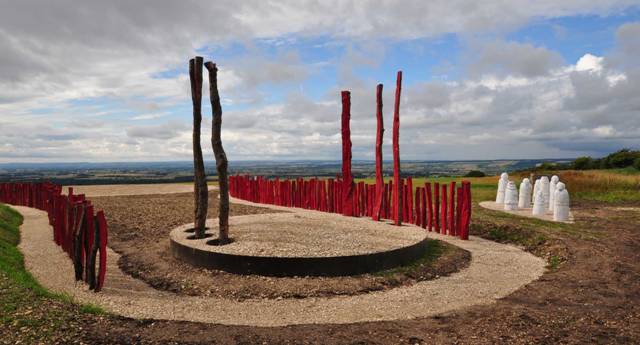 Jony Easterby opens the morning in Aberystwyth’s elegant cinema space on a note of mild apology. If what follows, he says, has resemblance to a sales pitch, then that is what it has been. It is the nature of his wholly individual art that it requires on occasion, as he shows, diggers and earth-movers. Budgets of seriousness demand presentations of seriousness to match. He need not have worried in his introductory tone to the gathering of practitioners, commentators and interested public. His description of his art is captivating.
 Easterby is an artist of the landscape. The images that he shows, from Wales to the Wolds of Yorkshire, make connection with his illustrious predecessor of three centuries ago. He too has the eye that discerns a “capability” within a landscape. He starts with before-and-after images of an upland plot high above the Dyfi, rugged highland traded in for a seeded, more productive, more aesthetic, and more bio-diverse alternative. He shows a work that is just within sight of Vanbrugh’s glorious Mausoleum on the fringe of the Castle Howard Estate. It is indefinable, sculpture, installation and landscape creation all at once, but fit to stand alongside Vanbrugh. In Maesteg the task, just as big, is more pragmatic, to create from a wrecked post-industrial, churned-up soil a wetland. Anthony Burgess once, while writing on Hemingway, made comment that artists need to know about more than art. They need to know about things. Easterby knows a lot about the earth, that he remakes as his own. He knows about soils and clays, the deep stains of acids and alkalis that inhibit the flourishing of plant life. Jane Lloyd Francis too comes from a perspective of deep knowledge, hers having been the unique place of a renowned equine theatre company. Her new absorption is water. The rivers of Wales are well documented. The great enclosures of industrial water are every so often passed around investment banks and hedge funds by the noble commission-men of London. Jane Lloyd Francis is in pursuit of those sources of water that are older, smaller, more elusive, often hidden. Her subject is the tiny wells that watered the fledgling communities of Wales, a quest of fascination in search of these sometimes near-lost places. Essential to life, both individual and community, they acquired symbolic and holy meanings. Her work has ended an explorative stage and given rise to a performance piece “Listening to Water.” An early element has been documentation, assisted by photographer Keith Morris. Lloyd Francis takes her audience to a culvert beneath an A-road where Taliesin’s well may be seen. The ancient well of Machynlleth is now located within a residential home, whose architectural parts span centuries. The first two artists reach their audience by way of image and verbal description. Dance is different in that the art itself is its own expression. Simon Whitehead makes the briefest of introductions to a work-in-development, and then demonstrates it in performance with Siriol Joyner. He has invited his audience to move to perceive varying perspectives, but in tribute to the peace of the work, with its cadences of woodland and birdsong, many remain tranquilly still around the periphery of the studio venue. Siriol Joyner herself has earlier opted for a complex mixture of languages in communicating her practice; she is part movement, part sound effect, part autobiography, part poetry and questioning, and in two languages. It is emblematic of movement itself, both concrete in form and execution, and high in suggestibility. She makes a quotation from the most under-appreciated of significant thinkers, Gregory Bateson. That the hand is a network of relations is known to anyone who has ever attempted a drawing. Follow the lines of the hand and the result is a bunch of bananas. The artistry is all in the perceiving of inner cross-workings and relationships. Organiser Carl Lavery expands the proceedings to comment from the floor. A viewer comments that Siriol Joiner’s flipping between languages is reminder that two languages only rarely comprise exact equivalents. Rather than a posture of competition, or old antagonism, they have the ability to inform each other. The new combined environmental regulator, Natural Resources Wales, gets to be called Cyfoeth Naturiol Cymru, a very different concept. The venue for “Homing In” is celebrating its fortieth anniversary. The name conferred upon it in 1971 was “Theatr Y Werin”, a concept of potency and durability with loose connection to notions of contract and property rights. “Homing In” has the slightly alarming sub-title “the Aesthetics of Sustainability”. A mirror of the Government of Wales’ mission for sustainability it is an exemplar of what universities should be. Jointly organised by Aberystwyth and Cardiff in partnership it is part of a larger Arts and Humanities Research Council project on art and sustainability. The three-part day takes artists and audience to an afternoon Philosophy Cafe and, lastly, to a viewing and discussion of “Sleep Furiously”. Participants include Jane Archer, Matthew Jarvis, Richard Downing, Ria Dunckley, Reuben Knutson, Kim Knowles and Damien Walford Davies, the last being one of the many talents to make an exit from Aberystwyth. A questioner, in provocative spirit, wonders if the critical community might not be overly under the shadow of a practice over-ripe in a Cartesianism of approach. Carl Lavery responds with a defence of equal eloquence and feeling. The study of aesthetics has never wavered from its traditional concern with sense, reception, and perception. |
Reviewed by: Adam Somerset |
This review has been read 2653 times There are 25 other reviews of productions with this title in our database:
|
