| Killingly Good |
At Theatr Pena |
| The Killing of Sister George - Theatr Pena , Torch Theatre , March 14, 2014 |
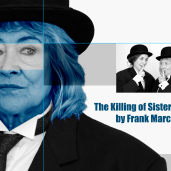 The last time that Theatr Pena visited the Torch they brought their radical re-visioning of “the Maids”. Frank Marcus’ play is a couple of decades on from Genet and the setting has moved from France to a top floor flat off London’s Portland Place. Nonetheless, a thread of connection links the two productions beyond the fact of Theatr Pena’s all-women company. Both playwrights depict relationships that enact games and rituals of dominance. In Frank Marcus’ script celebrity actress June Buckridge enforces upon companion-housemaid-lover Alice acts of atonement. These include the eating of a cigar butt and the drinking of used bath water.
“The Killing of Sister George” dates from the time when theatre censorship, in the form of the Lord Chamberlain, was preparing to leave the stage. Writers like Shelagh Delaney had been toying with non-hetero characters but it took the censor’s departure for plays like Charles Dyer’s “Staircase” and Mart Crowley’s “the Boys in the Band” to appear. What makes Frank Marcus’ script the stronger is that, unlike those other two plays, censorship meant it could not shout, but only suggest. The fact that it probes relationship over preference ensures that it endures well. The least durable element is the fourth woman, the downstairs friend who is there practically for support and clairvoyance and dramatically to relieve tension from a taut ménage a trois. Llinos Daniel does good work given the role she has, but Frank Marcus has not helped by giving her a name of Greek origin but suggestion that her country of origin, with its preference for mass firing squads, is more likely Hungary or further north. “The Killing of Sister George” has suffered from the lurid touch- explosive in its day-that action director Robert Aldrich brought to its filming. Director Erica Eirian has restored the more nuanced touch that is inherent in the script. Hannah O’Leary’s Alice has a vulnerable buoyancy to her. Christine Pritchard’s June aka Sister George mingles command and forcefulness with rage, taunting and suspicion. The play’s opening scene has her fondling her bookcase of trophies including her “Personality of the Year” award and the hospital ward named in honour of her fictional character. But there remains an element of the mysterious and unknown in the relationship between her and Alice, the truth in all relationships. It is evidenced by Alice’s junking of a trophy the day before that she has not cared for. Rosamund Shelley completes the trio, a smilingly opaque iron fist in a velvet glove. Her first appearance is fittingly in a two-piece suit of red with delicate white gloves. The production’s costume is rich in such detail. Alice goes out to queue for ballet tickets in chequerboard trousers, duffel coat and the kind of cap that John Lennon made popular. Designer Holly McCarthy’s flat conveys a fifties modernity that has dated in the sharper sixties, where an analytical BBC is constantly gauging popular response to its soap characters. Sister George is indignant that the central role of her character, awoken every morning by the tapping of a chaffinch on her window, is to be replaced by dim fellow villager Ginger Hopkins. “The Killing of Sister George” has a few jokes that endure. The fictional village of Applehurst is intended to embody all that is most beloved, common sense, identity and rural life. The episode in which Sister George’s moped is to be mowed down by a ten-ton trick is timed to coincide with Road Safety Week. The play ends with a sense that Alice may well be trading one home for another no less torturous. There is a cadence of the ominous last line that Henry James wrote for “the Bostonians”. Frank Marcus also writes one of theatre’s great last lines. “The Killing of Sister George” is a revival of the greatest interest. Theatre across Wales is a landscape filled with a hundred lovingly nurtured different vistas and perspectives. Theatr Pena is a crucial part of that landscape. |
Reviewed by: Adam Somerset |
This review has been read 2131 times There are 15 other reviews of productions with this title in our database:
|
