| Sumptuous & Full-Spirited Saunders Lewis Revival |
At Theatr Pena |
| The Royal Bed- Theatr Pena & Riverfront in Association with the Torch , Aberystwyth Arts Centre , February 21, 2015 |
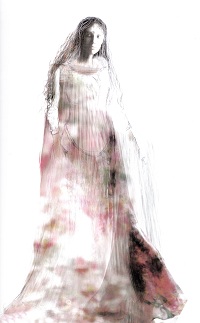 Theatr Pena’s revival, and translation by Siǒn Eirian, of Saunders Lewis’ 1954 “Siwan” impresses before a member of the six-strong ensemble has stepped on stage. Holly McCarthy's design, reinforced by Kay Haynes' lighting, has a statuesque grandeur to it, probably in truth greater than the actual thirteenth century Gwynedd royal residence of its representation. Its vaulting perpendicularity is emphasised by the six high-up candles in vertical alignment. A further twenty-one candles line the rear of the stage and form the left right corner. The furniture items, placed in formal ninety-degree relationship to each other, include a harp. Buddug Verona James, a company founder member, has done interesting things with music in the company's former productions and her role here as Musical Director is crucial.
 The opening music- Mike Beer on sound design- is a low repeated refrain with a tolling note at five second intervals. James sings, in accompaniment to Delyth Jenkins' harp, four French medieval troubadour songs between the acts of Lewis’ drama. These work greatly in the favour of the production. Formally, the work is a austere sculptural piece of theatre that takes it cue from the classical tradition of France rather than the indigenous tradition of Britain. “A cerebral theatre of classical atmosphere, which called for sophisticated acting techniques and an intellectually endowed audience” is how the contributor to the Welsh Academy’s Encyclopaedia phrases it. But it is also of its time, 1954 being the year too in which Christopher Fry wrote “The Dark is Light Enough” and Ronald Duncan “The Death of Satan”. Both these playwrights occupied similar territory of the highest moral seriousness The action is spread over two Spring days a year apart but otherwise Lewis adheres to the unities of Aristotelian prescription. In its composition the centre of the drama is slow in its revealing. Eiry Thomas’ commanding Siwan has been a royal mother at fifteen, carrying out her required duty to produce an heir and more. Aware of a bloom set, in her own words, to fade the erotic attraction from Francois Pandolfo’s part-latin Gwilym Brewis is irresistible. Only late on is it revealed that she is equal in Eros with a sense of political acuity. Russell Gomer’s Llywelyn is so consumed by the offence of infidelity that he sets the righting of personal affront before the dictates of realpolitik. Rounding out the company is Hannah O’Leary’s Alis. The role is dramatically central for her part as witness, rivetingly described, of an execution outside Siwan’s prison quarters. There is a nice sense of timing to Erica Eirian's production. A pedagogical tendency from time to time declares that theatre must needs be “relevant”, code often for a clumping didacticism. Nonetheless, this text makes repeated mention of the month of May and this May something unforeseen is likely to happen. Llywelyn makes his preparation for war as power inexorably accrues to Hubert de Burgh and the borders of Gwynedd grow ever less secure. On the day that Russell Gomer delineates the build-up of hostilities, bombers from a continental power have nudged the real-world coast of Cornwall. Among the writers of the last century Lewis takes his place alongside Yeats or Maurras for an immersion in the world of politics as deep as that of letters. He shows leadership is burden. “The crown presses and makes my temple ache” is an early line for Siwan. The security of a polity, says this work, is but a temporary accommodation. “The Royal Bed” is as relevant as it might be without any straining on the part of its makers. A note on the programme. Theatre programmes in the funded sector often communicate an uncertainty in purpose. That for “The Royal Bed” is exemplary, large in format, describing company and production with crispness, and including beautiful artwork (illustrated). More privileged companies should usefully look to it. With Omidaze in Cardiff it is a good season for companies led by women. The Investment Review should look kindly upon them. A thumbs up too for Theatr Pena’s regular producing collaborators from Newport and Milford. |
Reviewed by: Adam Somerset |
This review has been read 2295 times There are 15 other reviews of productions with this title in our database:
|
