| A Critical View of a Critical View |
At Theatr Pena |
| The Glass Menagerie- Theatr Pena , Aberystwyth Arts Centre , March 20, 2016 |
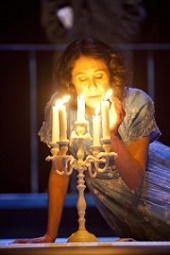 The Sherman, in addition to its own punchy repertoire, has some other good strands. One is the engagement with young people and performance, another the fostering of fresh voices to write about theatre. But for all the variety of critical response a conversation sprang up on social media this month on the sometime patchiness of reviewing coverage, in both quantity and quality. That dialogue among theatre practitioners has a pertinence with regard to Theatr Pena’s sixth production.
With “the Glass Menagerie” the company adds a classic of American theatre to its previous work from authors of Spain, Greece, France, England and Wales. It has had a good reception. “Art that hurts and tells truths” reports Jon Gower early in the tour. Theatr Clwyd, a first-time venue, pulled in a good audience, not bad as the theatre had two Tennessee Williams’ plays in one season. Aberystwyth is the third venue in Ceredigion alone and the last-but-one performance overall. With the tour now over another review is less useful than a consideration of what artists might reasonably expect from their commentators. A reaction from the Riverfront coincided with an article shared across social media entitled “How to write a theatre review”. The article was written by Susan Elkin for “the Stage” of 25th February, the occasion a visit to Poole to lead a workshop for young reviewers. The organisers, Lighthouse, had assembled an impressive cluster of tutors that included Aleks Sierz, Donald Hutera and Mark Fisher. Susan Elkin's first question to her tutees was “who is it you are writing for?” As a first question it is as basic as can be. Theatr Pena’s reviewer in Newport in a note of background to the play declares “the Glass Menagerie” to be “a text aware of its textuality.” This is all very Barthes-ian but its meaning is likely to be obscure to a general reader. Who indeed is it being written for? But secondly it is questionable how interesting it is as an observation. Connection is always more interesting than caesura. The chorus figure, who may or may not be partly present in the action, has a tradition in performance of much greater longevity than has the conventions of the realist play. In historical context Tennessee Williams is bracketed by Thornton Wilder and Arthur Miller. Six years previously “Our Town”, a huge hit, has a meta-theatricality that far exceeds “the Glass Menagerie.” Six years on and “A View from the Bridge” is built around a chorus figure who knows it all. Context is more illuminating than a reachable dose of Barthes. The reviewer does not care for what she sees. The acting is not much liked. “There is failure to create essential, palpable claustrophobia… important Christian imagery is overlooked and limited political and social context. Consequently, not only are episodic shifts undefined...the text has been fundamentally misunderstood. Its presentation of events in this deeply complex emotional play is simplistic and its direction of characters shallow.” The response suffers from two flaws in its premises. The first is an over-attention to the author’s life, that his play and its presentation be mandatedly autobiographical. Thus the emphasis given to a single word “no” is attacked as loss of an opportunity to express Tom’s gayness. But Tom is not gay. His life quite clearly has mystery but if he is the author Williams at the time was in pursuit of a Ms Hazel Kramer. The character Tom in this reading must be suffused with “Tennessee Williams’ own guilt at not being able to aid his beloved, mentally damaged sister.” That may be the life but it is not the fiction. Indeed the text says of Tom “His nature is not remorseless, but to escape from a trap he has to act without pity.” The most potent image in Erica Eirian’s production is the separation of Tom, the aspirant writer. It is reflected in the fierce right angle that dominates Holly McCarthy’s design, and embodied in the fact that Rhys Meredith as Tom rarely sits. It is truth of the role of the artist. That splinter of ice in the heart sets the world, even a family member in suffering, as object. Overall the Newport reviewer sets too great store by some details in the script, principally socio-historical. A press article on Franco is absent. The Depression is not visible. A screen with messages of “Annunciation”, “The Accent of a Coming Foot”, “Terror!”, “the Opening of a Door” is not used. The director “leaves absent DH Lawrence’s influence over sexual distortedness and conflict.” It is hard to interpret what action this critique wants on the part of the director. In any case it misreads the responsibility of a director, which is not to replicate a production that once happened. Artists are complex and there are other words of the author to look to. Williams refers to El Greco as a model for lighting “a free, imaginative use of light can be of enormous value in giving a mobile, plastic quality to plays of a more or less static nature”. He had little interest in a realist treatment- “everyone should know now the unimportance of the photographic in art.” To return to the theme of what makers might expect of their commentators half an eye on the text is no bad thing. But it is subsidiary to a focus of eye and ear on what is unfolding before an audience in a real present time and space. Productions change. In Aberystwyth it is far from the case that “neither light nor music are used with sufficient power as instruments of emotional impact.” Kay Haynes’ lighting is an absorbing and ever-altering palette of colours. The falling of evening even evokes a Matisse-ean pink. Peter Knight, with a repeated set of piano notes, provides a refrain of exquisite poignancy. |
Reviewed by: Adam Somerset |
This review has been read 1682 times There are 15 other reviews of productions with this title in our database:
|
