| A Look-back and Guide |
At Theatr Pena |
| Theatr Pena , Theatre of Wales , June 14, 2024 |
 The article below 22 February 2019 announced the dissolution of Theatr Pena. It included:
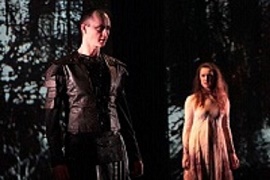
 "Our Company was formed in 2008 by a group of friends with nothing but a shared love of classic plays and a determination to create opportunities in theatre for women. We’re proud that we have never strayed from our original intent. Seven of our eight Board Members and seven of our eight Company Members are women, our Artistic Director, Designer and Lighting Designer are women, our casts have been either all women or 50:50 and at the heart of each play we have chosen are female characters." * * * * The article below 20th February 2015 is an interview with Erica Eirian: “ I was with Ros Shelley and we were discussing the lack of roles for elder women, the lack of opportunities to be in challenging classical plays. We love words, the power of words. It was in 2008, January 2008, imprinted in my mind and Ros said “Set a company up”. It started there, and a little seed grew in my mind. I floated the idea of staging Lorca’s “The House of Bernarda Alba”, “Blood Wedding” and “Yerma” with a number of friends - Christine Pritchard, Olwen Rees, Betsan Llwyd, Kathryn Dimery, Adrienne O’Sullivan, Eiry Thomas, Hannah O’Leary, Catherine Capelin and Ros. They were all so enthusiastic saying “Count me in if you are going to do it”. Christine- who is a realistic- said “Maybe we should begin by having a reading” and I said “We’ll start with “the House of Bernarda Alba.” * * * * Reviews of productions by Theatr Pena: "Woman of Flowers" : 28 February 2018 “Kay Haynes is again lighting designer. Her work here is superb. The production is evidence of the maturity that ensues from years, if not decades, of knowledge and collaboration. As well as Ceri James another Mappi Mundi founder, Peter Knight, is crucial to “Woman of Flowers.” His music and sound is fresh, surprising, and always supports, never distracts from, the action. “Holly McCarthy's costume design is a study in visual apposition. Theatr Pena's wardrobe supervisor Deryn Tudor has what must be a unique track record, having worked for both national theatre companies, National Dance Company Wales and WNO. The visual contrast between Eiry Thomas' black-costumed Gwydion and Betsan Llwyd's majestic Arianrhod is mirrored in the movement. Llwyd is steely regal majesty, Thomas shape-shifting mobility. The least dramatic role is given to Olwen Rees' Rhagnell who has to demonstrate loyalty that is frankly little deserved at the hands of her mistress. The men, Oliver Morgan-Thomas' Llew and Rhys Meredith's Gronw, are strong martial presences in black leather. Rhys Meredith ends in the manner of Schiller's Mary Stuart, movingly attaining sublimity in acceptance.” * * * * "The Glass Menagerie": 20 March 2016:, 14 February 2016 With “the Glass Menagerie” the company adds a classic of American theatre to its previous work from authors of Spain, Greece, France, England and Wales. It has had a good reception. “Art that hurts and tells truths” reports Jon Gower early in the tour. Theatr Clwyd, a first-time venue, pulled in a good audience, not bad as the theatre had two Tennessee Williams’ plays in one season. Aberystwyth was the third venue in Ceredigion alone and the last-but-one performance overall. With the tour now over another review is less useful than a consideration of what artists might reasonably expect from their commentators.” * * * * "The Royal Bed": 21 February 2015: 13 February 2015 “Theatr Pena’s revival, and translation by Siǒn Eirian, of Saunders Lewis’ 1954 “Siwan” impresses before a member of the six-strong ensemble has stepped on stage. Holly McCarthy's design, reinforced by Kay Haynes' lighting, has a statuesque grandeur to it, probably in truth greater than the actual thirteenth century Gwynedd royal residence of its representation. Its vaulting perpendicularity is emphasised by the six high-up candles in vertical alignment. Twenty-one more candles line the rear of the stage and form the left right corner. The furniture items, placed in formal ninety-degree relationship to each other, include a harp. Buddug Verona James, a company founder member, has done interesting things with music in the company's former productions and her role here as Musical Director is crucial. “The opening music- Mike Beer on sound design- is a low repeated refrain with a tolling note at five second intervals. James sings, in accompaniment to Delyth Jenkins' harp, four French medieval troubadour songs between the acts of Lewis’ drama. These work greatly in the favour of the production. Formally, the work is a austere sculptural piece of theatre that takes it cue from the classical tradition of France rather than the indigenous tradition of Britain. “In its composition the centre of the drama is slow in its revealing. Eiry Thomas’ commanding Siwan has been a royal mother at fifteen, carrying out her required duty to produce an heir and more. Aware of a bloom set, in her own words, to fade the erotic attraction from Francois Pandolfo’s part-latin Gwilym Brewis is irresistible. Only late on is it revealed that she is equal in Eros with a sense of political acuity. Russell Gomer’s Llywelyn is so consumed by the offence of infidelity that he sets the righting of personal affront before the dictates of realpolitik. Rounding out the company is Hannah O’Leary’s Alys. The role is dramatically central for her part as witness, rivetingly described, of an execution outside Siwan’s prison quarters.” * * * * “The Killing of Sister George” : 14 March 2014 “The last time that Theatr Pena visited the Torch they brought their radical re-visioning of “the Maids”. Frank Marcus’ play is a couple of decades on from Genet and the setting has moved from France to a top floor flat off London’s Portland Place. Nonetheless, a thread of connection links the two productions beyond the fact of Theatr Pena’s all-women company. Both playwrights depict relationships that enact games and rituals of dominance. In Frank Marcus’ script celebrity actress June Buckridge enforces upon companion-housemaid-lover Alice acts of atonement. These include the eating of a cigar butt and the drinking of used bath water. “The Killing of Sister George” has suffered from the lurid touch- explosive in its day-that action director Robert Aldrich brought to its filming. Director Erica Eirian has restored the more nuanced touch that is inherent in the script. Hannah O’Leary’s Alice has a vulnerable buoyancy to her. Christine Pritchard’s June aka Sister George mingles command and forcefulness with rage, taunting and suspicion. The play’s opening scene has her fondling her bookcase of trophies including her “Personality of the Year” award and the hospital ward named in honour of her fictional character. But there remains an element of the mysterious and unknown in the relationship between her and Alice, the truth in all relationships. It is evidenced by Alice’s junking of a trophy the day before that she has not cared for. “Rosamund Shelley completes the trio, a smilingly opaque iron fist in a velvet glove. Her first appearance is fittingly in a two-piece suit of red with delicate white gloves. The production’s costume is rich in such detail. Alice goes out to queue for ballet tickets in chequerboard trousers, duffel coat and the kind of cap that John Lennon made popular. Designer Holly McCarthy’s flat conveys a fifties modernity that has dated in the sharper sixties, where an analytical BBC is constantly gauging popular response to its soap characters. Sister George is indignant that the central role of her character, awoken every morning by the tapping of a chaffinch on her window, is to be replaced by dim fellow villager Ginger Hopkins.” “* * * * "The Maids": 23 June 2012: 14 June 2012: 25 June 2012 “Director Erica Eirian has drawn on the resources of the admirably conceived Theatr Pena to make her production very French. Buddug Verona James is a sultry chanteuse singing to Joe Corbett’s accordion, that instrument that makes music of an equal levity and elusive wistfulness. James’ worldliness and cropped hair modernity hair is in striking contrast to the Maids when they make their entrance. “Christine Pritchard gives Claire girlish mannerisms, tripping little footsteps and a nervy smile. She can truly be envisaged as sleeping in her little cot in the attic. Olwen Rees’ Solange has a concentration of venom rendered all the more potent by her maturity of years. Her severity of appearance contrasts with the rawness of expression, the passion in “I’m shuddering with pleasure.” Her loathing seethes in lines like “She loves us like a bidet.” “Rosamund Shelley’s Madame is a swirl of glamorous fur-wrapped display. She melodramatically declares herself ready to follow her lover to Devil’s Island, Siberia even. “Farewell” she sighs “to dances and parties and theatre.” The hierarchy of this stifling world is stripped bare, how she removes her servants’ film magazine with its Gary Cooper photo-shoots. “I’m something of a stranger in the kitchen” she declares. “The Maids” makes for an eerie, unsettling evening which makes it true to its author. Theatr Pena is a testament of will and aspiration to add something new to theatre in Wales. This is the first time the company has moved so far West from its supporting base in Newport; credit to the role of the Torch for facilitating it. In the spirit of the company’s frugality Riverfront director Nicolas Young doubles up as production photographer.” * * * * “Dark Love and Deep Song”: 18 February 2012 “Blood and death, tears and tragedy, love and longing - these were the staples of his agonising art, and over thirty samples of it were delivered in song, poetry and dramatic snippet at this recital by Theatr Pena. “The readings were punctuated by Lorca songs and the complete Seven Popular Spanish Songs of Manuel de Falla, sung by mezzo Buddug Verona James, with Caradog Williams at the piano. Ms James's was an object lesson in how the recitalist should insinuate herself into the mood of the piece, be it lullaby, dance, narrative or lamentation. These were songs enacted with full dramatic flourish and finish. “And the readers - Kathryn Dimery, Erica Eirian, Betsan Llwyd, Hannah O'Leary and Olwen Rees - took their cues from her, their recitations as colourful as their portrayals in extracts from Lorca’s plays Yerma and Blood Wedding. Ms O’Leary directed and several of the translations were by Gwynne Edwards.” * * * * "The House of Bernada Alba" : 06 February 2009 “Angustias, the eldest daughter of the house, has become engaged to Pepe el Romano, a vigorous young man who we never see but who plays a critical part in this sad tragedy of domestic life. The plot slowly unwinds like a thread being drawn from one of the large white sheets that the daughters are often at work on until it reaches its inevitable black ending. Gwynne Edwards’ translation brings us the power of Lorca’s writing. Erica Erian’s well judged, precise directing captures all the dryness of the earth that surrounds the tearing suppression of these five young, yearning women, providing us with an evening of great theatre. “An evening of great Welsh Theatre particularly from the performances of this excellent ensemble of many of Wales’ finest female actors. The elderly, long serving, long suffering household servant Poncia is giving an outstanding interpretation by Christine Pritchard; it’s a performance that wraps itself around you and has you laughing and shaking with her own high spirited lasciviousness. "Rosamund Shelley’s martinet is all the more menacing as a result of her very natural underscoring of the role. Kathryn Dimery is an actress who has the ability to play old or young, male or female; her Angustias, to whom the fateful Pepe has become engaged as he knows she comes with a fortune, is played with a determined dignity that tells us she might well step into her mother’s shoes some time in the future.” Picture: Woman of Flowers |
Reviewed by: Adam Somerset |
This review has been read 168 times There are 15 other reviews of productions with this title in our database:
|
