| Hell Sucks |
A Writer Remembered |
| Michael Herr , Writing On Vietnam (1) , July 1, 2016 |
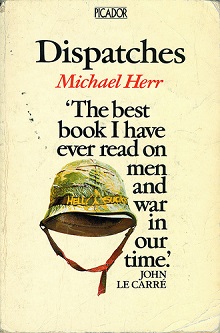 In my first working life I spent much time in departure lounges. The items in airport shops became familiar as they tended to vary little across the continents. Airport bookshops carried the same titles and the same authors. One book was prominent in the displays. It had a cover design of an arresting simplicity. In the same size typeface as the title it carried a recommendation from John le Carré “The best book I have ever read on men and war in our time.” It had the image of an American helmet with a ribbon around it. On the ribbon were the words “Hell Sucks.”
 Vietnam had consumed politics and news for a decade. It takes time for war to find the book that speaks for it. R C Sheriff's “Journey's End” came ten years after the end of the First World War. So too it was eight years between the last flight from Saigon and the arrival of a book that mattered. “Despatches” was the book that was needed to fill the void. Michael Herr was in Vietnam from 1967-1969 as the correspondent for Esquire. “Have you come to write about what we’re wearing?” a soldier asked him, knowing the magazine’s focus on fashion for men. Herr left in a condition of illness at a time prior to post-traumatic stress disorder as a diagnosis. During his time in the country he filed relatively little. But, eight years in the making, his experience coalesced into the book “Despatches.” The experience in Vietnam led Herr to the film industry. In 1979 Herr wrote the voice-over for Willard in Francis Ford Coppola’s “Apocalypse Now.” In 1980 he moved to London, in part a reaction to the discomfort of celebrity status that his book had brought. To the newspapers who asked him to write about Vietnam his response was “Haven’t you read my f------ book? I’m not interested in Vietnam. It has passed clean through me.” He never returned to South-east Asia. In London John le Carré introduced him to Stanley Kubrick, a long-time resident in Britain. He wrote the screenplay for Kubrick's film “Full Metal Jacket.” In the 1980s London’s Docklands was in a condition of decay and provided the location for the battle grounds of Vietnam. Herr went on to write a memoir and books on Walter Winchell and Hollywood. In 1991 he returned to America and made his living with uncredited rewrites of screenplays for Hollywood. The term he used for it was “a wash and a rinse”. He resisted Kubrick's calls for him to add a colloquial flavour to the screenplay for his last film “Eyes Wide Shut.” Herr became a practitioner of the Tibetan strand of Buddhism. Herr in Asia was in a country that no longer exists. Vietnam has gone from a centuries-old rural society to one that is predominately urban. The population is mainly young for whom war is history. Ask an older Vietnamese about war and the answer tends to be “War? Which one, the French, the American, the Chinese?” Herr recognised early on that the forces of his own country had scant understanding that Vietnam's strivings for self-determination reached far back in time. He met a few Americans who had an eye for history. “Mission intellectuals like 1954 as the reference date”, he wrote, “ if you saw as far back as War 2 and the Japanese occupations you were practically a historical visionary.” For most of the makers of American policy it had started in 1961. The diplomatic effort that preceded the build-up of American forces took the form of an International Control Commission. In 1957 it comprised observers from India, Poland and Canada, all pessimistic on the fragility of the armistice between North and South. President Eisenhower stated at a joint session of Congress “the cost of defending freedom, of defending America, must be paid in many forms and in many places...Military as well as economic help is currently needed in Vietnam.” The Commission itself held small respect in the country on which it pronounced. It was supposed to be neutral with its make-up from the West, the Soviet bloc and the developing world. Only two ICC flights a week were permitted into Hanoi and they had to leave within the hour. The representatives had no diplomatic status and the Canadians were distrusted and shunned. On March 8th 1965 the next era began. A flotilla of landing craft hit the sand of the beaches at Da Nang. It was the same site that the French had reinvaded twenty years before. The first 3,500 troops of the USA embarked to be adorned with garlands of orchids by the young women of the region. On November 2nd that year Quaker Norman Morrison immolated himself by fire outside the Pentagon. The Americans flooded into the government of the South. Political advisers decided the colour of the lights for the fountains in the middle of Saigon. Whether it be the cutting down of trees for the installation of parking meters or the cataloguing system for the national library and museum American advisers took over. The arrivals were bolstering a regime of small strength. In 1966 the Department of Defence estimated that a quarter of the forces of the South, 124,000 soldiers, had deserted. The American camps were vast and a source of theft and corruption. They were surrounded by mini-towns made of packing cases and material stolen where the troops could buy the products that the PX stores lacked. Sex and drugs led. Heroin usage grew to twenty-two percent of the soldiers. In New York it was 3% pure and cost $50 a capsule. In Saigon it cost $2 and was 98% pure. In1971 5000 troops required hospital treatment for combat reasons. The number for reasons of drug abuse was 20,529. This was the world that Herr plunged into. At the age of 27 he was older than the combat soldiers. Over the course of the war 4,865 helicopters were shot down. The army command allowed correspondents an extraordinary access. They could catch military helicopters, Herr said, like taxis. He went to war with the grunts. In the Pentagon Clark Clifford asked a general how a sweep had gone that involved 100,000 troops. “Badly”, was the military reply, “Damn it, they won't come out and fight.” Clark finally asked: “What is the plan for the United States to win the war?” The answer he received was that there was no plan. The enemy would be overcome by force of attrition. Tactics were elevated to strategy. The reality was the death of Americans without engagement with the enemy. Booby traps were endemic with “Bouncing Betty” the most feared. It was conical in shape, its three prongs jutting out of the jungle soil and packed with shrapnel. Michael Herr 13th April 1940- 23rd June 2016 |
Reviewed by: Adam Somerset |
This review has been read 530 times There are 19 other reviews of productions with this title in our database:
|
